

Webinars
Agentic Test Automation: Intelligent end-to-end testing across technologies
Agentic Test Automation’s new features set the standard for QA in the...
What sets Agentic Test Automation apart from Playwright, Claude, and other AI testing tools

In just a few years, developers went from barely using AI to, at some companies, using it for nearly all of their code. As development cycles compressed, QA was pushed into its own AI revolution: AI-generated tests are increasingly seen as a mandate, the only way to keep up with how fast code now ships.
And yet, not all AI-generated tests are created equal. Some AI testing tools speed up test creation but still produce brittle scripts, and the growing maintenance burden eventually undercuts any speed gains. Tricentis Agentic Test Automation (ATA) also uses AI to generate tests, but it was built for testing from the ground up, on the foundation of Tosca’s model-based approach, for fast and durable agentic tests.
Tools that specialize in quick AI test generation, like Playwright paired with Claude, have a place in this new AI era. They can be genuinely helpful, but the differences between a quick solution and an enterprise testing platform are vast, and they show up across every part of the quality lifecycle.
Agentic Test Automation is better suited for the enterprise for the same reason Tosca changed the test automation industry nearly two decades ago: model-based testing is more reliable, accessible, and better at validating end-to-end business processes than script-based testing.
Agentic Test Automation autonomously generates model-based tests in Tosca. These tests are built on reusable modules that represent a discrete action, like logging into an application with the right credentials. If an application change affects a module, such as the login button moving, the QA team updates the module once, and the fix propagates across every test that uses it. That keeps Agentic Test Automation tests valid even as the application evolves.
Watch the webinar: Business-driven testing: How to write tests that speak the language of your organization
Script-based tests like those produced by Playwright are tied to the application’s underlying details, so a single change can easily break tests. Pairing an open-source tool with an LLM like Claude doesn’t change this. It just means teams write more of these brittle tests, faster, and the rework burden grows with every new asset.
Some open-source tools now offer agents that help repair broken tests, but their existence only underscores how easily these tests break. Even with a healing agent, it’s still up to the development team to check the agent’s fix, which means more code changes to manually review.
Like all Tosca tests, Agentic Test Automation tests are inherently flexible. The only difference is speed: Agentic Test Automation builds model-based tests in minutes. But the benefit remains the same. If an application changes, the team updates the module once, and every ATA test is fixed. Maintenance doesn’t add up, and there’s no healing-agent output to manually review. The tests are durable from the start.
At its core, Tosca’s model-based approach is about matching requirements to real user behavior. Each module represents a business flow and its intent, which is what QA teams should really be testing: whether the business is working as expected.
An open-source test, whether written by a person or Claude, is a file in a code repository. It can include tags or comments pointing to a ticket or requirement, and some teams build careful conventions around that, but nothing guarantees that every requirement has a test, or that every test maps back to a requirement.
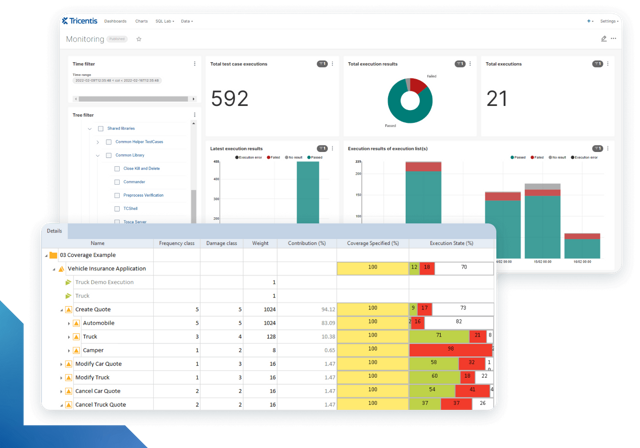
Once again, Agentic Test Automation is built to solve this problem. Tosca tests automatically link to requirements, and requirements can be weighted by business risk, based on how often a function is used and how much damage a failure would cause.
Read the eBook: How agentic testing changes the way testers work (and what that means for the enterprise)
This has profound implications for regulated and government environments, where traceability, auditability, and oversight are often legal mandates. As AI agents generate more tests, it also matters more than ever to non-regulated industries. The more tests a QA team can create with an agent, the harder it will be to keep intent visible, unless requirements are etched into the test itself.
As our VP of Products David Landsberg puts it, open-source tests combined with an LLM build up “automation debt.” When tests can be produced quickly without requirement tracking, the result is often an unruly library of meaningless, duplicate tests that QA teams nevertheless must maintain.
Agentic Test Automation prevents this from happening. It still generates tests quickly. Users have seen an 8x increase in test creation speed and an up to 60% increase in productivity. Even at this speed, the tool guards against duplication. When Agentic Test Automation creates a test, it searches for matching modules and existing test assets and merges or updates them. As a result, the test library quickly grows in coverage, and teams keep the speed of AI-generated tests without the rework and maintenance burden that would otherwise follow.
Even with the limitations and risks, many teams find that pairing an open-source tool with an LLM works well for quick web testing. These tools can be a good fit for fast UI fixes, particularly if a QA team is under pressure to validate web updates fast.
Yet, even if a company is successfully using these tools for browser-based automation, that isn’t enough to cover enterprise quality. In most companies, business processes flow between browsers, legacy desktop applications, and ERP systems like Oracle or SAP. Open-source test automation covers only a small portion of what it takes to validate these processes end-to-end.
Read more: Why browser-based automation can’t test your ERP apps
Agentic Test Automation works across 190+ technologies. Tricentis is an SAP Solution Extensions Partner with deep expertise in testing SAP applications and workflows. Tosca is designed to test the business logic that happens outside the UI, in proprietary ERP data tables and the back-end integrations behind every critical business process.
As an enterprise grows, these end-to-end flows become the backbone of the business. Without a way to validate them at scale and at the speed of AI, enterprises risk hidden defects reaching production and falling behind today’s compressed development schedules. Agentic Test Automation delivers what enterprises need now: fast, durable AI testing for end-to-end business processes.
To learn more about Agentic Test Automation, watch our latest webinar: Agentic Test Automation: Intelligent end-to-end testing across technologies
Learn more about intelligent test automation and how an AI-powered testing tool can optimize enterprise testing.
Learn more about intelligent test automation and how an AI-powered testing tool can optimize enterprise testing.