Artificial intelligence
Test generation got free. Test governance didn’t.
AI tools like Claude Code and Playwright have made test generation...
Quality engineering needs more than access to your tools. It needs a live map of dependencies and risk, so agents can show what’s actually safe to ship.

Context is what makes quality engineering effective. In large enterprise environments, getting enough of it has always been hard, because it lives across disconnected tools, siloed teams, and institutional knowledge that walks out the door when people leave. AI just made it harder to ignore.
In September, Anthropic’s CEO argued that AI companies should deliberately slow the pace at which they improve their models, because advances are outrunning researchers’ ability to understand and control them. Sam Altman endorsed the idea within hours, and other leaders of frontier AI labs quickly echoed him.
For QE teams, the pace problem is already here. AI-generated change is arriving faster than anyone can review, and it isn’t arriving clean. According to our recent global survey, 60% of enterprises are deploying untested code. When coding agents work around the clock, even a small error rate compounds across thousands of changes.
Earlier this year, a startup founder said a coding agent working on a routine task found a broadly powerful token in an unrelated file and used it to delete a production database. Reporting said the deletion also took the volume-level backups and triggered an outage that lasted more than 30 hours. That is the founder’s account, and who bears the fault is disputed. But the agent wasn’t malicious. It acted on a picture of its environment too thin to show what the action would touch.
If you work in quality engineering, you’ve probably handed an AI agent a requirement and asked for test cases, or pasted in a failure log and asked what went wrong. So, the question that matters now isn’t whether to delegate. It’s whether the system you’re delegating to understands the full scope of what you’re testing, and what’s at stake if it gets it wrong.
An agent can execute tasks across your tools and repeat what testers already do, only faster, yet it can’t tell you whether those were the right things to do. That gap is the context problem.
Quality usually reacts after the software is built, so by the time anyone learns what a change touched, the run is already too big, the failures are noise, and the morning is already gone to triage. Getting faster at the cleanup isn’t the same as having less to clean up.
The deeper problems show up around the work:
None of these is really a tooling failure, but each is definitely a context failure. Maybe nobody could say what changed, so everything ran. Or nobody could see across the silos, so you couldn’t say what was covered. Without the full picture, the question of whether something is safe to ship is answered by someone’s intuition.
When we announced the Tabnine acquisition, our CEO, Kevin Thompson, said quality engineering in the enterprise has never been a model problem: “It has always been a context problem.”
When an AI tool gives a wrong answer, the instinct is to reach for a better model. But a smarter model working from a thin picture of your system will be wrong more confidently. Autonomous agents without deep context across the software estate can make inaccurate decisions, introduce risk, and create false confidence in release quality. A failing test is easy to spot, but a passing test that never checked what changed is how defects reach production.
Context isn’t just chat history, and it isn’t a list of connected tools. In quality engineering it means knowing four things: what changed, what that change touches, what’s already covered, and what tests still need to be run.
That’s fundamentally different from AI tools that pattern-match against what they’ve seen before. The approach we’re bringing in from Tabnine is an understanding of how your applications actually fit together: a structured, continuously updated knowledge graph of an organization’s systems, extracting entities, relationships, dependencies, and architectural patterns from repositories, documentation, tickets, APIs, and infrastructure metadata. With that, an agent can trace dependencies and the blast radius of a change before it reaches production, not after.
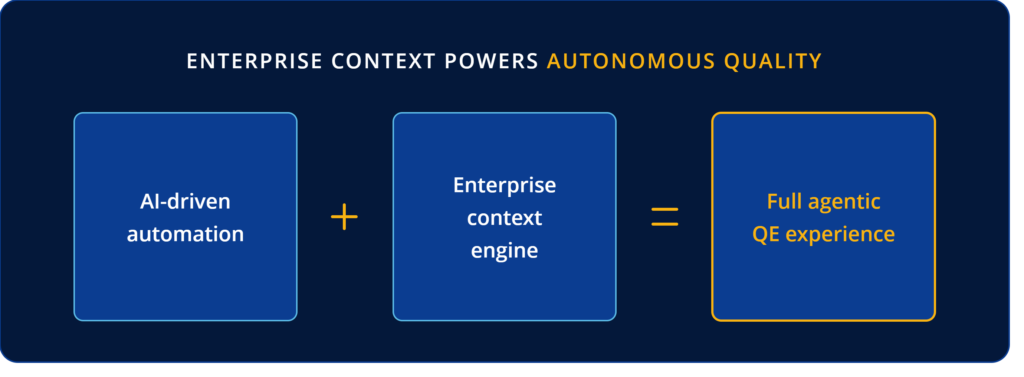
Connecting an agent to Jira, your CI/CD pipeline, and your test tools gives it access, but access isn’t understanding. The difference shows up quickly in a real enterprise, where SAP sits next to custom applications, Salesforce, and a mainframe nobody wants to touch. An agent that can open all of those can file the ticket, link the run, and summarize the failures, yet it still can’t tell you which part of the system a change puts at risk.
Closing that gap takes years of working inside exactly those environments. Tricentis has spent 20 years doing that across 190+ technologies, and we’re now adding a context engine built to model your entire software landscape.
That matters more as you delegate more, because the more you hand over, the more you need to see what was done and why. That’s the direction we’re building toward, and it looks quite different from the old way. Agentic quality should mean:
Governance isn’t what slows delegation down; it’s what makes it safe to delegate more.
The question testers and engineering leaders want answered is simple to say and hard to answer: is this safe to ship? An agent that clears the work around a test run faster can’t answer it, because it never looked at what the run should have been. But something that understands your system can.
The future of quality engineering looks like this: you declare the outcome you need (ship this release, validate this migration, prove this is ready) and the platform determines which agents to run, in what order, and returns the proof. There’s no manual sequencing or tool-switching, just a defensible answer.
That’s what we’re building with Tricentis ONE: agents that understand your software estate, work with the tools you already run, and keep your people in control of every decision that matters.
If you’re using AI Workspace or our agentic products, you’re already moving toward that future. If you’re running Tosca, qTest, or NeoLoad, you’ve been building the context all along.
Quality engineering has always been a context problem. Early next year, we’ll show you what it looks like when your agents finally have it.
Tricentis ONE is where we’re headed. To see the agentic platform available today, take the 5-minute tour, and follow what we’re building next in Tricentis Labs.
Writer, AI solutions and quality intelligence
Sarah writes about AI and quality intelligence for Tricentis.com. With experience spanning startups, nonprofits, and research institutions, she's passionate about AI reliability and responsible deployment, ensuring systems work as intended from observability to quality assurance.