

Webinars
AI transformation roundtable with IBM and TTC Global
IBM, Tricentis, and implementation experts share what it really takes...
Explore the biggest agentic AI news and trends of 2026, what they mean for enterprise software teams, and how they are reshaping software testing.

TL;DR
For the last few years, the AI debate has centered on who has the best model. But with the rise of open-weight models and the increasing commoditization of LLMs, the conversation is shifting to what organizations can actually do with AI by integrating the technology into real business workflows.
In 2026, agentic AI is moving beyond simply generating content and answering questions to planning and executing tasks, orchestrating workflows, analyzing and acting on data, and taking action on behalf of employees.
As agents become more capable and connected to critical business systems, organizations are rethinking how software gets built, tested, managed, and used. From software development and continuous testing to context and governance, agentic AI is beginning to transform the software landscape.
Read on to learn about some of the biggest agentic AI developments in 2026 and what they mean for enterprise software.
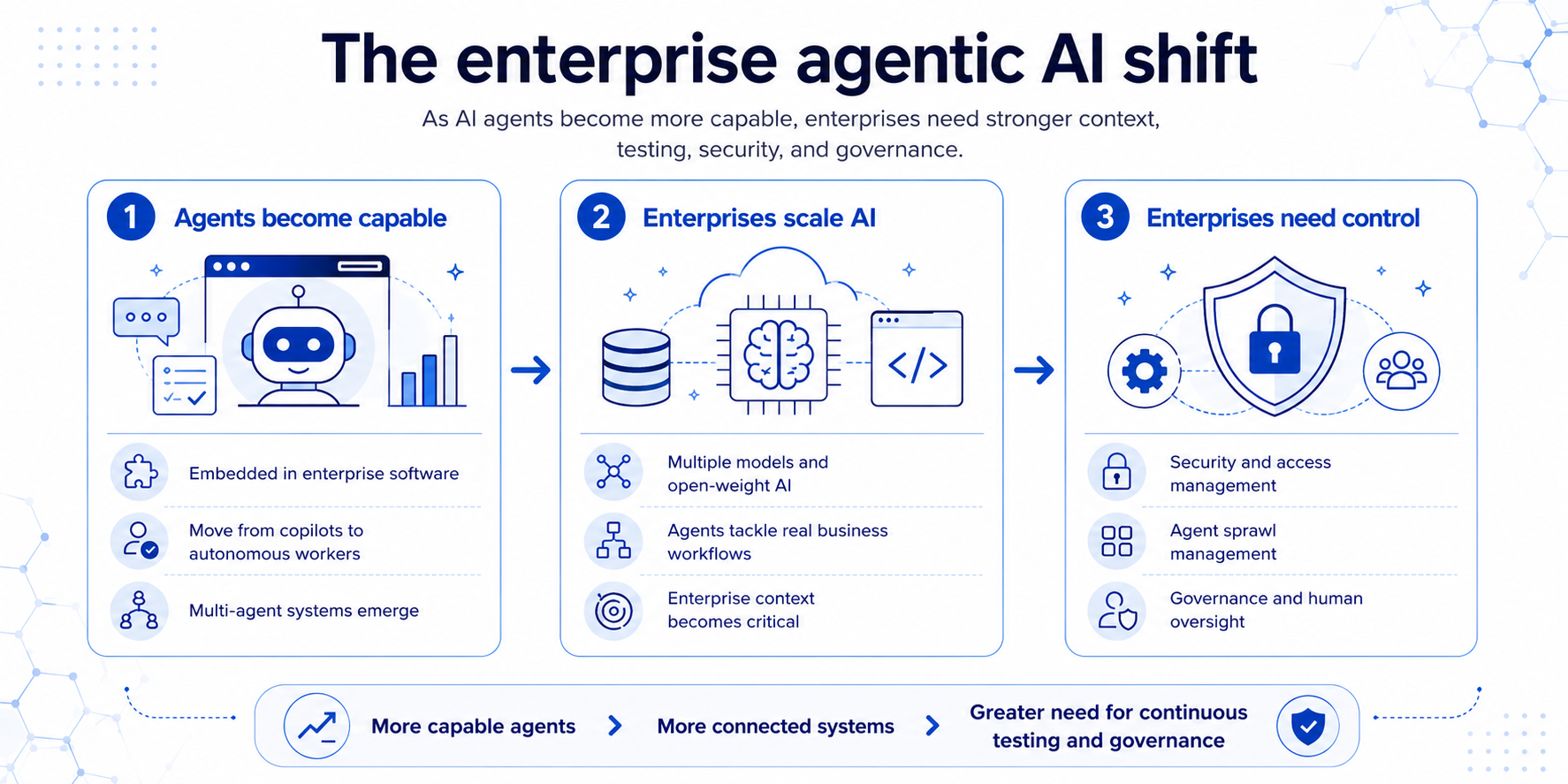
The biggest agentic AI developments of 2026 are moving beyond which model is better than the next. They’re focused on how organizations are putting increasingly sophisticated AI to work, and how they’re adapting their software and infrastructure to best support it.
With that in mind, let’s examine nine of the biggest AI developments we’ve seen this year.
No longer standalone AI experiments or novel science fiction concepts, AI agents are now being directly embedded into the tools employees already use. In fact, Gartner predicts that 40% of enterprise applications will have task-specific AI agents this year.
A variety of tools, including HR, analytics, and finance platforms, are now adding agents that can handle specific tasks. As a result, agents are increasingly becoming native application capabilities that companies can use out of the box.
No longer standalone AI experiments or novel science fiction concepts, AI agents are now being directly embedded into the tools employees already use.
While traditional AI copilots wait for a human prompt, organizations are now using task-specific agents to manage specific workflows autonomously.
Instead of asking AI to simply help write something, employees can now ask agents to research, analyze, create deliverables, and check their work in one fell swoop.
One recent study found that agentic usage grew fivefold during the first half of 2026 while the complexity of tasks delegated to agents increased.
Software development is one of the clearest examples of this trend. Agents can increasingly write code, run tests, diagnose failures, and improve software on their own.
This isn’t to say that AI agents are replacing humans; just that humans are delegating more and more work to agents. To protect systems and data, organizations must strike the perfect balance between which decisions agents can make on their own and which require human approval.
As individual agents become more sophisticated, enterprises are beginning to experiment with using several agents together in conjunction with each other. For example, one agent might conduct research while another analyzes the data and yet another executes on it.
However, this trend is still nascent; in May 2026, researchers in Europe found that just one in 12 organizations were currently leveraging multiple agents in production.
When agents are focused on one task, they can have narrower instructions and permissions compared to general-purpose agents.
But as multi-agent systems scale, they introduce additional complexity. In the event one agent fails, there can be a cascading effect causing agents that rely on its output to fail, too.
Enterprises are increasingly looking to diversify beyond a single model because they don’t want their AI strategy to hinge on one vendor’s business.
At the same time, organizations are turning to open-weight models that make it easier to test different models based on factors like cost, performance, and privacy.
For example, AT&T — which uses 45 billion tokens every day — expects open models to power as much as 80% of its total AI usage down the road.
Different models can serve different jobs. A large frontier model might be best for complex reasoning while an open model might be better for sensitive workloads.
As organizations continue to embrace flexibility, the model layer is becoming increasingly interchangeable for many use cases. Organizations want to avoid being locked into a single vendor’s model.
As agents proliferate across systems, the attack surface expands.
Giving AI the ability to take actions and access sensitive data introduces new security challenges for enterprises.
On one hand, poorly governed or compromised agents may modify enterprise systems. On the other, cybercriminals can use agentic tools of their own to target corporate data or systems.
By 2028, Gartner says that 25% of all generative AI applications will experience at least five minor cybersecurity incidents a year, up from 9% in 2025. By 2029, the firm predicts 15% of enterprise GenAI applications will experience at least one major cybersecurity incident.
As agents proliferate across systems, the attack surface expands. As a result, security teams must prioritize identity and access management, using least-privilege permissions, zero trust architecture, continuous monitoring, and continuous testing to protect systems.
As the technology matures, enterprises are increasingly using agents to get real things done. A December 2025 report from Zapier found that 72% of enterprises were either testing or using AI agents, suggesting adoption is already widespread.
Enterprises are deploying agents across customer service, software development, testing, marketing, and analytics workflows, among other use cases.
For example, where a chatbot might simply generate a response, agents can now take things further by identifying issues, retrieving relevant data, determining the most appropriate fix, and following up.
Similarly, in software development, agents can now move through multiple stages, including testing, debugging, and creating documentation. As software development speeds up, organizations have to ensure testing keeps up with that velocity.
Using an AI-powered test automation tool, teams can accelerate testing to further strengthen applications against potential vulnerabilities.
Organizations are beginning to understand that agents need access to the right data but also need to know what the data means. In fact, a lack of context — the definitions, relationships between data, and institutional knowledge that exist within the business — is one of the main reasons AI agents fail.
Two companies can use the same models and get wildly different results because one company has prioritized context and the other has not.
According to Gartner, a lack of context causes agents to produce inaccurate responses and waste money. By providing agents with the context surrounding the data, enterprises can drive higher ROI from investments in agentic AI.
Two companies can use the same models and get wildly different results because one company has prioritized context and the other has not.
As organizations get better results from agentic AI, they deploy more and more agents. This, in turn, leads to another problem: agent sprawl.
According to IBM, just 18% of organizations have a complete inventory of their agents. As a result of this lack of visibility, 68% of executives worry their AI initiatives won’t deliver.
As agents proliferate, organizations could end up deploying multiple agents that perform similar tasks. This can lead to duplicate costs, inconsistent behavior, and security vulnerabilities, among other suboptimal outcomes.
Bottom line? While organizations have spent years managing IT sprawl, they need to turn their attention to managing agent sprawl, too, as their AI investments mature.
When agents are deployed in the wild and able to make decisions and take action, enterprises need to create clear boundaries that govern what agents can and can’t do. Otherwise, the results can be disastrous.
By 2027, Gartner predicts 40% of enterprises will demote or decommission autonomous agents due to governance failures.
More than writing AI policies, organizations need controls at the agent level. Which data can which agent access? When should an issue be escalated to a human? How will agent behavior be logged for auditing?
Keep in mind that not all agents are created equally. Some agents may be able to act entirely independently while others might require human approval before an action.
This is an area where continuous monitoring and testing become more valuable, because agents need to be evaluated and tested after they’re in production to keep systems and networks safe and operational.
Ultimately, the promise of agentic AI may depend less on whether an agent is capable of performing a task and more on whether the organization can trust the agent to perform the task reliably and securely.
Here’s how LTIMindtree (LTM), an AI-centric global technology services company, used Tricentis agentic AI:
Too many manual testing bottlenecks were consuming too many of LTM’s resources and slowing down project delivery timelines.
The team turned to the Tricentis Agentic Quality Engineering Platform, which combined Tricentis Agentic Test Creation and Tricentis Agentic Test Automation.
LTM sped up test script automation and execution by 67%. Tricentis helped LTM enhance its value proposition with a more compelling testing solution while differentiating itself from its competitors.
Case study: LTM accelerates testing transformation with Tricentis agentic AI
Agentic AI in 2026 is evolving the way enterprises build, operate, and test software.
The enterprises pulling ahead are not deploying more AI – they’re redesigning how their business operates.”
As agentic systems become more capable, engineering teams will need to ensure they can scale AI adoption without compromising software quality or security.
Looking to leverage the power of agentic AI across your software development team? Explore how Tricentis is helping engineering teams adopt agentic AI for smarter software testing.
This post was written by Justin Reynolds. Justin is a freelance writer who enjoys telling stories about how technology, science, and creativity can help workers be more productive. In his spare time, he likes seeing or playing live music, hiking, and traveling.

Agentic AI refers to AI systems that can reason, plan, and act on their own with a degree of autonomy that’s defined by the organization.
Unlike generative AI, which relies on human prompts, agents can execute multiple steps on behalf of a user or team without any prompts. Agents are able to access specific data and systems and can also work together with other agents.
In 2026, organizations are increasingly moving beyond experimenting with agentic AI to deploying it in production.
Enterprise applications continue to feature agentic capabilities while agents are taking on more complex, multi-step workflows compared to standalone tasks. As organizations increasingly look to avoid vendor lock-in and keep costs in check, they are interested in using multiple models.
Agents are changing enterprise software by helping users move beyond traditional prompt-based AI toward capabilities that can perform tasks on their own.
This new technology may mark a shift in how SaaS applications are designed; employees may end up telling software what to do instead of clicking around interfaces.
Context, which refers to the shared institutional knowledge, business rules, and definitions an organization possesses, is important for AI agents because they need the information to understand precisely what enterprise data means.
Without the right context, agents can return inaccurate answers, take the wrong actions, and drain more of an organization’s token budget on wasted spending.
AI agent sprawl refers to the uncontrolled proliferation of agents across the enterprise and the lack of visibility into where they are deployed.
As different lines of business deploy AI agents for myriad use cases, enterprises may find themselves with duplicate agents, increasing costs and introducing additional security risks.
To keep systems and data safe and control costs, organizations must take a thorough inventory of all agents in production and understand what they can access and who is responsible for them.
The biggest risks of agentic AI in the enterprise stem from agents being able to take direct action, modifying systems and accessing sensitive data. Lacking context, an agent may make an incorrect decision and then execute on it, for example.
At the same time, agentic AI may also introduce security and governance risks. To protect systems, IT teams need to ensure they know what agents exist and what access they have at all times.
Engineering teams can use agentic AI for software testing by transforming testing into a continuous part of software development.
As AI agents accelerate software development and increase the velocity of code changes, continuous testing becomes increasingly important. Otherwise, innovation may come at the expense of software security and reliability.