

Artificial intelligence
Why 95% of AI pilots fail – and what it takes to scale in the agentic era
Why 95% of AI pilots fail—and what good agentic AI looks like. Learn...
Learn what agentic orchestration is, how it works, how it differs from workflow orchestration, and why it matters for enterprise AI systems.

TL;DR
Forty percent of enterprise applications will carry a task-specific AI agent by the end of 2026, Gartner predicts. Just a year ago, this number stood at five percent. That’s a thirty-five-point increase!
In the same article, Gartner predicts that agentic AI will be driving 30% of enterprise application revenue by 2035, exceeding $450 billion in value. This is up from a measly 2% in 2025.
Companies seldom plan for such a pace. In fact, AI adoption is quite haywire. Enterprises end up plopping a coding agent here, a chat support agent there. Maybe they throw in an HR agent from an entirely different vendor altogether.
Each of them works fine on its own. But things get messy when you put them up in the same environment. Suddenly, agents start tripping up on each other’s outputs. They start to duplicate work and make conflicting decisions that confuse downstream systems.
This is exactly the type of problem agentic orchestration was built to solve. In a world increasingly driven by AI agents, it will become even more important to coordinate them. In this piece, we will explore what agentic orchestration is, how it works, and some of the best practices.
Agentic orchestration is the management and control layer (at the software level) that coordinates between multiple AI agents and tools to deliver complex tasks.
It does this by assigning tasks, managing shared context, and resolving conflicts to drive one outcome instead of pursuing several at the same time.
Think of music orchestrators. They stand in front of talented musicians: violinists, pianists, saxophonists, drummers, the whole crew. Now, what if each musician started to play on their own?
The result would be pretty chaotic. It’s the orchestrator who brings method to the madness and guides the tempo and the sequence. The noise becomes a symphony. The same holds true for agentic orchestration.
Now, the term “orchestration” gets thrown around a lot, often loosely. You have some people who use “agentic orchestration” to describe systems with more than one AI model chained together. That’s incorrect.
Real orchestration comprises a control layer that tracks the agent’s states, delegates tasks to the right agent, and holds the shared memory for the agents. AI agents themselves, by design, have amnesia.
So it’s important for the memory to exist somewhere to make things coherent for the individual agents. This control plane also acts as an escalation layer. If the output crosses a risk threshold, the same orchestrator escalates to a human for review.
The current focus on agentic is aptly captured by Anushree Verma, Senior Director Analyst at Gartner. “AI agents will evolve rapidly, progressing from task- and application-specific agents to agentic ecosystems,” said Anushree.
“This shift will transform enterprise applications from tools supporting individual productivity into platforms enabling seamless autonomous collaboration and dynamic workflow orchestration.”
Real orchestration comprises a control layer that tracks the agents’ states, delegates tasks to the right agent, and holds the shared memory for the agents.
Now you must be wondering, isn’t AI getting smarter? And doesn’t introducing more AI agents to the mix make the system smarter still? Well, not quite.
Google Research published a paper in January 2026 to answer this. Researchers ran 180 configurations across five architectures (one single-agent and four multi-agent) and found that agents working independently in parallel without a coordination layer amplified errors by 17.2 times compared to a single AI agent.
With centralized orchestration, things were different. When one orchestration agent validated and routed work between specialized agents, it brought the number down to 4.4 times.
While orchestration might not remove errors altogether, it does offer a huge advantage, especially in systems where accuracy is paramount.
The coordination problem can be visualized through a simple example. Imagine you’re working at a manufacturing site.
Three team members build their own automated email triggers for posting orders into the same inventory system:
None of these independent supply chain personnel is doing anything wrong here. But the end result is that the same system now reflects three orders instead of one.
This is a simple coordination problem. Had each of them known that the others were posting orders, they would have drawn up a unified process. But with the coordination gap at hand, the site runs a risk of producing three times the quantities needed.
At best, they might need to spend hours debugging the cause of the problem and rectifying it. This is the problem agentic orchestration helps address among AI agents.
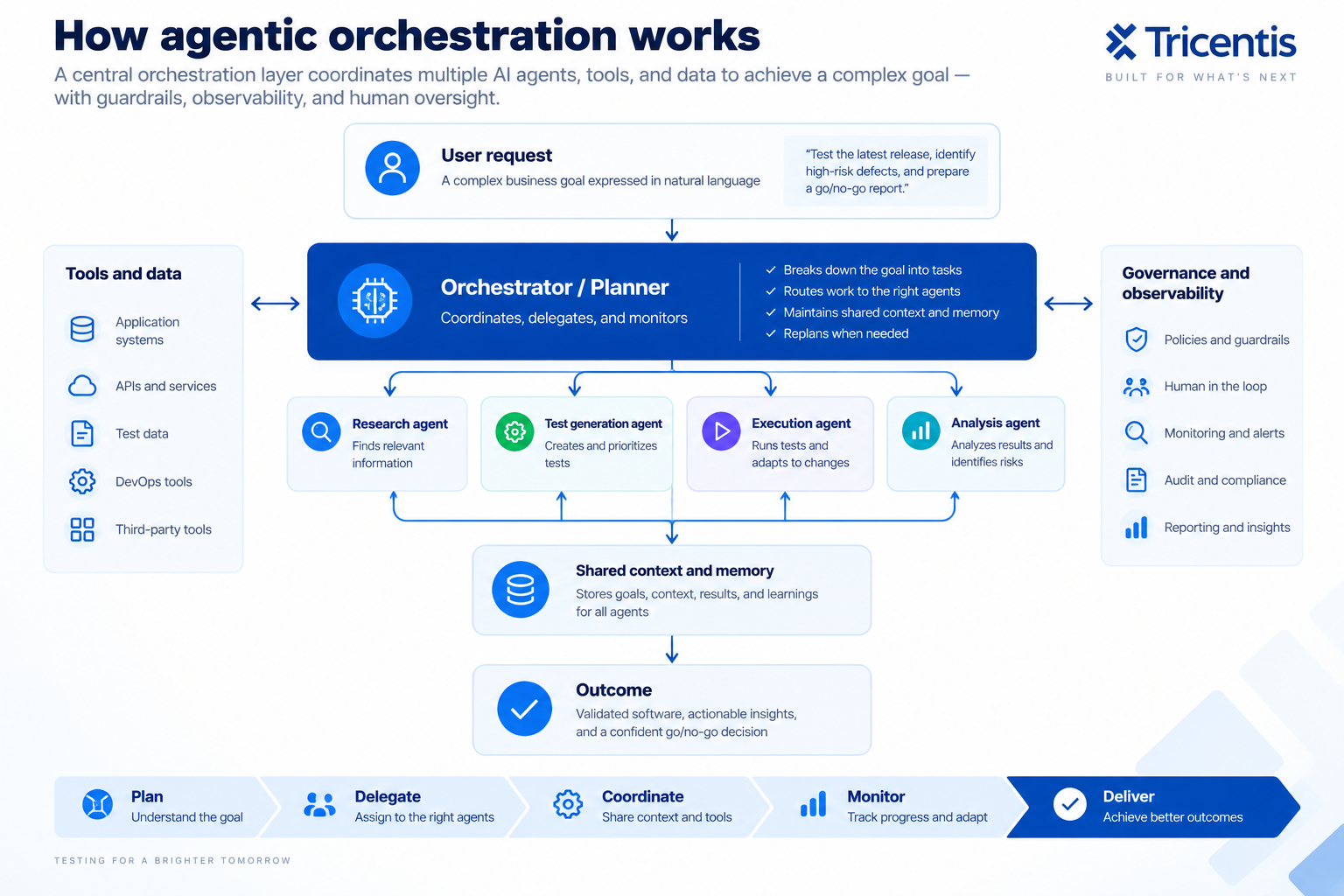
Agentic orchestration relies on a handful of recurring components that make the multi-agent system work harmoniously:
This agent breaks down a goal into subtasks and decides which of the subagents handles each one.
This agent breaks down a goal into subtasks and decides which of the subagents handles each one.
This is a directory of all the available agents, their capabilities, and their assigned permissions within a system.
This is the common memory layer that allows agents to work in harmony, without conflicts. It provides fresh context and retrospect to each of the subagents involved.
This is the list of tools and data available to perform the orchestration.
These are checkpoints where a human reviewer performs a check on the output before it moves forward.
Each of the agent’s actions needs to be logged in a table. Every decision and handoff should be recorded to track failures back to the source. This is important for auditing and troubleshooting whenever agents fail in some way.
AWS’s own prescriptive guidance lays out the flow:
Workflow orchestration involves coordination of a series of predefined, mostly deterministic workflows.
People use both the terms “agent orchestration” and “workflow orchestration” interchangeably. Let’s mull over the two terms a bit to get clarity.
Workflow orchestration involves coordination of a series of predefined, mostly deterministic workflows. They follow a fixed sequence with limited branching logic.
This is the classic IF-ELSE logic that most RPAs have been using for years. In other words, step one triggers step two, which in turn decides a case from a series of predetermined decision points. All of this has been programmed in by a human in advance.
Agentic orchestration adds reasoning to the mix. The agents here are capable of decoding ambiguous input from a user. It can decide which path to take and then adjust the plan mid-execution based on the larger context.
A workflow orchestrator runs a preconceived script, while the agent orchestrator makes a judgment call based on the context in real time.
| Factor | Workflow orchestration | Agentic orchestration |
| Decision logic | Predefined rules and fixed sequences | Real-time reasoning based on context |
| Adaptability | Low; Breaks whenever an unexpected input is encountered | High; Agents are capable of replanning and executing around unexpected inputs |
| Trigger | Scheduled or event-based | Goal-based. The exact steps to take are determined by the agents |
| Human role | Programs the workflow upfront | Reviews and approves at checkpoints, usually before performing high-stakes decisions |
| Used for | Repetitive and well-defined processes | Ambiguous, multi-step tasks where judgement is needed |
A number of agentic orchestration frameworks exist. But you really only need to know the four base patterns, as outlined by IBM:
One orchestrator governs all other agents. It acts as the nerve centre and assigns tasks to each of the subagents, making the final call. Agents are more predictable and easier to govern under this regimen.
The problem is that the orchestrator has the potential to become the bottleneck and single point of failure.
Agents communicate directly and arrive at a consensus for decisions without a controlling entity. This is more resilient and scalable. This architecture is harder to predict and audit, though.
In this paradigm, several orchestrator agents sit in hierarchical layers. Higher-level agents oversee groups of subagents that perform specific tasks. This is the most common architecture that enterprises converge to as their systems mature.
Each organization isn’t bound to using just one of these orchestration architectures. As a matter of fact, most organizations lean towards a blend. The blend helps them tailor the architecture based on their specific business needs.
Under this regime, the AI agents can collaborate without requiring a shared data set. They don’t need to give up autonomy either. Super useful when the business case is privacy- or security-sensitive.
For several health, multi-stakeholder, and banking scenarios, data cannot be freely shared. Suppose you have an ad bidding platform. The agent from the supply side needs to talk with the demand side agent.
Although the goal here is to enable an optimized bid, only need-to-know data will be shared between the agents, and neither of the agents sacrifices their autonomy to the other.
The adoption curve is steep as it gets. Gartner’s own data shows why. According to the 2026 Gartner CIO and Technology executive survey, only 17% of organizations have deployed AI agents so far.
At the same time, though, more than 60% of organizations expect to deploy AI agents in the next two years. This is by far the most aggressive adoption curve measured for any technology through the survey.
This pull isn’t just fueled by curiosity. It’s actually fueled by a number of business drivers:
A human in the loop is maintained to check intermediate critical outputs throughout the process.
Tasks that used to require multiple departments and weeks of waiting can now be run within a single orchestration session. A human in the loop is maintained to check intermediate critical outputs throughout the process.
Individual agents tend to fail in the shadows. Orchestrated agents go out in style (read: loudly). They emit several errors and log the failures in the process. This helps catch the issue before it reaches the customer.
As the number of agents grows, the orchestration layer adopts a single governance framework without having to reinvent the wheel. The same permissions, audit trails, and approval policies can be applied consistently across the full fleet of agents without having to customize for each one.
Plenty of enterprises own AI agents at this point. The problem is that most of these agents are underused or trip over each other because they can’t “talk” to each other.
Orchestration offers one of the cheapest forms of getting more from the existing AI spend. It helps AI agents do more, faster, and more accurately.
Agentic orchestration is showing up in everyday business processes. Most customers don’t even realize it, but they’ve already come across it in one form or another. It’s that seamless!
You call up your bank and request your balance and the last three transactions made. The request gets routed to a triage agent, a knowledge retrieval agent, and an escalation agent. The triage agent checks the nature of your request.
After validating your authenticity, it invokes the knowledge retrieval agent, which checks the database and spits out information according to your request. You end up requesting a more complex query, like opening up a dispute and making a complaint.
That’s where the system prompts the escalation agent to find you the available and most knowledgeable human to deal with your query.
A code generation agent writes code for an IoT app according to the specs provided. A test agent vets the code for syntax, IoT connectivity, and edge cases. Meanwhile, a security review agent scans the codebase for vulnerabilities.
This entire operation is made possible within a single pull request, thanks to an orchestrator agent managing affairs.
Imagine a hotfix is delivered by your dev team and your solution is now in hypercare. Suddenly, an incident pops up. The agent diagnoses the incident.
Next, it checks if any deployments have been made recently. It verifies that the incident indeed happened due to the recent hotfix. The agent then proposes a rollback, and a human engineer approves.
Let’s discuss how agentic AI helped LTIMindtree (LTM), a global technology service provider with 90,000 employees worldwide. (And now, it’s a Tricentis Tosca implementation partner.)
The tech giant needed to cut manual effort for test case creation across its SAP and enterprise testing projects.
LTM piloted Tricentis Agentic Test Creation and Agentic Test Automation, automating full UI and API test coverage on core platform apps.
LTM cut low-complexity test design time by a massive 67%. On the flip side, high-complexity design time was reduced by up to 83%.
Nisarg Pandya, test lead at LTM, commented about the win: “ We’re excited to roll this out more broadly. It will shrink project timelines greatly across multiple projects spanning different geographies, teams, and systems.”
Learn more about this case study here.
Challenges to consider
Orchestration solves a coordination problem. But it creates a few new ones along the way:
Each agent requires a defined set of permissions, a clear escalation path, and accountability.
As the agent count goes up, so does the governance overhead. Each agent requires a defined set of permissions, a clear escalation path, and accountability. As the number of agents starts to pile up, these questions become harder and harder to answer.
Designing an AI orchestration layer that truly benefits the business is a complex task. You need to design topologies and choose whether to centralize or decentralize the orchestration.
This is an entirely different beast of a skill compared to prompt engineering and traditional software architecture design. Most organizations don’t have this skill level in-house. The result is that roughly 40% of all agentic AI projects are expected to be scrapped by 2027, according to Gartner.
If the orchestrator goes down, glitches, or gets a bad instruction, every subagent underneath it inherits the same problem all at once. Centralized orchestration concentrates the risk into one choke point.
When you’re working with three agents, and they all contribute to a bad outcome, it becomes harder to ascertain which one of them introduced the actual error and which ones were responsible for just passing that error along. Troubleshooting such systems can become difficult.
We dwelled a bit on how agentic orchestration works. But now let’s deep dive into some of the best practices:
Begin by picking a small workflow that has clear success criteria. Practice running the workflow through agentic orchestration till you iron out all the kinks. Only once you’re confident should you start to scale to regional/departmental and then global/company wide processes.
You should be choosing the topology (centralized, decentralized, hierarchical) that makes sense for your business.
Be intentional while choosing your topology of choice. You should be choosing the topology (centralized, decentralized, hierarchical) that makes sense for your business.
A third-party vendor shouldn’t be forcing down an architecture because it’s the one they’re most adept with. If your vendor can’t cater to your business needs, fire them.
You shouldn’t be strapping on governance after having deployed your agentic solution. You should have the gating done from day one. It makes the design much simpler.
The relevant comparison for ROI is whether orchestration tops a well-tuned single agent. It shouldn’t be determined against a manual work process. Otherwise, you’re not measuring value accurately.
Orchestration isn’t a new problem statement. In fact, it’s a problem the world has grappled with since time began.
Think of miscoordinated attacks during wars, farming with misaligned weather patterns, and losses incurred due to bad planning in the supply chain. These are all examples that the world still faces today.
With AI agents, the problem has taken on a new, interesting twist. In a world run by AI agents, the stakes have grown higher, and that’s where agentic orchestration comes in as the glue to hold everything together.
It’s important to note that agentic orchestration doesn’t remove the risk altogether. On the contrary, it gives you a mechanism to observe, govern, fine-tune, and catch errors.
Want to see how coordinated AI agents can handle test design, execution, performance validation, and fine-tuning, all from a unified workspace? Explore the Tricentis AI workspace to see how it applies agentic AI and orchestration to build more intelligent, resilient software testing workflows.
This post was written by Ali Mannan Tirmizi. Ali is a Senior DevOps manager and specializes in SaaS copywriting. He holds a degree in electrical engineering and physics and has held several leadership positions in the Manufacturing IT, DevOps, and social impact domains.

Agentic orchestration is the mechanism of coordinating multiple AI agents to execute work towards a shared goal.
A central orchestration layer assigns tasks, manages shared context, and resolves conflicts in case one arises between agents. Human agents are looped in at high-stakes junctures.
ChatGPT, as of July 2025, can be considered agentic AI. It now comes with a built-in agent mode, which allows planning, browsing, execution of code/workflows, and validation autonomously.
A multi-agent system is a set of independent AI agents that are working on related tasks. Agentic orchestration is the control layer that determines how these agents will interact, in what sequence, and with what level of oversight.