

What is penetration testing?
Discover penetration testing, including types, techniques, and how...
Discover what AI penetration testing is, how it works, common AI security threats, and best practices for protecting AI-powered applications.
TL;DR
Learn how AI is transforming penetration testing in this complete guide—covering uses, benefits, risks, best practices, and what’s next.
If you’ve spent any time poking at AI-powered apps recently, you’ve noticed pretty quickly that the game has changed. Back in the day, pentesting was all about going after classic web vulnerabilities like SQL injection, cross-site scripting, and the other usual suspects.
Now, with large language models (LLMs) running everything from chatbots to code generators, there are suddenly more doors to check and way more things that can go wrong.
I found this out myself the first time I tested a machine learning model in production. It wasn’t just the interface or the API keys that made me think about this—it was everything.
You’re staring at the model, thinking, “OK, how do I even start?” Well, it turns out that a lot of the classic pentesting mindset still helps, but you need to twist it a bit to fit the AI world.
Honestly, I spent half a night worrying I’d missed some weird new kind of attack that wasn’t in my regular checklist. In this post, let’s go over what I learned and discuss AI penetration testing in detail.
AI penetration testing is, well, testing—but for machine learning stuff, not just websites and databases.
AI penetration testing is the practice of probing artificial intelligence models and AI applications to identify vulnerabilities like prompt injection, data poisoning, and model manipulation.
It also encompasses using AI-powered automation to accelerate and enhance traditional security testing across your broader infrastructure.
The point is to spot weaknesses in systems that learn from massive amounts of data and make decisions for you, often without anyone really understanding exactly how.
There are two main sides here. First, there’s using AI and automation to boost traditional pentesting (better scans, smarter payloads, more automation). Second, there’s pentesting the AI itself and trying to break it, confuse it, trick it, or steal its secrets.
Many of the best AI pentesting tools today scan endpoints and churn through huge datasets so much faster than a human ever could. They pick up on strange patterns or suspicious inputs, go through logs and outputs, and can run all the usual scripts and tests.
But they’re not perfect. Sometimes AI flags things that look weird but are actually fine. Or worse, it misses something real because it has never seen this kind of trick before.
Where stuff gets spicy is with the AI apps themselves. Modern LLMs, like the chatbots everyone’s playing with, are super powerful but also kind of unpredictable.
Your classic web attacks work sometimes, but now you’ve got model stealing, training data poisoning, adversarial input (literally fooling the model by sending weirdly crafted data), model inversion, and a bunch of new risks you need to keep in mind.
If you’re thinking that sounds too complicated, you’re right. A pen tester’s job now is about covering more ground while also developing new tools and methods to keep up.
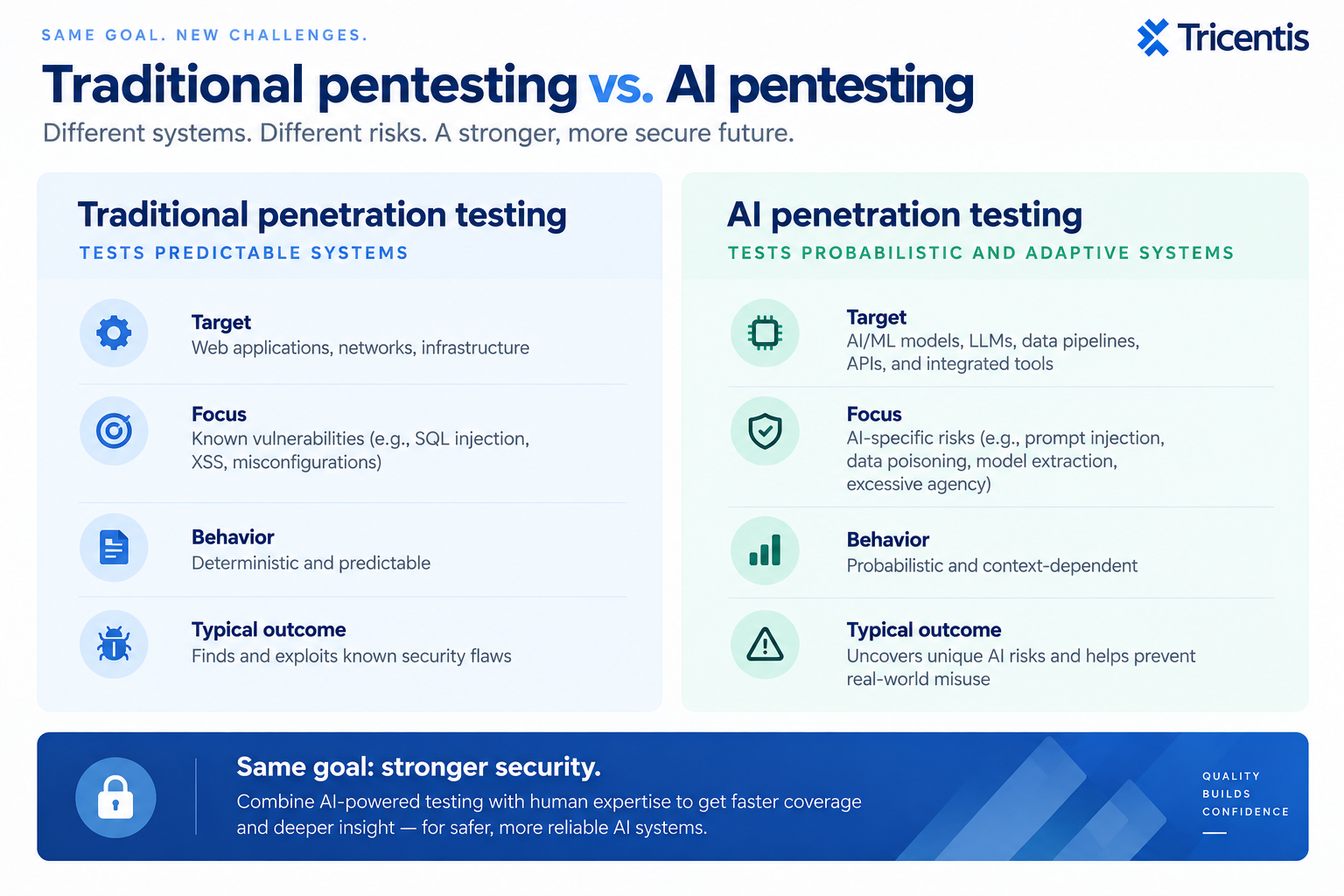
When comparing traditional pentesting to AI pentesting, the main difference comes down to deterministic behavior versus probabilistic behavior.
In traditional pentesting, you test systems that follow rigid rules. If you send a specific SQL injection payload into a vulnerable field, the database returns an error or leaks data every single time. The vulnerability is predictable and reproducible.
With AI systems, the model’s response can change based on context, temperature settings, system prompts, or slight variations in phrasing. Rather than testing fixed endpoints alone, you are testing how the model interprets intent, whether it leaks training records, and whether it can be tricked into taking actions it shouldn’t.
| Area | Traditional penetration testing | AI penetration testing |
| What you test | Networks, servers, web applications, and fixed business logic. | Model behavior, prompt guardrails, data pipelines, and agent permissions. |
| How often it runs | Periodic audits, such as once a year or before major releases. | Continuous checks integrated into pipelines and runtime monitoring. |
| Speed and scale | Limited by manual tester hours and manual report writing. | Fast automated scanning across thousands of payloads and endpoints. |
| Common threats | SQL injection, XSS, broken access control, and buffer overflows. | Prompt injection, data poisoning, model extraction, and excessive agency. |
| Output consistency | Deterministic (same input produces the same response). | Probabilistic (outputs vary based on context, phrasing, and model state). |
Sure, prompt injection gets a lot of attention. It’s a serious problem and deserves coverage, since it manipulates the way the model responds and might let attackers change its behavior. But to be honest, there’s a whole menu of issues that pen testers face with AI systems, and ignoring the rest is setting yourself up for big trouble.
Let’s talk about data poisoning a bit. With poisoning, attackers slip bad data into your training sets, corrupting how the model learns. Sometimes this is just noise. The model gets worse, less accurate, and loses reliability.
Other times, it’s targeted. Attackers aim for your fraud detection or recommendation system, tweaking it to let specific cases through or even opening sneaky backdoors that only activate when triggered.
If you’re running AI in healthcare or financial sectors, a poisoned model means real damage. Wrong diagnoses, identity theft, maybe even someone getting credit they shouldn’t.
There are also model extraction attacks. Someone copies your model by querying it a bunch, learning its predictions, and then clones it for their own use. Some attackers are more interested in stealing a model’s training data, which sometimes includes sensitive or private info.
Evasion attacks are another layer, changing the input at inference to sneak by detection systems. Instead of poisoning the training data, here you’re fooling the AI while it’s making a decision. Malware authors do this by tweaking their code just enough so ML-based security gates miss the threat. Even biometric systems can be fooled with clever enough attacks.
The important thing here is that all of these risks tie back to the expanded OWASP Top 10 for LLM and AI: leakage of private info, issues in plugin integrations, excessive confidence in predictions, or denial of service (DoS) attacks on models. If you’re pentesting in 2025, ignoring these is a quick way to miss the real threats.
Multi-agent systems coordinate a bunch of different attacks, adapting their strategy if the defense pushes back.
Some security pros wonder if AI can really think like an attacker. Sometimes it does, but sometimes it’s just faster. Honestly, it also depends on the system and who’s running the test.
A lot of companies use agentic frameworks today. For example, multi-agent systems coordinate a bunch of different attacks, adapting their strategy if the defense pushes back.
These AI platforms are great at routine stuff, but not so much at unpredictable, creative attacks that require real intuition. You still need humans to think about context, business logic, and the stuff that’s never in the documentation.
To actually use AI to pentest systems, start by mapping your assets. Not just endpoints—think about all your models, APIs, data pipelines, and places where external stuff gets pulled in.
If you’ve got a chatbot, consider every third-party plugin and external document it can access as an attack vector. Sometimes this mapping feels like a scavenger hunt, sometimes like a detective story, but it pays off.
After you know what’s at risk, dive into risk assessment. This means systematically testing for AI-specific attack vectors:
Prompt injection is an attack where malicious user input manipulates a large language model into ignoring its system guardrails and executing unintended instructions. In testing, try both direct jailbreaks and indirect prompt injection embedded inside uploaded files or retrieved web pages.
Model extraction is a technique where an attacker systematically queries a machine learning model to recreate its proprietary architecture, weights, or capabilities. Probe your endpoints with query bursts to verify rate limiting and response throttling.
Data poisoning occurs when an attacker corrupts training or fine-tuning datasets to introduce deliberate biases, backdoors, or classification errors. Test the integrity of your data pipelines and verify data provenance.
Excessive agency occurs when an AI model or agent is granted overly broad permissions, functionality, or access to external tools without sufficient human oversight.
Check whether prompt manipulation can coerce the model into running unauthorized database queries or calling sensitive internal APIs.
Some AI scanners can automate these steps, but honestly, you get more when you combine them with manual review from pen testers with machine learning know-how. It takes time, and you can chase a lot of false positives, but going too fast means you miss the subtle stuff.
Integrating AI testing into CI/CD pipelines is ideal. More companies do “continuous pentesting” now, not just during once-per-year audits. It’s automated, always running, and improves security posture as soon as new code lands.
There are mistakes sometimes, tests that break or engineers flagging nonsense, but that’s the price for moving fast and catching real threats early.
With AI in the picture, organizations can analyze and cover way more ground, test thousands of endpoints, and spot difficult-to-detect patterns almost instantly.
Pentesting an AI system requires a structured approach so you don’t get lost in the weeds. A practical methodology covers a few distinct stages.
1. Mapping the AI attack surface
Start by mapping every place the AI touches the outside world. This means creating a catalog of your models, APIs, data ingestion pipelines, vector stores, and third-party plugins. If your chatbot can search internal documents or run database queries, every one of those connections is a potential target.
2. Probing with adversarial inputs and prompt fuzzing
Next, test the model’s resilience. For language models, this means running prompt fuzzing to see if you can bypass system instructions, leak hidden prompts, or trigger restricted outputs. For traditional machine learning classifiers, this involves sending perturbed inputs to see if the model misclassifies data.
3. Evaluating data stores and retrieval pipelines
If your application uses retrieval-augmented generation (RAG) to pull in context, probe the vector database. Check whether users can retrieve documents they do not have permissions to see or whether an attacker can inject malicious instructions into files the AI reads.
4. Testing tool access and execution boundaries
When models can call tools, APIs, or database commands, test what happens when the model receives malicious inputs. Verify whether prompt manipulation allows an attacker to trigger unauthorized actions, delete data, or exfiltrate sensitive keys.
5. Documenting and validating fixes
Finally, record reproduction steps and remediation guidance. For AI flaws, fixes often mean tightening system prompts, adding input validation guardrails, or reducing API token scopes. Run regression tests to verify that future model tweaks do not reopen the vulnerability.
The benefits are clear. With AI in the picture, organizations can analyze and cover way more ground, test thousands of endpoints, and spot difficult-to-detect patterns almost instantly. This means higher frequency testing and catching vulnerabilities close to when they’re introduced, often before attackers can exploit them.
Detection gets smarter too. AI models can notice odd behavior, spot attack signatures across apps, cross-compare logs, and dig up vulnerabilities that would take ages for a human to spot. Automated pentesting saves money (even more if you compare it to hiring external pen testers every few months).
But don’t make the mistake of thinking this means security teams can shrink. The experts are still needed to figure out what matters most, validate findings, and tackle the hardest problems.
But AI brings risks too. Sometimes, you’ll get flagged about problems that aren’t a big deal, or, more dangerously, the system will miss issues because the data didn’t teach it what to look for. Training data quality is everything.
Bad or incomplete data means that AI misses attacks, and there’s no easy fix if attackers invent new tricks.
And then there’s transparency. AI models are often “black boxes” that can be hard to interpret and tough to explain, especially to non-technical people. You need oversight and human validation; otherwise, critical vulnerabilities might slip through for months.
As pen testers know, AI can’t replace experience. Legendary hacker Kevin Mitnick famously said: “All of the firewalls and encryption in the world can’t stop a gifted social engineer.” Tools get smarter every year, but creativity, context, and intuition still win.
Combine automation with expertise. Set clear goals, define what you’re testing, scope the models and integrations, and document risks up front. Use modern frameworks like the OWASP Top 10 for AI, but don’t forget traditional AppSec best practices.
Collaboration across devs, ops, security, and business helps. AI systems involve a whole ecosystem (e.g., APIs, backend apps, data pipelines, etc.), and often, the connections are the weak points. Communicating findings early, remediating quickly, and educating teams about new AI risks helps build real resilience, not just checkbox security.
Always keep humans in the loop for big findings. Let the AI do routine scanning, but serious vulnerabilities and strategy should involve real people making decisions.
At the end of the day, pentesting in the age of AI means blending automation, creativity, and collaboration.
AI is changing the pentesting landscape for both sides, attackers and defenders. It’s leveling up the speed of discovery and fixing, but also the speed at which attackers probe for weaknesses.
We’re starting to see predictive vulnerability analysis (finding risks before attackers even try), rapid attack simulation, and continuous validation as products from leaders in AI testing like Tricentis. Automated security is becoming a default, but new skills are needed for the teams that run it.
Every pen tester I know is learning on the fly. Attackers use AI to find holes faster, and defenders automate testing to keep pace. But the arms race means no one gets to relax. Even small mistakes or missed details can open you up to real trouble.
At the end of the day, pentesting in the age of AI means blending automation, creativity, and collaboration. AI makes security better, but it also means evolving your approach all the time.
If your organization is serious about defending its AI apps, don’t just run tools, get your hands dirty, and be ready to catch new tricks, because the attackers sure will. If you actually want to see how AI can boost pentesting, take a look at what Tricentis is offering.
This post was written by David Snatch. David is a cloud architect focused on implementing secure continuous delivery pipelines using Terraform, Kubernetes, and any other awesome tech that helps customers deliver results.
Learn more about intelligent test automation and how an AI-powered testing tool can optimize enterprise testing.
Learn more about intelligent test automation and how an AI-powered testing tool can optimize enterprise testing.

No. AI tools handle repetitive scanning, data analysis, and payload generation at scale, but human testers are still required to understand business logic, evaluate complex exploit chains, and verify context.
Prompt injection remains one of the most common and dangerous risks. It allows attackers to override system prompts, extract sensitive records, or trigger unauthorized backend actions through natural language.
Traditional pentesting looks for deterministic code flaws such as SQL injection. LLM pentesting evaluates non-deterministic behaviors, prompt manipulation, data leakage from vector stores, and unintended execution of external tools.