

DevOps
Testing is not a monolith: lessons from DevOps Unbound
Experts debate different testing types, whether better testing is an...
Learn the differences between alpha vs. beta testing, when to use each phase, their benefits, and how they improve software quality.

TL;DR
Developing good software takes time, effort, and a lot of testing. During that development phase, you need to gather regular feedback and test the application or defects. That kind of feedback loop is a continuous part of the software development lifecycle.
However, when the testing comes early in the development process, we have special names for those feedback cycles.
We call them “alpha” and “beta” testing. If you’re working for a software company and you’re thinking about adopting alpha or beta testing for your team, you should understand the differences and how each phase of testing can help your team.
Alpha and beta tests are different from what many software teams think of as testing. A lot of software teams focus on automated software testing. These are tests that run automatically.
The test scripts themselves are written by software developers and processed by computers. Automated testing is a critical part of any software development, and scores of teams around the world have invested in improving their automated tests, to great effect.
The second type of testing that many software teams invest in is manual testing, either by internal users or a dedicated QA team. This used to be an extremely popular phase of software testing for all types of companies.
The popularity of QA testing has waned somewhat in recent years, but it’s still an extremely effective phase of software testing. Manual testing involves a pre-planned script for testers to follow, as they validate that the application works as expected across a wide range of scenarios.
Alpha and beta testing do not fall into the buckets of either automated testing or manual testing. Instead, alpha and beta testing fall into a bucket that I like to call user-based testing.
Instead of following scripts written by employees of the company, user-based testing involves handing the software over to real end users and allowing them to use the software like, well, real users.
You might provide them with some general testing points, but you provide the users the ability to use the software as it is, however they want.
Automated testing is a critical part of any software development, and scores of teams around the world have invested in improving their automated tests, to great effect.
Alpha testing is the first phase of user-based testing. Alpha testing is designed to operate while the application you’re developing is still changing rapidly. Testing that early in the development flow provides a few advantages.
First off, it provides your team with early feedback on features, which tells you early whether your users are connecting with what you’ve built. The early feedback also gives you the chance to find out about bugs, big or small, in your application.
Alpha testing involves inviting a small number of usually highly dedicated users to use your application. How you source these users can be of particular interest for many companies.
You want to identify users who are representative of your broader user base, but who are also highly invested in your application and are somewhat technically focused. After all, you’ll be relying on them for bug reports and feedback on the new features that you’ve developed.
Critically, you also need users who are patient, as they will need to deal with constant changes to the code and what will likely be a deluge of bugs.
After their invite, you should unleash these valuable customers to use your application as they normally would. At certain times, you might ask them to test very specific parts of the application, so that you can collect feedback on how well your early-development features are working.
Beta testing is the second phase of user-based testing. Generally, the beta testing phase comes when your team has developed all or nearly all of the features you’re planning to add during this phase of development.
Your focus during the beta test is finding defects, rather than gathering raw feedback on the quality of developed features.
That doesn’t mean that new feature development will be entirely finished before beginning a beta test; sometimes the bulk of the work is done, and you can turn your customers loose on the parts that you’ve finished while the team works on finishing up the rest.
The key mechanism you want to present to your users during the beta testing phase is a clear, effective way to report bugs.
You’re beta testing because you expect that there are still lots of bugs in the way that your software works. You provide beta access to your software to dedicated customers in the hopes that they’ll help you find those bugs.
Alpha and beta testing offer a number of similarities:
All in all, alpha and beta testing are remarkably similar processes. For this reason, many software companies don’t decide to adopt both processes unless they’re preparing a major transformative release.
Generally, most teams will skip alpha testing for most or all of their releases, choosing to adopt it only for particularly large development projects.
The key mechanism you want to present to your users during the beta testing phase is a clear, effective way to report bugs.
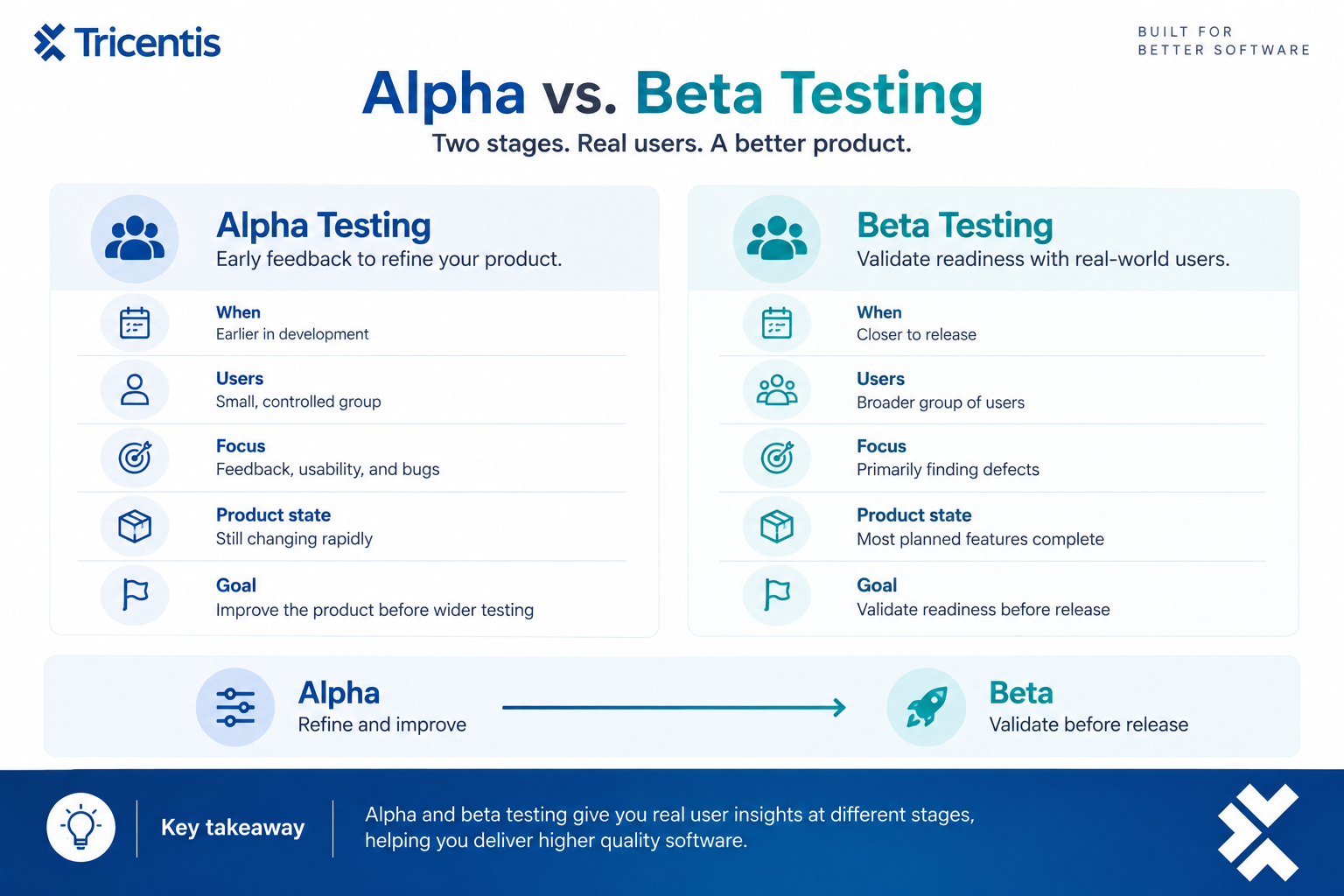
While there are a lot of similarities between alpha and beta testing, there are some key differences that impact whether your team wants to adopt either or both for your project. First off, alpha testing comes before beta testing during the process.
Critically, the transition from alpha testing to beta testing comes when you’ve wrapped up active development of the most important features that you identified at the start of your project.
Beta testing also involves a much broader cohort of users because the work you’re doing is much closer to ready for release.
And, like we’ve noted, the focus during beta testing is primarily intended to find and eliminate defects, while alpha testing is first intended to gather feedback on the quality and usability of your developed features.
| Type of testing | Alpha | Beta |
| User audience | Some internal testers, a few external users | Broad group of representative external users |
| Primary goal | Collect feedback on new features | Find and eliminate software defects before public release |
| Phase of project | While new features are still being developed | Following the development of most or all new features |
| Frequency of use by software teams | Rare; usually only with major projects covering lots of features | More common; often used by teams on projects of all sizes |
Development teams across the software world utilize agile software principles to run their development lifecycle.
Traditional alpha and beta testing can sometimes feel superfluous in an agile workflow because agile teams focus on releasing code to production as quickly as possible in order to shorten feedback cycles.
Those shortened release cycles don’t mean that teams mean to abandon alpha or beta testing, though. Instead, agile teams who wish to utilize alpha or beta testing approaches might stratify their releases into multiple environments, like a dedicated staging or pre-release environment.
That allows rapid releases to public-facing environments without that work going directly to a supported production environment.
From a different angle, agile teams operate like they’re running an alpha or beta test all of the time.
The principles of alpha and beta testing, where teams are looking to collect quick feedback about the efficacy of features and discover bugs through testing by real-world users, are front and center in agile software development.
Swen Vincke, the head of the studio that developed Baldur’s Gate 3, noted that the years-long alpha test of video game Baldur’s Gate 3 “causes extra development effort, but it leads to a better game, which is ultimately the goal of the entire exercise.”
They approached alpha testing like an agile team: continually collecting feedback and updating their game based on the input of their users.
Both approaches emphasize gathering rapid feedback and iteration on the software for your users, which is a proven way to deliver high-quality software.
Here’s an example of how Experian, a global data and technology company, made their testing more efficient with Tricentis Tosca.
Testing was a major challenge for Experian. They had a heavy reliance on manual testing, which was difficult to scale, but at the same time, onboarding new testers had a long lead time before those testers were performing at their best.
Experian adopted Tricentis Tosca, which slashed the time needed to onboard new testers. This let new testers get up to speed much more quickly, and also meant that they were able to elevate the skills of existing testers to a higher level, too.
Experian saved more than 20,000 hours of manual testing time in their first six months after adopting Tricentis Tosca.
They estimated that time savings were worth a million dollars in savings in the first year. A tester can now write a test suite for a particular application in 30 minutes, whereas executing that manual test previously took weeks.
You can read more about this case study here.
High-quality teams utilize testing at every phase of the SDLC, and they leverage both automated and manual tests to get that testing done.
Alpha and beta testing are a core part of a well-rounded testing approach. High-quality teams utilize testing at every phase of the SDLC, and they leverage both automated and manual tests to get that testing done.
To maximize the value of your alpha and beta tests, you want to start maximizing the value of your automated tests well before you’re sending software to your users. In order to get the most out of your automated testing processes, your best tool is Tricentis Test Automation.
Tricentis’s automated testing and AI-powered test runners allow your team to eliminate bugs before you ship them to your customers.
And when you do ship defects that your customers find during beta testing, using Tricentis AI testing to define tests that reproduce the issue means that you can rest assured you won’t ship regressions to your customers as development continues.
If you’re interested in seeing how Tricentis makes your entire testing lifecycle more effective, reach out to us today. Your users will appreciate that you did.
This post was written by Eric Boersma. Eric is a software developer and development manager who’s done everything from IT security in pharmaceuticals to writing intelligence software for the US government to building international development teams for non-profits. He loves to talk about the things he’s learned along the way, and he enjoys listening to and learning from others as well.

One of the more common uses of alpha testing comes from the world of video games, where development studios will often release games in “Early Access” mode.
Perhaps the most visible and successful version of this came from 2023’s Baldur’s Gate 3, a game that spent 3 full years in Early Access mode.
The alpha testing process for these games allows the developers to continuously collect feedback from dedicated players about which features are working well and which ones they should rework or scuttle before the full launch.
In truth, neither alpha nor beta testing is strictly better. What value you extract from each is dependent on both your team and your software. With that said, most software teams find more consistent value from beta testing than alpha testing.
Much like the letters of the Greek alphabet that they’re named after, alpha testing comes before beta testing when you adopt both.
All three forms of testing belong to the category of user-based testing. Alpha testing comes near the end of the development process and involves hand-selecting interested users to provide feedback on whether the new features work as desired, in addition to finding bugs.
Beta testing involves a broader net of public users. These users are primarily concerned with rooting out bugs in the developed features. These bugs are harder to find during the development process.
UAT (user acceptance testing) involves working directly with invested stakeholders. It helps determine whether the developed features meet the requirements set forward by the users. These are the users who first requested the software features at the beginning of the development process.
Teams will often choose one or two, but not all three, of these options during their testing process.