

DevOps
Forrester Research: What Quality Metrics Matter Most for DevOps?
Learn about new Forrester research on how DevOps leaders use and value...
Learn the differences between CI/CD and DevOps, how they work together, and best practices for improving software delivery.

CI/CD and DevOps are often mentioned in the same breath, which is why so many people treat them as interchangeable. They are related, but they are not the same thing.
DevOps is the broader operating model: it changes how teams collaborate and share responsibility across development and operations, while CI/CD provides the automated path that takes code through testing and toward release.
One is the culture and operating model; the other is a key technical mechanism that helps make that model work.
This difference is important because organizations rarely struggle from lack of tooling alone. They struggle when pipelines exist without a supporting culture or when teams talk about DevOps without the automated practices that make fast, safe delivery possible.
Once that distinction is clear, both concepts become more useful in day-to-day delivery.
The cleanest way to explain the relationship between CI/CD and DevOps is this: DevOps describes how teams organize software delivery; CI/CD describes how they automate key parts of that delivery.
If a team says it is practicing DevOps, that usually implies more than just having a build pipeline. That means development and operations work more closely together and share ownership of releases.
Production feedback informs the next cycle, and teams favor automation over handoffs and blame. CI/CD, meanwhile, is the automation that carries a change from commit toward release, with builds, tests, and packaging handled by the pipeline.
DevOps answers “how should teams work?” CI/CD answers “how should code move?”
The primary characteristic of DevOps culture is increased collaboration between the roles of development and operations.
DevOps brings the people who build and run software into a tighter working relationship. The aim is to release more quickly without sacrificing reliability. Testing is part of that from the start, with security often brought in early as well.
It is best understood as a cultural and operational model, not as a single tool or pipeline.
Martin Fowler emphasizes the cultural part clearly: “The primary characteristic of DevOps culture is increased collaboration between the roles of development and operations.” That quote is useful because it pulls the conversation away from tooling and back to the organizational change DevOps actually requires.
In practice, DevOps usually includes:
A team can buy tools that support DevOps. But it cannot buy DevOps itself. That is one reason organizations sometimes implement CI/CD tooling successfully while still struggling to achieve DevOps outcomes.
DevOps works by reducing the friction between writing software and running software. In older models, work moved from development to QA and then to operations like a relay race. Testing often came late, and the team responsible for deployment was left to troubleshoot when a release went wrong.
DevOps shortens those handoffs. Teams work in shorter cycles, and automation moves changes from commit toward release.
Monitoring and test results then feed into the next round of work. This is why testing becomes so important in DevOps. If teams are going to release more often, they need trustworthy signals that tell them whether a change is safe.
A simple way to picture the DevOps loop is this:
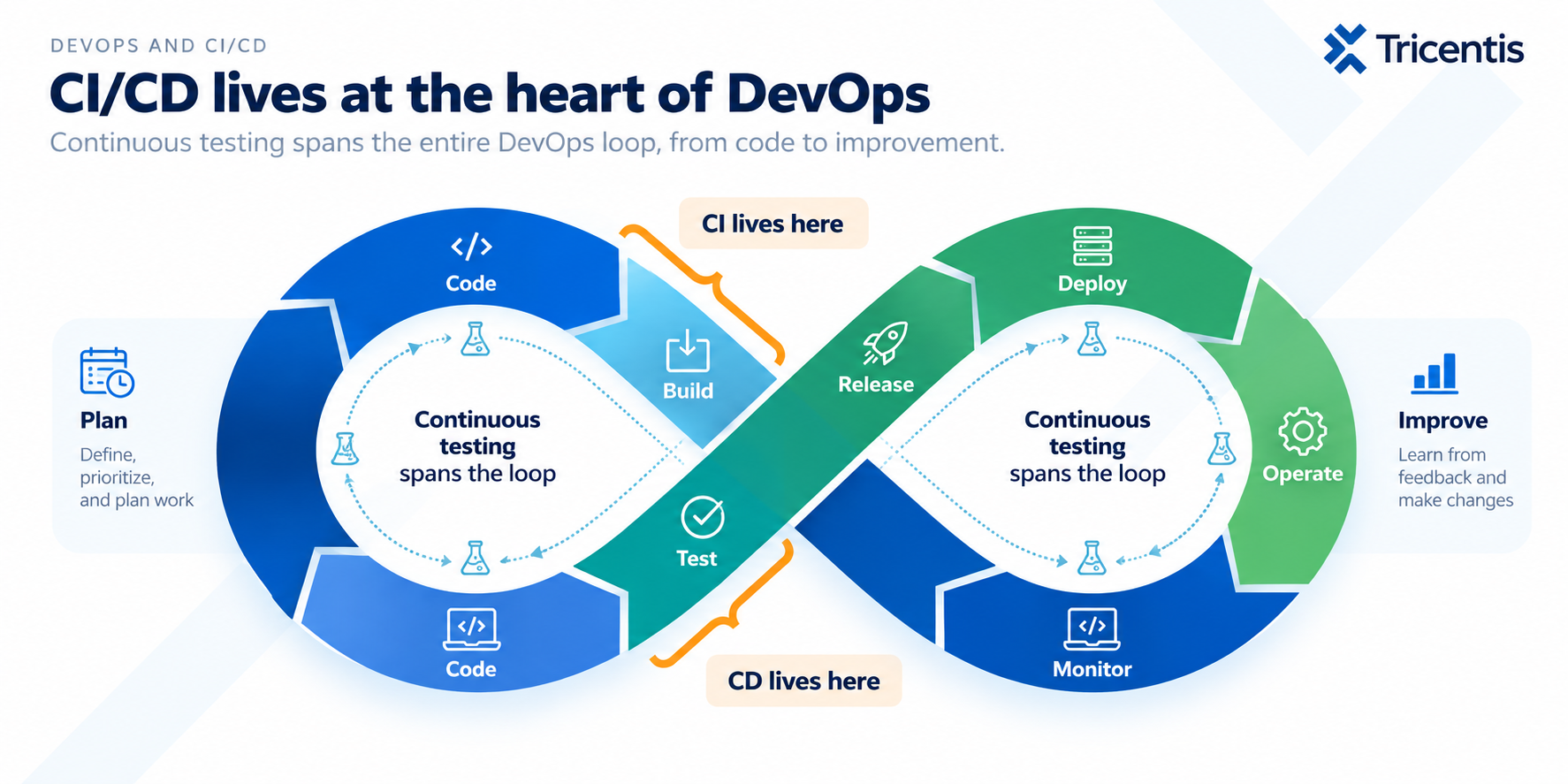
That is also why DevOps is bigger than CI/CD. CI/CD supports the middle of this loop. DevOps also covers the conditions around it: who owns the service once it is live, how teams use feedback, and how they improve over time.
CI/CD stands for continuous integration and continuous delivery or continuous deployment. CI/CD is the technical machinery that turns a code change into something ready to release.
CI, or continuous integration, is the practice of merging code changes into a shared main branch frequently and validating those changes with automated builds and tests. The goal is to catch integration conflicts and regressions early, before they become larger and more expensive to untangle.
CD extends that flow. In continuous delivery, code that passes automated checks is kept in a deployable state and can be released on demand. In continuous deployment, the release step is also automated, so every change that passes the pipeline can go directly to production.
For a deeper definition of the “CI” part specifically, Tricentis’s guide to continuous integration covers the basics well. The broader point for this article is that CI/CD is a workflow system. At its core, CI/CD makes software delivery repeatable rather than a one-off manual exercise.
A typical CI/CD flow starts the moment a developer commits code. Once a developer commits code, the pipeline checks it out and produces a build.
Automated tests validate that build before the pipeline packages it. The resulting artifact then moves through whatever environments and approvals the organization requires.
A simplified version looks like this:
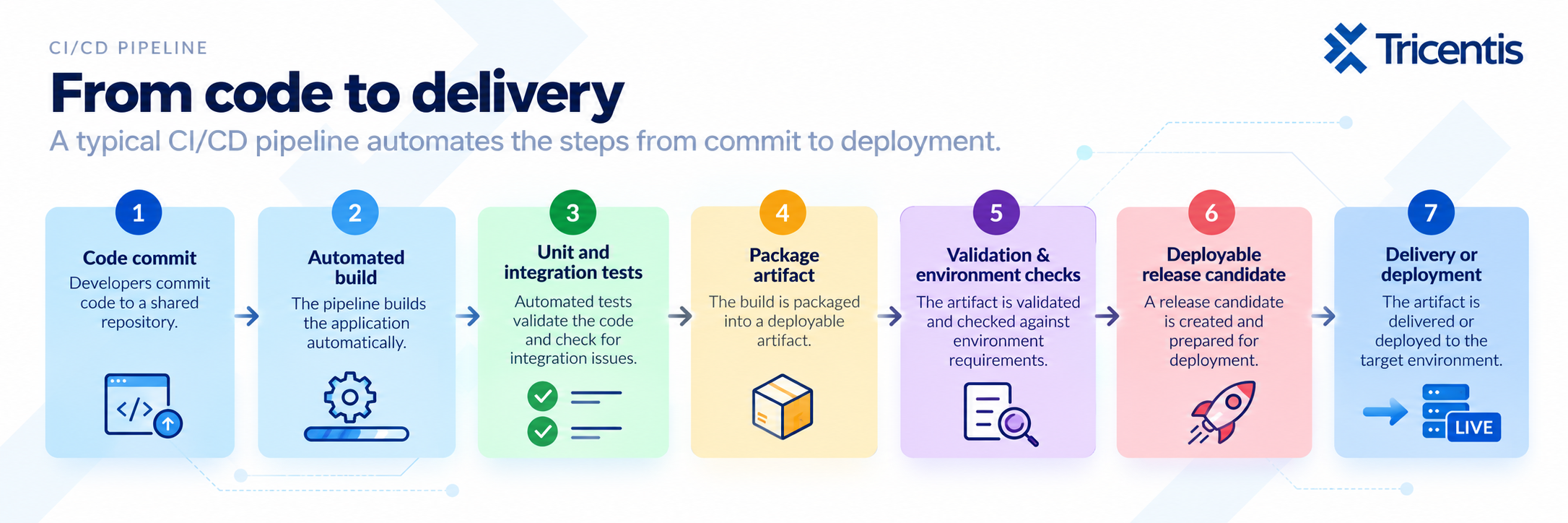
What makes the model powerful is not the sequence itself but the automation and consistency around it.
CI/CD is about turning software delivery into a repeatable system rather than a manual event. That is why testing cannot be an afterthought here. If pipelines move quickly but quality checks are weak, teams only accelerate the spread of defects.
The most important difference between CI/CD and DevOps is scope.
DevOps is a broader philosophy and operating model. Its concerns go beyond the pipeline itself: how people work together, who owns the outcome, and what teams learn from production.
CI/CD is narrower. It automates the path a code change takes from integration through release.
Here is the relationship at a glance:
| Category | DevOps | CI/CD |
| What it is | A culture and operating model | A set of engineering practices and automated pipelines |
| Main goal | Improve collaboration, delivery speed, reliability, and feedback across the lifecycle | Automate integration, testing, and release workflows |
| Primary focus | People, process, shared ownership, and delivery outcomes | Code movement from commit to release |
| Scope | Broad | Narrower |
| Requires tooling? | Yes, but tooling alone is not enough | Yes, heavily dependent on tooling and automation |
| Includes testing? | Yes, as part of end-to-end quality and release confidence | Yes, as automated quality gates inside the pipeline |
| Can exist without the other? | A team can have DevOps aspirations without mature CI/CD, but it will struggle to deliver on them | A team can have CI/CD tooling without real DevOps culture |
This is why “CI/CD vs. DevOps” is slightly misleading if read as a competition. They are not alternatives. CI/CD is one of the practical ways teams implement a DevOps approach.
CI/CD gives DevOps teams the automation needed to deliver quickly without adding friction. Without it, the work between commit and release remains manual, bringing delay and inconsistency back into the process.
With CI/CD in place, teams can merge and test changes sooner, then move them forward with fewer handoffs.
This is also where continuous testing becomes central. DevOps is not just about shipping faster. It is about shipping faster without breaking trust. Continuous testing gives teams that trust by embedding automated quality checks throughout the software development life cycle.
Tricentis’s DevOps testing guidance makes the same point in practical terms: in a DevOps workflow, testing starts early and runs throughout the pipeline so teams get business-risk feedback on every change instead of waiting for a late-stage testing window.
The main benefit is that CI/CD and DevOps reinforce each other. DevOps creates the organizational conditions for rapid, collaborative delivery. CI/CD creates the technical flow that makes rapid delivery operationally realistic.
When used together, teams usually gain:
This is also where Tricentis fits the picture. Tosca is positioned as an enterprise test-automation platform that combines a model-based approach with AI-powered support. This matters because DevOps and CI/CD break down quickly when testing becomes the bottleneck.
Explore how Tricentis products help teams integrate continuous testing into CI/CD and DevOps workflows.
DevOps creates the organizational conditions for rapid, collaborative delivery. CI/CD creates the technical flow that makes rapid delivery operationally realistic.
Here’s how Experian increased the speed of delivery with Tricentis Tosca.
Experian needed to speed up releases, but manual testing could not provide enough confidence as scope and frequency increased. Its earlier scripted automation effort had also become difficult to maintain, while validation remained weak.
Experian replaced its earlier scripted approach with Tricentis Tosca. It rebuilt the suite around reusable assets and connected testing to CI/CD workflows through Jenkins and distributed execution.
Experian moved from nine-week testing cycles to continuous testing. It reported 85% test automation with minimal maintenance and few false positives, as well as automated coverage for 95% of requirements.
You can read more about this transformation here.
The most common challenge is assuming that pipeline tooling alone creates DevOps. It does not. A team can have automated builds and releases yet still operate through siloed ownership and late-stage handoffs.
Another challenge is weak testing maturity. Many organizations can build and deploy automatically before they can validate automatically. That creates a dangerous mismatch: delivery accelerates, but confidence does not.
This is one reason software testing methodologies still matter. Teams need a testing strategy that fits their delivery model, not just automation for automation’s sake.
A third challenge is overloading pipelines with tests that are slow, brittle, or poorly targeted. Not every check belongs at every stage. The right placement depends on what the test is meant to catch and how quickly the team needs feedback.
Finally, teams often underestimate the change-management side. DevOps asks people to share responsibility, not just tasks. That can be harder than adopting the tools.
The first best practice when implementing CI/CD is to treat culture and automation as parallel work, not sequential work. Do not wait for a perfect cultural transformation before automating, but do not assume automation will produce cultural change on its own.
The second is to invest in continuous testing early. Quality gates should appear where they can give teams fast, reliable feedback. The mix will vary by stage, from unit checks early in the pipeline to broader regression testing later on.
The third is to keep pipelines fast and intentional. If feedback arrives too late, people stop trusting or using it.
The fourth is to design for shared visibility. Everyone involved in delivery should be able to see a failure clearly, understand where it occurred, and know what happens next.
The fifth is to connect release confidence to business risk, not just technical pass rates. A green pipeline is useful only if the tests inside it are validating the right things.
For teams building at enterprise scale, this is where a platform like Tricentis Tosca becomes relevant. It is meant to help teams scale automated testing across different technologies and business processes without turning test maintenance into the new bottleneck.
If DevOps is about shared ownership and continuous improvement, agentic AI is most useful when it helps teams spot risk earlier and respond faster without compromising quality as delivery accelerates.
Agentic AI matters here because CI/CD and DevOps involve repetitive work that still demands context. Teams need to decide what to test, investigate failures, and judge release risk—often across several tools.
In CI/CD, agentic systems can help select relevant tests and speed up failure triage. In DevOps, their role is broader: they can help teams understand the impact of a change and coordinate work across the delivery lifecycle.
Agentic AI does not replace DevOps culture. It strengthens the feedback loops that DevOps depends on.
That distinction is important. If DevOps is about shared ownership and continuous improvement, agentic AI is most useful when it helps teams spot risk earlier and respond faster without compromising quality as delivery accelerates. It should reduce toil, not remove accountability.
CI/CD and DevOps are often discussed as if they were competing ideas, but in practice, they solve different parts of the same problem. DevOps gives teams a shared way of working and the feedback they need to deliver software well; CI/CD gives them the automation and repeatability to do it consistently.
Neither works especially well in isolation. A pipeline without shared responsibility becomes a fast way to move risk downstream, and a DevOps culture without automated validation quickly runs into the same old delivery bottlenecks under a new name.
What connects the two is continuous testing: the discipline that turns speed into confidence.
For teams trying to make that model work at enterprise scale, the challenge is rarely whether to automate. The real question is how to automate without creating more maintenance or making releases harder to manage. That is where Tricentis fits into the conversation.
Tricentis Tosca helps teams bring codeless, model-based, AI-powered test automation into CI/CD and DevOps workflows, so testing becomes part of delivery rather than a blocker to it.
To see how Tricentis supports continuous testing across the software development lifecycle, explore the full Tricentis product portfolio.
This post was written by Deboshree Banerjee. Deboshree is a Senior Backend Engineer at Stripe and has previously held engineering roles at Goldman Sachs, Walmart, and tech lead roles at venture-backed startups. Throughout her career she has worked on large-scale distributed systems where data durability, redundancy, security, and operational reliability are critical concerns. Her experience evaluating enterprise software through the lens of scalability, resilience, and data protection informs her analysis of SaaS backup and recovery platforms.
Learn more about intelligent test automation and how an AI-powered testing tool can optimize enterprise testing.
Learn more about intelligent test automation and how an AI-powered testing tool can optimize enterprise testing.

CI/CD in DevOps refers to the automated practices that take code changes from integration through testing and toward release. It supports DevOps by making delivery faster and more repeatable while giving teams clearer signals about whether a change is ready.
Yes. CI/CD is commonly treated as one of the core technical practices that supports a DevOps approach. DevOps is broader than CI/CD, but CI/CD is one of the main ways teams put DevOps ideas into action.
No. CI/CD automates how code is integrated, tested, and released. DevOps is the broader way of working that shapes how teams collaborate and take responsibility for what they ship.
Different models describe DevOps in different ways. A simple version divides it into planning, development, delivery, and operations. More detailed versions show it as a continuous loop that runs from planning and coding through deployment, monitoring, and improvement.