

Webinars
How to embed quality across the agentic SDLC
Learn how QA teams can embed quality across the SDLC while scaling...
Learn SDLC best practices for every phase, from planning through deployment, and see how AI-driven testing strengthens your development life cycle.

TL;DR
Essentially all software that you come across, useful or not, good or bad, has come out of some version of the same process.
The difference between software that ships on time and holds up in production and software that turns into a support nightmare isn’t necessarily talent or skill sets. What typically sets software apart is the discipline around the process itself. This process is called the software development life cycle (or SDLC for short).
Shipping better software, minimizing risk, and improving customer satisfaction are among the direct benefits of following a defined, repeatable process instead of ad hoc effort.
Get the fundamentals right at each stage, and quality stops being something you expect at the end and becomes something you build in from the start. In this post, we’ll talk about this discipline, best practices, and how AI is changing the game.
The software development lifecycle (SDLC) is what happens behind the curtain: a structured, repeatable process of turning an idea into software real people can depend on. This typically happens in seven phases: planning, analysis, design, coding, testing, deployment, and maintenance.
The SDLC isn’t a seal of perfection. Following the SDLC doesn’t guarantee an on-time delivery and a smooth release every time.
What the SDLC does buy is a way to keep the team and the product running when things go wrong. The full complexity of software—what it is, why it’s built, and how it’s built—won’t fit in a seven-page diagram, but the desire to do better is why the diagram exists.
The exact labels matter less than the underlying idea, and it can be simplified to a few maxims: Nothing gets built without a plan. Nothing ships without being tested, and nothing survives production contact without ongoing maintenance.
The SDLC isn’t tied to one management methodology. However, how each team manages the process varies slightly depending on which methodology gets chosen.
Agile and DevOps compress the development stages into short, iterative loops instead of running them all at once, which aligns best with some of the best practices we’ll outline below.
Following a defined SDLC doesn’t guarantee you’ll ship good software. However, skipping it almost guarantees expensive surprises and a degraded experience for your users. Just a few things that could go wrong include scope creep, misaligned requirements, and integration issues.
Bugs caught in planning cost far less to fix than bugs caught in production. Much of what counts as SDLC best practice is really risk management by another name: identifying and mitigating problems earlier, before they grow into bigger ones.
Paul DiGrazia, VP of Quality Engineering at Wolters Kluwer, put it plainly when describing how his organization’s quality strategy has had to evolve alongside AI-generated code: “I’ve been doing this a long time, and this is the most disruptive time in software quality I’ve ever seen, by orders of magnitude,” he said in a Tricentis case study.
That kind of change is exactly why revisiting SDLC fundamentals is important. But knowing why the framework matters is only the first step; you’ll also want to understand its phases and what to do at each step.
Incorporating AI considerations into each phase, such as automated testing or intelligent planning tools, can help teams adapt to rapid technological changes and maintain best practices.
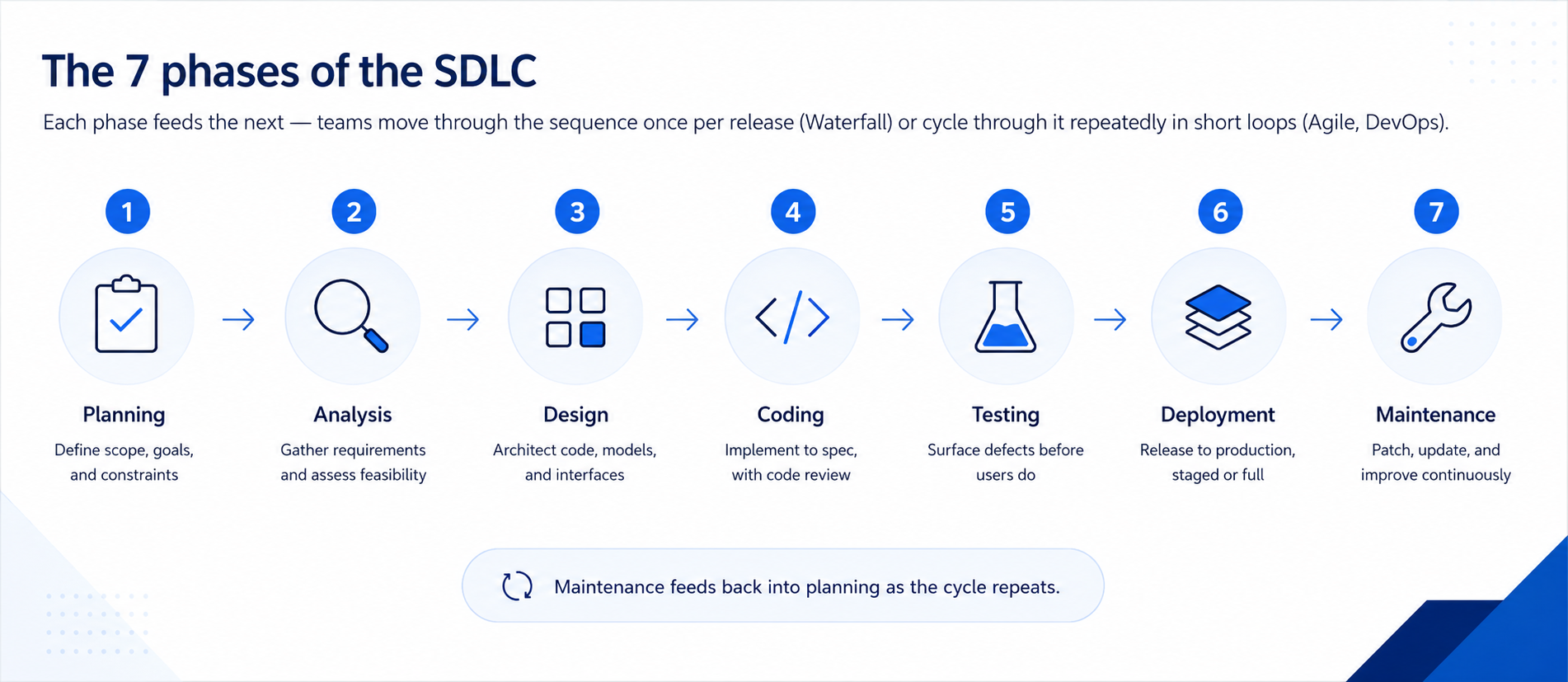
The planning phase defines the project’s scope, goals, and constraints before anyone writes a line of code. Clarifying requirements early helps teams feel unified in their direction and reduces uncertainty.
You’ll want to be explicit about what the project is not going to do. Scope creep rarely comes from one dramatic decision; it comes from a lot of well-intentioned instances of “sure, we can add that.”
The analysis phase turns high-level goals into a practical implementation plan. Tasks for this phase involve gathering detailed requirements, running feasibility checks, and evaluating the technical and financial constraints they’ll be working within.
Emphasizing risk management here helps project managers feel secure and proactive about potential challenges.
Involve QA and security stakeholders early, not just after code is written. Ambiguous requests, edge cases, error states, or compliance needs turn into expensive rework two or three phases below.
Involve QA and security stakeholders early, not just after code is written.
Design translates requirements into architecture. Simply put: it’s how the software fits into its environment. This phase’s output is a software design document that developers use as their build reference.
Favor modular design. Independently deployable components are easier to test in isolation, and they’re easier to hand off between teams.
This is the commonly known implementation phase, where the design becomes working software. Development teams write their code based on the spec set in the previous two phases. Moreover, it perfectly complements the phase below: testing.
A robust code and PR mindset from early on is necessary at this step. A second set of eyes, especially from more experienced engineers, is more than an optional courtesy and catches mistakes that might be invisible to the author of the code.
Testing is where defects, usability issues, and performance problems get surfaced before they roam free in production. AI and its force-multiplying capabilities have greatly influenced testing, empowering QA engineers to feel innovative and at the forefront of technological change.
Don’t treat testing as a single gate at the end or as a static process. Continuous testing—running tests throughout development instead of only before release—helps teams feel confident in their quality assurance efforts and trust that issues are caught early when they are safe to fix.
Deployment moves finished software to production, whether that’s a full public release or a canary or staged rollout to a limited group first.
Use a beta, canary, or phased release when the blast radius of a bad deploy is high. Watching real usage on a limited rollout is always easier to contain compared to a rollback after a full release.
Maintenance is where everything above falls into place. Involves everything that happens after launch: patches, updates, bug fixes, and adjustments as real-world usage reveals what the design phase didn’t anticipate, plus bugs missed.
Track and analyze defects systematically to get better at preventing the next one.
Getting several hundred people to test consistently, with a shared set of metrics, was a persistent challenge as the organization scaled.
Wolters Kluwer’s Quality Engineering Center of Excellence was responsible for hundreds of applications and roughly half a dozen major platforms, spanning legacy technology alongside newer cloud environments.
Getting several hundred people to test consistently, with a shared set of metrics, was a persistent challenge as the organization scaled.
The team standardized on Tricentis qTest as its test management system to centralize testing across its toolset, then adopted Tricentis Agentic Test Creation (ATC) to generate test cases, steps, and expected results directly from requirements.
Wolters Kluwer achieved 100% automation at the UI and API levels for its core platform applications, and qTest users, a group that grew past 500, saw a 30% time savings in test case design after adopting agentic AI for test creation.
According to VP of Quality Engineering Paul DiGrazia, the shift moved release decisions from “gut feeling” to a data-driven process.
You can read more about this case study here.
While some best practices belong cleanly in a specific SDLC phase, some are agnostic to the whole cycle. Here are a few that come to mind:
Document decisions as you make them, not after the fact. Documentation written in hindsight tends to explain what happened rather than why, which makes it far less useful the next time someone has to make a similar call.
Keep requirements traceable from planning through testing. If you can’t point to which requirement a given test case validates, you won’t be confident in your test coverage.
Build a company-wide definition of “done” before development starts, and keep it updated during the entire workflow. Ambiguity here is one of the quieter ways scope creep and missed deadlines happen.
Confusion around when a software feature is “done” is common between the development team and non-technical users—a perfectly preventable source of frustration, especially during hot releases.
Build a company-wide definition of “done” before development starts, and keep it updated during the entire workflow
Shift-left testing means moving testing activities earlier in the SDLC, into design and coding, instead of treating it as a phase that only starts once development wraps. The earlier a defect is caught, the less it costs to fix.
CI/CD shortens the distance between writing code and learning whether it works. Every commit gets tested automatically, so defects surface within hours instead of at the end of a sprint or, worse, after release.
It also reduces the risk of any single deployment and increases the confidence of the development team in what they’re coding and releasing.
When releases happen frequently and in small increments, a bad change affects a smaller slice of functionality and is easier to roll back than a monolithic release that bundles months of work together.
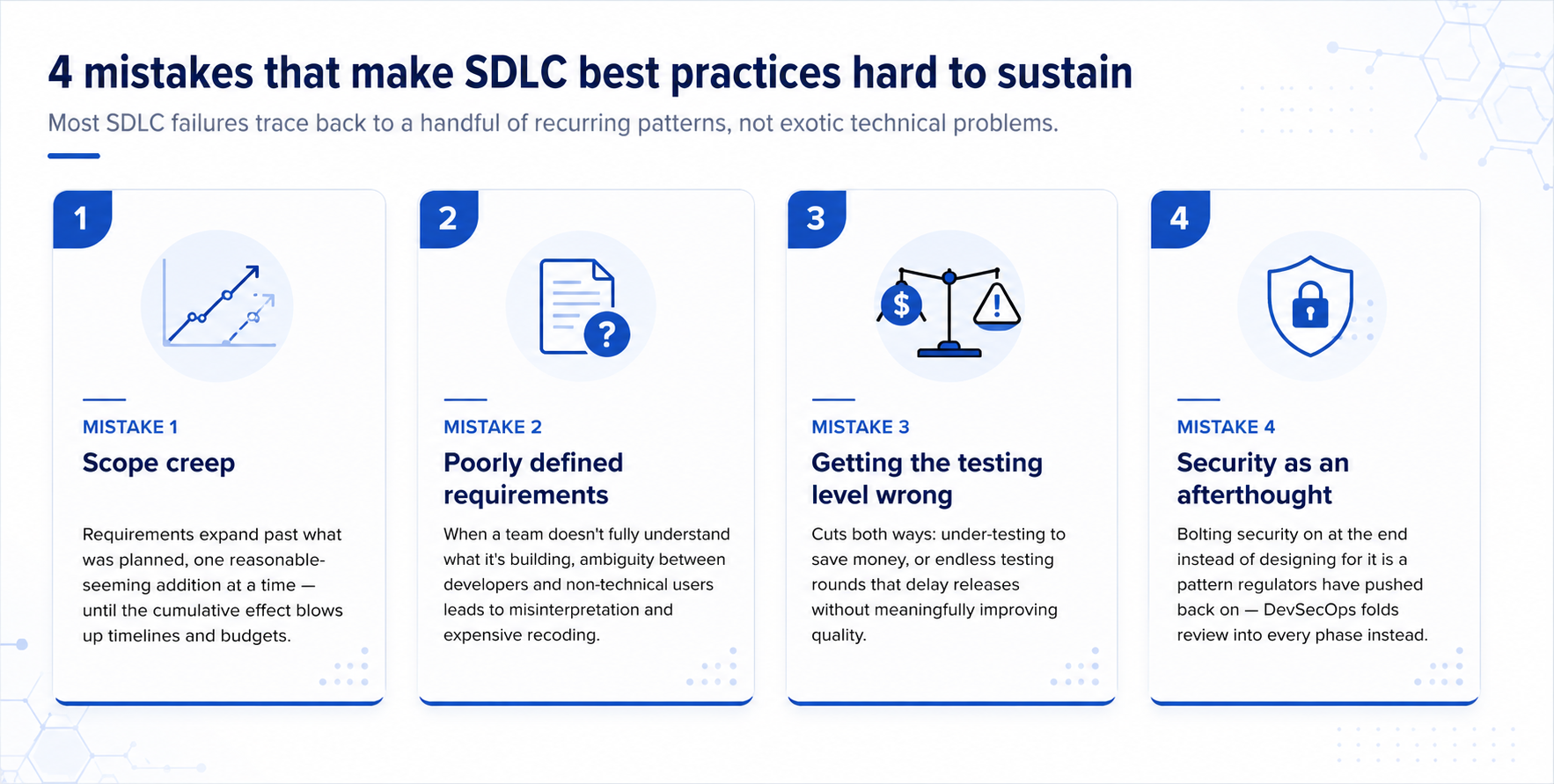
While not everything is as simple as following a script, rest assured—most SDLC failures trace back to a handful of recurring mistakes, not exotic technical problems.
Scope creep is when a project’s requirements expand past what was originally planned. Each addition seems reasonable; however, the cumulative effect blows up timelines and budgets.
Poorly defined requirements are close behind. When a team doesn’t fully understand what it’s building, or there’s ambiguity between the development team and the non-technical users (see the definition of “done” above), it can lead to misinterpretations and expensive recoding.
Misjudging what to test goes two ways. Some organizations under-test to save time and resources, while others push toward endless rounds of testing and over-alignment that delays releases without a measurable improvement of quality. Neither extreme serves the organization.
Security as a third-class concern is a pattern regulators have increasingly pushed back on. Practices like DevSecOps exist specifically to address this by folding security review into every phase instead of treating it as a final checkpoint.
Now that we’ve covered what the SDLC is and what can go wrong, your organization should be ready to start implementing a robust SDLC process. But it’s not that simple; you can’t improve what you don’t measure.
There’s no need to reinvent the wheel when it comes to measuring effectiveness. The DORA (DevOps Research and Assessment) framework provides a chart to measure the performance of the SDLC across five axes: deployment frequency, lead time for changes, failed deployment recovery time, change fail rate, and deployment rework rate.
Alongside the DORA metrics, plenty of teams track escaped defect rate (the number of bugs that make it to production despite testing) as a proxy for how well the earlier phases of the SDLC are actually working.
A rising escaped defect rate is usually a sign that something upstream, in requirements, design, or test coverage, needs attention before the next release.
When exchanging experiences and numbers against other quality teams, Tricentis’ ShiftSync community is a reasonable place to compare notes.
AI is all over every phase of the modern SDLC, from generating first-draft code to flagging patterns in test
AI is all over every phase of the modern SDLC, from generating first-draft code to flagging patterns in test. Coding and testing are where the shift is most concrete.
At its core, testing means comparing actual behavior against expected behavior. Spotting where the two diverge is exactly the kind of pattern-recognition task agentic systems are built for.
Having said that, AI isn’t a fix-it-all silver bullet. The DORA 2025 State of AI-assisted Software Development report found that AI acts as an amplifier of existing engineering practices rather than a fix for broken ones.
Teams with strong foundations get faster (and leaner) with AI; teams with fragmented processes tend to see that dysfunction amplified instead of resolved.
Agentic AI testing refers to AI systems that can independently plan, generate, and execute test cases from requirements, rather than simply assisting a human tester with suggestions.
Instead of a QA engineer manually translating a user story into test steps, an agentic system can draft the test cases, the steps, and the expected results directly from the requirement itself, and adjust as those requirements change.
None of this replaces the judgment of an experienced tester. It shifts that judgment away from repetitive test-case authoring and toward reviewing edge cases and deciding what’s actually worth testing.
See how Tricentis qTest’s Agentic Test Creation applies this at scale.
This post was written by Guillermo Salazar. Guillermo is a solutions architect and software engineer with 10+ years building large-scale systems across web, data, and cloud environments. He has held engineering leadership roles up to VP of Software Engineering, architecting cloud-native data platforms — including the operational intelligence system whose insights informed a $200M acquisition. He specializes in Snowflake, AWS (Glue, SageMaker, Lambda), FastAPI, and Microsoft 365 / Google Workspace platforms, and holds AWS Solutions Architect, Developer, AI Practitioner, and Cloud Practitioner certifications.
Learn more about how to scale, orchestrate, and accelerate test automation for complete visibility into your testing process.
Learn more about how to scale, orchestrate, and accelerate test automation for complete visibility into your testing process.

The seven phases are planning, analysis, design, coding, testing, deployment, and maintenance. Each phase has input, output, and functional owners.
Some frameworks label the early phases slightly differently (for instance, splitting out a separate feasibility analysis step), but the same seven-part structure holds across most descriptions of the SDLC.
The 40/20/40 rule is a rough guideline for allocating project effort: about 40% to analysis and design, 20% to coding, and 40% to integration and testing.
It’s a metric popularized in software engineering literature; its point is simply that writing code is a smaller share of the work than planning and testing combined.
Also known as the Pareto principle, the “rule” describes how a small portion of a codebase tends to generate a disproportionate share of defects, complexity, or maintenance work.
Product owners use it to prioritize: find the modules or features responsible for the most bugs or the most usage, and focus review and refactoring effort there first.
There isn’t one best methodology; it depends on the project and your team. Waterfall suits small, well-defined projects with stable requirements, while Agile fits larger, evolving projects that need frequent stakeholder input.
AI is showing up across most SDLC phases, from code generation to automated test case creation, but adoption is more uneven than what’s suggested by the hype.
Artificial intelligence amplifies existing engineering practices (good or bad) rather than magically fixing broken ones, and most teams aren’t using AI in their CI/CD pipelines specifically.