

Webinars
Agentic Test Creation: AI-driven creation, analysis, and management
Boost release confidence with AI driven test creation that focuses...
Learn what shift left testing is, how it works, its benefits, implementation best practices, and how to improve software quality by testing earlier.
TL;DR
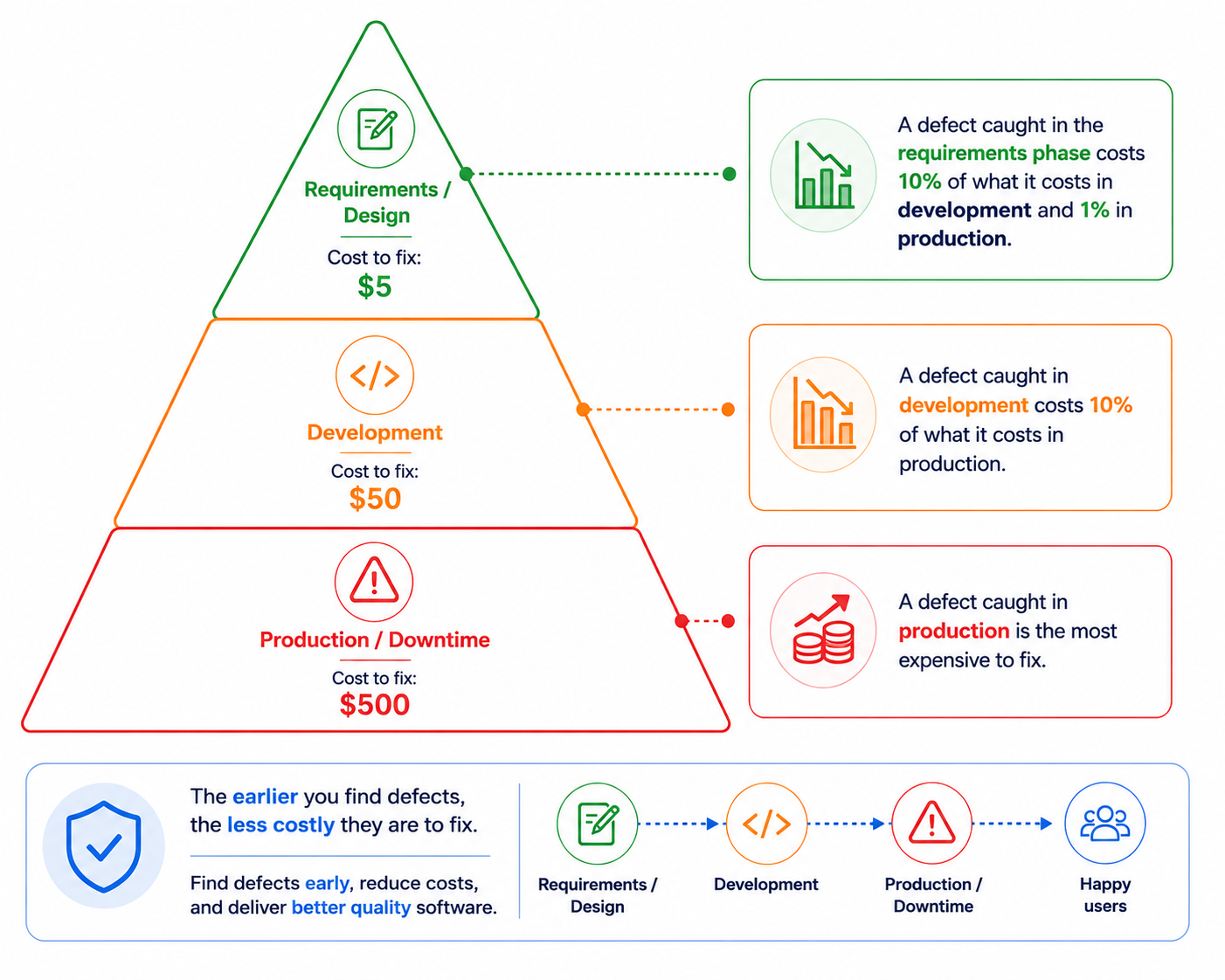
In software development, timing doesn’t just drive speed to market. It has an impact on your entire cost structure. Consider the 1-10-100 rule of quality control; a defect caught in the requirements phase costs 10% of what it does to fix in development and 1% of the expense to fix it in production.
Despite this reality, some engineering organizations still view QA as the last, isolated gate at the end of a sprint. Developers write code as quickly as they can, sometimes with AI tools that double or triple their speed, hand it off to QA, and move on to the next set of features.
The results are release bottlenecks, context switches for developers so they can fix “old” code, and frantic fixes to production issues.
Shift-left testing breaks down the traditional pipeline by moving quality checks up to the earliest possible stages of the software development lifecycle (SDLC). Instead of treating testing as the inspection phase at the end of the process, it’s shifted to the left: the beginning of the process.
This introductory guide is a complete blueprint for understanding and adopting shift-left testing, including:
Shift-left testing is an approach to continuous quality that moves testing to the earliest possible stages of the software development lifecycle (SDLC).
In a traditional development timeline, testing sits on the right. It acts as a late-stage gate applied immediately before deployment. Shift-left literally shifts that activity to the left. It embeds quality assurance into design meetings, architectural reviews, and sprint planning before developers write any code.
Rather than treating QA engineers as gatekeepers whose job it is to catch bugs after the fact, shift-left establishes them as quality advisors.
This shift to the beginning of the lifecycle reflects an underlying philosophy and a change in mindset. Quality is a proactive endeavor, not a reactive phase.
Rather than treating QA engineers as gatekeepers whose job it is to catch bugs after the fact, shift-left establishes them as quality advisors.
They help build software correctly from the ground up. Most critically in this model, developers, testers, product owners, operations, and security teams share collective responsibility for quality across the entire pipeline.
While that simple definition of shift-left testing focuses on moving testing to the beginning of the lifecycle, it isn’t just about running tests earlier instead of later. It spans the entire development process:
Shift-left turns testing into an ongoing conversation and a continuous process. This replaces high-risk “big bang” releases with a steady stream of quality software.
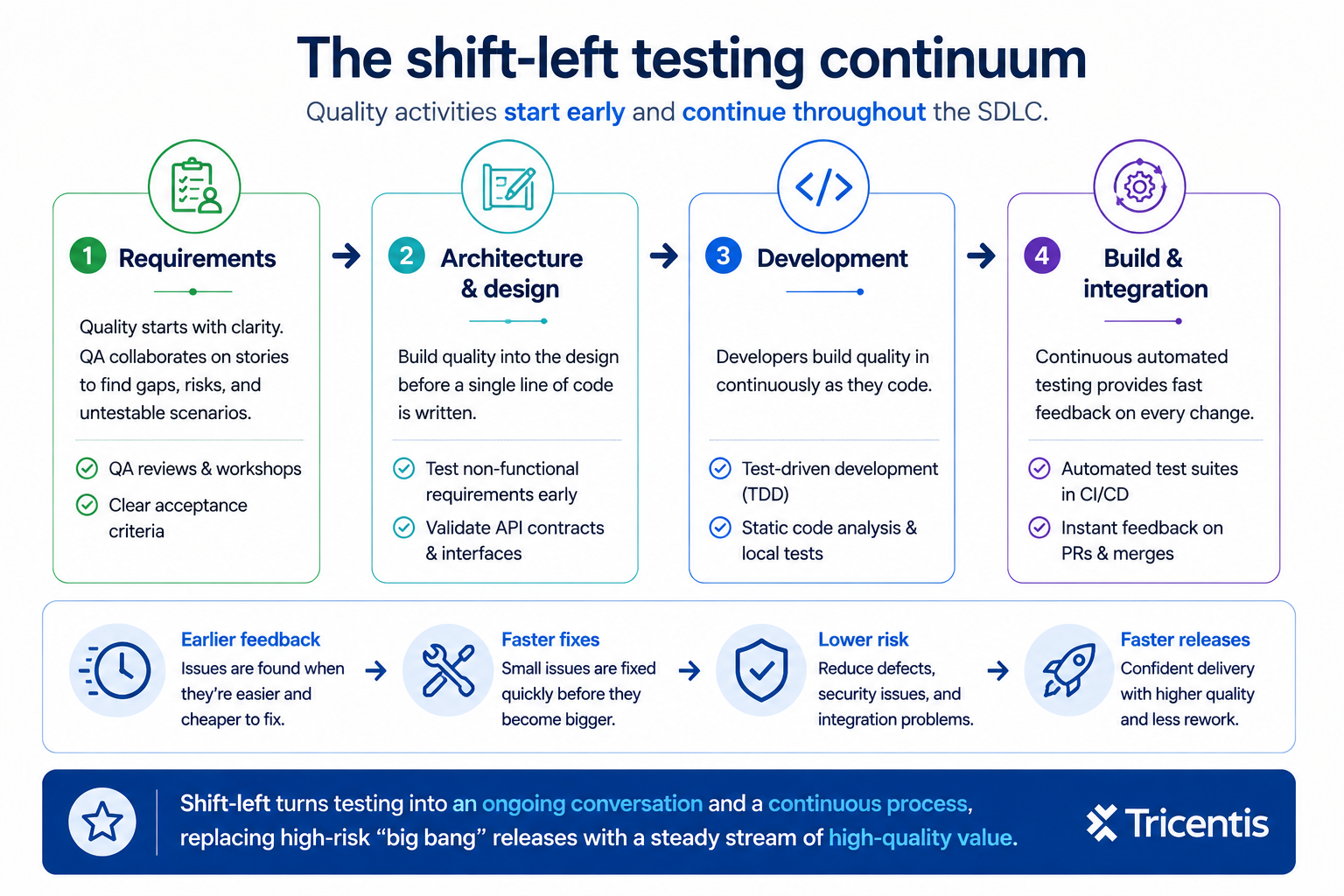
Shifting left will have a significant impact on your software organization’s ability to deliver quality software at speed and scale.
The 1-10-100 rule mentioned earlier illustrates the financial benefits of preventing defects at the start of the SDLC instead of discovering them down the line.
Fixing a flaw in a requirement or avoiding a logic problem in the initial design costs a fraction of what it takes to remediate the same problem in QA—or worse, patch it in production. Shifting left prevents a minor issue from compounding into expensive technical debt or deficiencies.
When testing is performed at the end of a sprint, it becomes a potential release bottleneck. Unscheduled bug-fixing cycles derail delivery schedules and lead to missed and potentially unknowable launch dates.
By catching and resolving defects on the spot during development, software arrives at the end of the pipeline ready for deployment. This shortens the cycles, makes dates more predictable, and enables frequent deployments since software is always ready to deploy.
“The essence of my philosophy to software delivery is to build software so that it is always in a state where it could be put into production.”
— Martin Fowler
Testing late in the cycle typically catches surface-level UI bugs and shallow functional issues. But it rarely uncovers fundamental architectural problems early enough to fix them cleanly, rather than applying quick fixes or temporary patches.
Early involvement from QA and automated testing forces teams to write modular, testable, and maintainable code from the beginning. So, code is more resilient and scalable, and systemic problems are caught earlier.
In traditional organizations, there’s a natural friction between developers who are pushed to release new features quickly and QA teams responsible for blocking unsafe releases. Shift-left breaks down silos and removes this “us vs. them” clash.
Depending on where your teams are right now, early testing can take several distinct shapes along the software delivery lifecycle.
Shifting left isn’t a one-size-fits-all practice. Depending on where your teams are right now, early testing can take several distinct shapes along the software delivery lifecycle.
This approach to shift-left focuses on lower-level developer testing, making it easier to catch code defects before units are integrated.
A common approach in enterprise environments that are transitioning from waterfall to modern frameworks, incremental shift-left breaks complex software into smaller increments.
In existing continuous delivery environments, testing is promoted to an active participant in the entire process, including feature specification and automated execution instead of a separate phase.
Model-based shift-left starts testing before development produces the first line of code. This attempts to prevent issues caused by flawed specifications.
Moving from a traditional testing model to a shift-left strategy requires both technical upgrades and cultural changes. So, to avoid disrupting your delivery schedules and triggering overwhelmed development teams and team member backlash, adopt a phased approach.
Here are some of the key phases to keep in mind as you formulate your plans.
Stronger cross-functional collaboration doesn’t happen overnight, and sometimes, rather than happily working together, teams actively resist the shift. Developers might view testing as an added burden, while QA engineers might see the shift as a threat to their roles.
Embedding quality during the planning phase prevents flawed requirements from reaching clients.
Shift-left has to begin before developers start producing code. Embedding quality during the planning phase prevents flawed requirements from reaching clients.
An effective way to shift-left without creating additional developer friction is to automate tests in your workflows.
You can’t establish early testing without test environments that are available on demand and realistic sample data.
| Focus | Traditional testing | Shift-left testing |
| Timing | Late; after the build phase | Early and continuous; starts during requirements and design |
| Objective | Detecting defects before deployment | Preventing defects and design gaps before they are built and packaged |
| Feedback speed | Slow; developers receive defect reports days or weeks after pushing changes | Immediate; developers receive test results from local tests or automated tests when they push their code |
| Release velocity | Slower; testing is a bottleneck before deployment | Faster; enables continuous integration and deployment |
| Risk profile | High risk of discovering critical problems at time of release | Lower risk of discovering flaws at release since testing is performed at every stage |
Agile development and shift-left testing are natural partners. Agile thrives on short iterative cycles, rapid feedback, and continuous adaptation, and those things are difficult to achieve if testing is an isolated checkpoint at the end of a sprint.
Shifting left embeds testing directly into every step in a cycle, transforming QA from a delayed downstream gate to an active driver of velocity.
If you align your early testing properly, it ensures that your user stories are validated incrementally, your code is delivered production-ready, and sprints close with working software.
Here are the best practices agile teams can follow to gain these benefits:
QA engineers and developers should work side by side to define test scenarios with concrete acceptance criteria.
Never postpone test planning to the sprint review or hardening phases. QA engineers and developers should work side by side to define test scenarios with concrete acceptance criteria. If a user story lacks clear test criteria, ideally criteria that they verify with automated tests, it’s not ready for development.
Catch syntax errors, security issues, and code smells on the fly before code reviews begin. Integrating static analysis directly into developer IDEs, commit hooks, and pull-request workflows enforces uniform code standards across the team with no extra effort.
Writing and maintaining test scripts by hand in development creates significant overhead for QA teams, especially as AI code assistants make producing new code easier for developers.
Leveraging AI-driven and agentic test creation tools to build test cases automatically as features are designed relieves this stress. The right tools analyze requirements and UI components to draft test scripts, allowing developers and testers to focus on higher-leverage tasks.
Large code merges slow down feedback, complicate troubleshooting, and increase deployment risks.
Encourage developers to submit smaller, atomic pull requests, and batch them into small, targeted releases. Running targeted unit and integration tests on smaller changes makes it easier to isolate and fix issues within minutes rather than days.
Shift your focus from vanity metrics, like raw bug counts or total test cases executed, to indicators that measure quality and delivery speed:
The benefits to shifting left are undeniable, but transitioning to an early testing model is rarely without complications. You’ll need to find your way around technical, structural, and cultural hurdles before the move succeeds.
Developers often see testing as an unwelcome interruption and an unfair additional responsibility.
Avoid adding or imposing manual testing steps. Embed quality tools directly into their workspace, especially as pre-commit hooks and automated pull-request checks that integrate into their existing workflow.
Running comprehensive test suites on every pull request can turn five-minute build pipelines into 45-minute obstacles. This destroys developer productivity and often leads to tests being disabled completely.
Set up smart test selection and execution. Run fast unit tests and static analysis on local commits, and reserve integration suites for pull requests and comprehensive tests for CI pipeline builds.
Early testing requires access to accurate and realistic test data, as well as environments that match production as closely as possible. If developers have to wait hours for staging environment access or stop work to manually seed mock databases, testing will stall or be skipped.
Build containerized, ephemeral test environments with technologies like Docker and Kubernetes and pair them with automated, synthetic test data creation to provide developers and testing engineers with clean, isolated environments.
Developers lack deep expertise in non-functional areas, such as security or edge-case validation, while traditional QA testers struggle with coding and pipeline configurations.
Position QA engineers as quality coaches. Rather than executing manual tests, they work alongside developers to design automated frameworks and pair program with them to refine their skills, too.
Removing the divide between development and testing changes quality assurance from a late-stage gate to an active driver of engineering velocity, system stability, and innovation.
Shift-left testing is more than a tactical adjustment to when and how you execute quality assurance. It’s a cultural and operational shift for your software teams.
Removing the divide between development and testing changes quality assurance from a late-stage gate to an active driver of engineering velocity, system stability, and innovation.
When your teams catch defects early in the SDLC, such as in user story definition, static analysis, or automated testing, the positive impact is immediate. Development costs drop, release cycles shrink, and production incidents decrease.
Here’s a case study outlining how a major healthcare insurer succeeded with shift-left testing.
As the second largest dental benefits administrator in the U.S., DentaQuest runs critical applications that serve more than thirty million members. Their development team was struggling with common performance testing issues:
DentaQuest replaced their legacy solution with Tricentis Neoload, allowing them to integrate load testing and APM testing into their development framework.
This moved their performance left, earlier in the lifecycle, so the team could evaluate low-level components and API endpoints before the system was completely integrated.
Learn more about this case study here.
As software architectures grow more complex and delivery expectations accelerate, teams need tools like Tricentis qTest to orchestrate and automate their continuous quality strategies.
Ready to modernize your testing strategy, eliminate release bottlenecks, and unleash your development velocity? Discover how Tricentis qTest and Agentic Test Creation empower engineering teams to automate quality seamlessly from the very first commit.
This post was written by Eric Goebelbecker. Eric has worked in the financial markets in New York City for 25 years, developing infrastructure for market data and financial information exchange (FIX) protocol networks. He loves to talk about what makes teams effective (or not so effective!).
Learn more about how to scale, orchestrate, and accelerate test automation for complete visibility into your testing process.
Learn more about how to scale, orchestrate, and accelerate test automation for complete visibility into your testing process.

The four types of shift-left testing are traditional, incremental, agile/DevOps and model-based.
Shift-left testing is a strategy to move quality assurance earlier into the software development lifecycle, while test-driven development (TDD) is a developer practice where unit tests are written before the code.
While TDD can be considered a good tactic for shift-left at the implementation level, shift-left includes non-coding activities like planning, architecture risk assessments, and continuous integration testing.
In QA, shift-left means moving testing and quality control to the “left” side of the project timeline, so they occur during the early planning and development phases rather than at the end.
By shifting left, teams discover and resolve defects early in the lifecycle when they are faster and cheaper to fix, transforming QA from a final step to a continuous quality discipline.