
AI-powered test optimization with Tricentis Testim and SeaLights
See how Tricentis Testim and SeaLights combine AI-powered automation...
Tricentis qTest and SeaLights work together to close AI-generated test gaps by combining user-story-based test creation with deep code coverage insights—enabling a fully automated, feedback-driven testing loop.
In today’s fast‑moving software world, release velocity keeps climbing, and AI is accelerating it even further. To keep quality teams aligned with rapid change, we’ve brought together two powerful capabilities: Tricentis SeaLights’ deep code-level insights and Tricentis qTest’s intelligent test management and AI-generated test creation.
Here’s how these technologies integrate to create a complete, AI-driven testing feedback loop.
Most organizations already use tools that generate tests directly from user stories. Tricentis qTest supports this through agentic test creation (ATC), which creates test cases from requirements in Jira. Those tests are then executed, and SeaLights monitors their behavior to understand:
This gives teams immediate clarity into which modified code is covered and what remains untested.
AI-generated tests are only as good as the user stories they’re built from. If a user story is vague, incomplete, or lacking edge cases, the resulting tests will be limited too.
This is where SeaLights comes in.
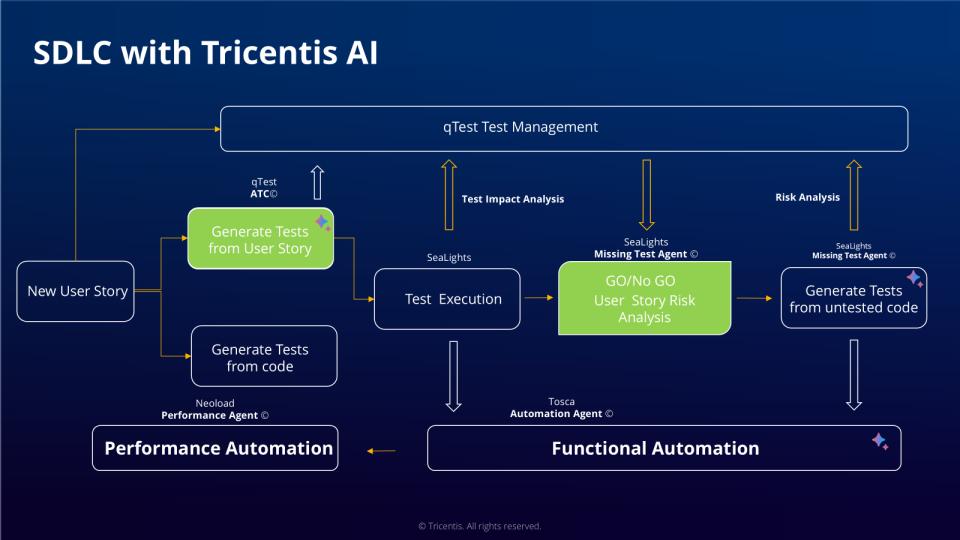
By capturing code coverage during test execution across qTest, SeaLights identifies exactly which methods remain untested. These untested methods are critical clues: they represent real gaps in your test suite that user-story-based AI alone cannot fill.
SeaLights then returns these untested areas back into the AI process, giving qTest’s agent more context to generate additional, richer tests.
This integration forms a closed-loop pipeline where requirements, code behavior, and AI work together. Instead of treating test creation and test execution as separate activities, qTest and SeaLights synchronize them so teams can automatically identify gaps and generate the exact tests needed to close them.
Here’s what that looks like.
Teams begin with user stories, often created by product managers, and increasingly with support from AI. Those user stories lead to code changes and initial tests. This ensures the entire workflow is anchored to business intent from the very beginning. Every test downstream is automatically traceable to the requirement that triggered the code change.
Using ATC, qTest automatically converts user stories into structured test cases. ATC standardizes the structure and quality of initial tests, giving teams a consistent baseline before deeper coverage analysis begins. It also frees teams from manual test writing for straightforward requirements.
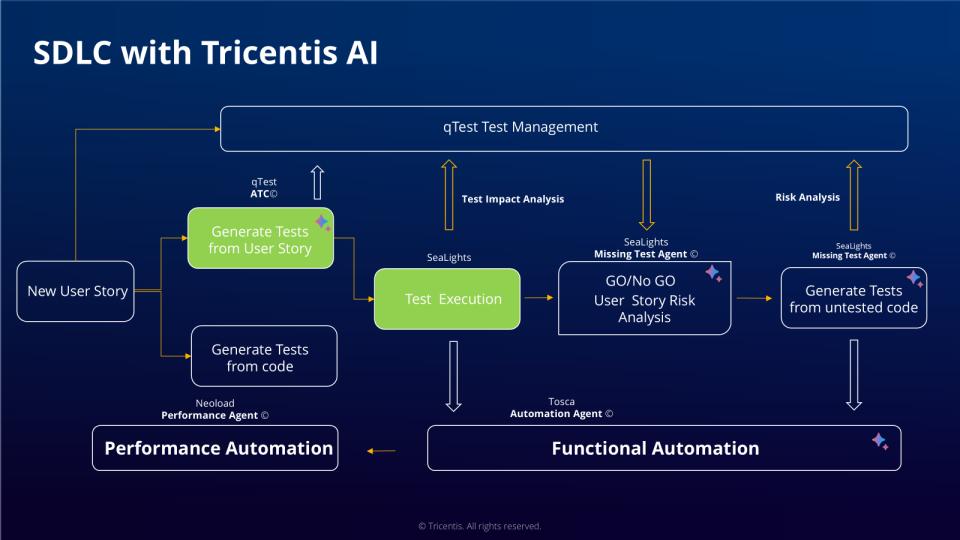
When those tests run, SeaLights tracks:
This goes beyond traditional unit test coverage. SeaLights captures full lifecycle coverage, across functional tests, integration tests, and more.
For example, in a given user story, SeaLights might detect 44 modified methods. It then breaks down exactly how many of those were exercised during testing and how many were not.
By correlating tests to the exact code they touch, SeaLights exposes gaps that would otherwise stay hidden until late in the release cycle. This provides engineering and QA with an objective, code‑driven view of test completeness, not just what was “expected” to be covered.
This is where the integration becomes transformative.
The AI agent now pulls in:
Using this richer context, the agent analyzes the business intent of the untested code and automatically generates new test cases to expand coverage.
This step bridges the gap between requirement-based test creation and actual code behavior. Instead of relying solely on human-written stories, the AI grounds its new tests in real, observable code paths, dramatically improving accuracy and reducing risk.
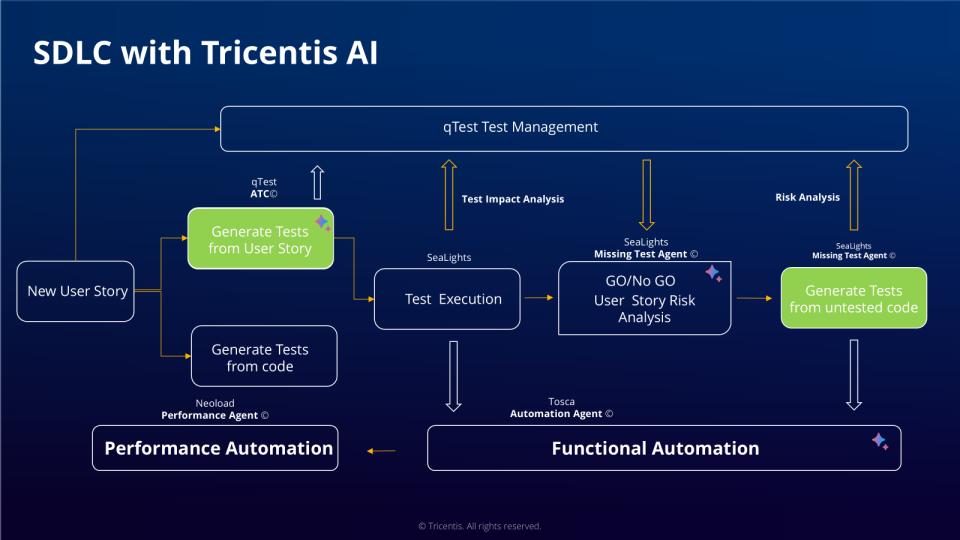
Once created, these new tests are pushed directly into qTest to complete the loop.
Teams now have:
This is all connected, automated, and traceable back to business requirements.
Together, these steps turn your test suite into a living system — one that adapts to every code change, detects blind spots automatically, and continuously generates the tests required to maintain high confidence in release quality.
With this integration, Tricentis delivers truly end-to-end intelligence:
This is the future of autonomous, intelligent quality — where test suites evolve automatically as code changes, and teams gain unprecedented visibility into release readiness.
See the integration in action, from Jira to qTest to SeaLights and back again. Watch it here.