

Webinars
Scaling test automation in a remote work environment: Best practices for distributed execution and API testing
Learn with us as we share best practices for overcoming testing scale...
In this post, you’ll learn when and how to use distributed testing to validate performance, reliability, etc. under unpredictable conditions.

Imagine launching a new feature at your start-up and suddenly getting huge spikes of traffic every month. In an ideal world, you need to test for that. You need to know how your app behaves under real-world load, not just a few hundred users on your laptop. That’s where distributed testing comes in.
In this post, we’ll show you what distributed testing is, why it matters, and how to get started creating your own distributed test environments. We’ll dive into how to simulate realistic traffic patterns, coordinate multiple testing machines, and collect meaningful results so you can find bottlenecks before your users do.
Whether you’re running microservices, APIs, or a monolithic app, you’ll learn when and how to use distributed testing to validate performance, reliability, and scalability under unpredictable conditions.
Put simply, distributed testing is basically a testing method where you run tests on your application using multiple machines at the same time, instead of relying on just one machine.
Let me introduce you to my imaginary friend Peter. Imagine Peter is holding a 2,000-pound elephant on his back. That’s basically your application under load. But distributed testing isn’t just asking, “Can Peter hold the elephant?” It’s asking, “Can he hold it for a minute? For an hour? For three days? Can he walk with it on his back?”
Put simply, distributed testing is a testing method where you run tests on your application using multiple machines at the same time, instead of relying on just one machine. The idea is to spread the test load across several computers to better simulate how real users interact with your app from different places.
Think of it like trying to simulate a big crowd visiting your website, not with just one test runner alone, but with a whole team of testers spread around the world, all testing together. This setup creates a more realistic environment because the tests can interact with each other, syncing their actions like real users would.
This method helps uncover problems that only show up when your app handles heavy traffic from many sources at once. Traditional testing from just one machine can’t realistically recreate those conditions because it’s limited in how much load it can generate.
You know, back when I was working for a start-up, we had this routine where every month, when the main API had huge spikes of traffic, we’d go and run performance tests a couple of days before. Why? Because we knew that particular week would bring massive traffic. That experience taught me something crucial: You can’t just guess when your system will break under pressure.
So, when should you actually use distributed testing? Well, if you’re telling me you’re doing load testing from your laptop or sending company-wide emails asking everyone to hit refresh at 9:05 a.m., that’s not real performance testing. Let me share some scenarios where distributed testing actually makes sense.
Think about a new phone launch scenario. At 8:55 a.m., nobody’s connected to your site, but at 8:59 a.m., suddenly five million people are trying to buy that shiny new device, and by 9:55 a.m., it’s out of stock and traffic drops back to zero. A single testing machine simply can’t simulate that kind of spike realistically. You need multiple machines working together to create that surge and then the sudden drop-off.
Geographic distribution is another big one. Your users aren’t all sitting in the same data center as your test machine. They’re spread across continents, dealing with different network conditions, latency, and bandwidth limitations.
Complex architectures with microservices, APIs, and interdependent components also scream for distributed testing. These systems have lots of moving parts that talk to each other, and you need to understand how they behave when our Peter is holding that 2,000-pound elephant. Remember: not just if he can hold it, but for how long, and can he walk with it on his back?
But here’s the thing—distributed testing isn’t always necessary. Simple apps with predictable usage patterns might not need this complexity. The key is understanding your real-world usage and choosing the approach that matches those conditions.
Distributed testing relies on a few core concepts and an architecture that lets multiple machines work together.
Distributed testing relies on a few core concepts and an architecture that lets multiple machines work together. At the heart of it is the controller-worker model. The controller node acts like a conductor: It hosts the test plan, tells each worker machine what to do, and gathers data when the run finishes. Each worker machine then goes off and generates traffic all at once.
Remember Peter and the elephant? In a distributed setup, each worker is like a different friend helping Peter hold that 2,000-pound elephant. One friend might test how Peter handles the weight for a minute, another watches for how long he can stand under it, and a third might see whether he can walk across the room. Each perspective reveals different performance insights.
Let’s talk about the key architectural elements involved here:
With this architecture, you can scale horizontally easily. You can add more worker nodes to simulate larger loads or geographic distribution, and you can stress-test your app under conditions that mirror unpredictable real-world traffic.
You know how sometimes you set up something perfectly in your local environment, but when it goes live, everything breaks? That’s exactly what happened to us at the start-up I mentioned. We’d test locally and think everything was great, but when those monthly traffic spikes hit, we’d discover network issues, configuration problems, and all sorts of fun surprises.
Setting up a distributed test environment requires more planning than just spinning up a few virtual machines and hoping for the best. First, you need to figure out how many worker machines you actually need. Here’s a simple way to think about it: If one machine can handle 200 concurrent users reliably, and you want to simulate 1,000 users, you’ll need about five machines to distribute that load properly.
The tricky part is getting all these machines to talk to each other. Network configuration is where most people get stuck. All your machines need to be on the same subnet, and firewalls need to allow communication between the controller and workers.
Moreover, your target application has to be accessible from all testing nodes, too, which means coordinating with networking admins to make sure routing and access permissions are set up correctly. Load balancers and CDNs need to handle traffic from all your testing machines without blocking what looks like a coordinated attack.
The last piece is monitoring the whole setup once it’s running. You need visibility into all your testing nodes to catch resource constraints or sync problems before they mess up your results.
Unlike simple testing, in distributed testing, you need multiple machines working together without stepping on each other. Workload modeling isn’t just dividing users by machine count. You need realistic user patterns: For a retail website, maybe 60% browse, 25% purchase, 15% check accounts. Each behavior stresses your application differently.
Data management gets tricky fast. All workers can’t use the same test accounts or product IDs, as this will cause conflicts. Each worker needs its own data subset or sync mechanisms to prevent interference.
Test execution requires coordination. All machines must ramp up together, hit peak load simultaneously, and ramp down in sync. It’s like conducting an orchestra—if the violins start five minutes before the drums, you won’t get realistic results.
You also need to test real user journeys across services, not only isolated endpoints. Users log in, search, add to cart, check out, etc. These complex flows span multiple components, and that’s where distributed testing really shines.
Finally, results aggregation is challenging, since each worker generates separate logs and metrics. You need tools that collect distributed data and make sense of it.
Back at the start-up I mentioned before, we learned the hard way that you can’t just run a distributed test and hope for the best. You need eyes on everything.
“Performance testing is not about finding bugs but bottlenecks,” says Scott Barber, co-author of Performance Testing Guidance for Web Applications. This insight is especially crucial in distributed testing, where bottlenecks can appear anywhere. Real-time monitoring becomes crucial because you’re coordinating multiple machines across different locations. Unlike single-machine testing, where you can watch everything on one screen, distributed testing requires dashboards that show you what’s happening across all your worker nodes simultaneously.
For instance, in this case, the four golden signals (latency, traffic, errors, and saturation) become more important. You need centralized log aggregation because each worker generates its own performance data, error logs, and metrics. Tools like ELK Stack or Grafana help collect and correlate all this distributed information.
Moreover, results aggregation is where most teams struggle. Each worker node reports different response times, throughput numbers, and error rates. You need tools that can combine these into meaningful insights while preserving important regional variations that might indicate specific performance issues.
Test with new machines first to validate your setup before moving to large-scale runs.
Over the years, a few key practices have helped me avoid pitfalls.
Distributed testing isn’t just about throwing more machines at your performance problems; it’s about understanding how your application behaves in the messy, unpredictable real world.
So, whether you’re preparing for those monthly traffic spikes or launching your next big product, distributed testing gives you the confidence to say things like, “Yes, we can handle five million users,” instead of crossing your fingers and hoping for the best.
Start small, scale gradually, and remember: If you’re responsible for an application, you should be doing performance testing on it.
The investment in distributed testing infrastructure pays off when your users get the experience they deserve, even under the most demanding conditions. If you’d like to take your testing to the next level, explore the performance testing sources from Tricentis to discover how tools can streamline your distributed testing workflow.
Lastly, for more testing insights and best practices, check out these complete testing methodology guides.
This post was written by David Snatch. David is a cloud architect focused on implementing secure continuous delivery pipelines using Terraform, Kubernetes, and any other awesome tech that helps customers deliver results.
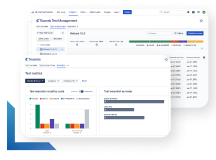
Learn how to supercharge your quality engineering journey with our advanced testing solutions.
Learn how to supercharge your quality engineering journey with our advanced testing solutions.