

Conference Highlights
Digital validation with Vera and qTest: modernizing compliance
Join this session to learn how Digital Validation, supported by Vera...
In this post, you’ll learn what compliance reporting is and why it’s important. We’ll also go over its benefits, challenges, and more.

Fundamentally, compliance reporting is how you prove your software development process actually meets the regulatory standards you’re supposed to follow. It guarantees that your software systems adhere to the necessary legal and regulatory requirements.
In this post, you’ll learn what compliance reporting is and why it’s important. We’ll also go over its benefits, challenges, best practices, and key regulations affecting it. Additionally, you’ll learn about Tricents Vera, the industry-trusted tool for seamlessly automating compliance reporting.
Compliance reporting is the process of maintaining clear records of how the entire software development and data management process adheres to internal and external guidelines, legal requirements, and industry best practices.
Through this reporting, teams demonstrate to stakeholders the steps they take to meet regulatory expectations.
As Evelyn Kampe and Aaron Massey put it in Perspectives on Regulatory Compliance in Software Engineering: “Compliance reviews within a software organization are internal attempts to verify regulatory and security requirements during product development before its release.”
In an organization, compliance reporting isn’t just for a select few. It’s everyone’s job in the development team. It must be a part of every phase of the software development life cycle (SDLC). Therefore, every team member (developer, QA, project manager, security, legal, audit, risk management, etc.) is responsible for it.
Compliance reporting is the process of maintaining clear records of how the entire software development and data management process adheres to internal and external guidelines, legal requirements, and industry best practices.
Now that we know compliance is a shared responsibility in the dev team, below is a quick overview of the contributions made by internal teams in meeting compliance regulations:
Operating a culture of compliance reporting guarantees the production of secure, high-quality, and compliant software. Other benefits include:
Auditable records can be provided as proof that the product complies with all mandatory regulatory requirements.
Demonstrates a verifiable ongoing commitment to data security and privacy, thereby fostering loyalty and market credibility and investor confidence.
Organizations avoid financial shocks by identifying and closing compliance gaps early.
Business continuity is ensured because entities are shielded from licence revocations and business shutdowns.
Streamlines the audit process, as proof of due diligence is readily available. Therefore, the audit process by external auditors is smooth, saves time, and is less stressful.
Different industries have distinct regulatory requirements. For example:
GDPR governs data protection in the EU. It requires strict controls on user data collection and processing.
PCI-DSS ensures secure handling of all payment card information.
ISO/IEC 27001 requires organizations to integrate security as a managed process within the SDLC. Mandates security compliance testing, penetration testing, and vulnerability scans to verify that all security scans are effective.
HIPAA mandates security measures for healthcare data in the US.
SOX focuses on financial reporting accuracy for public companies.
SOC 2 assures clients of data security, availability, processing integrity, confidentiality, and privacy. It’s critical for SaaS providers.
A robust compliance reporting system includes these key elements:
It links requirements (e.g., “GDPR data deletion”) to test cases, test results, and defects. Shows which compliance rules were tested, the results, and whether gaps exist.
Includes pass or fail rates for compliance tests, environment details (e.g., “Staging/Production”), timestamps, and who ran the test (TestExecutor ID). Crucial evidence that tests are done correctly and under the right environments.
All bugs found during compliance testing, severity levels (e.g., “Critical” for GDPR violations), root causes (e.g., “Code did not encrypt data”), and proof that issues are fixed. It demonstrates how compliance issues are identified and resolved.
Risks that still exist even after testing (e.g., “Third-party library might leak data”), and plans to mitigate these risks. Shows proactive management of compliance weaknesses.
Formal approval from QA and management, often with e-signatures for audit trails. It proves accountability and that compliance was reviewed.
For tracking who changes compliance documents (e.g., test plans, policies) and when changes were made. An immutable record of document changes that cannot be modified retroactively, thus ensuring that everyone is working from the latest approved version.
For tracking who accessed the compliance reports, what changes were made to the reports or configurations, and the timestamps for all these actions. It’s solid proof of the integrity of the compliance reporting system itself.
A centralized list of all the relevant regulations/standards (e.g., GDPR, HIPAA) and specific requirements (e.g., “Encrypt data in transit”). Ensures that teams understand what to comply with.
To build a strong and effective compliance strategy, consider these vital pillars:
Define exactly what compliance means for your team. Clearly outline your goals and the regulatory scope, thus specifying which regulations apply to your use case. This way, everyone is clear about the rules and the target.
Regularly review how well you’re following the rules to help identify issues before audits. This proactivity helps to catch problems before they get too complicated/expensive to fix.
Educate your team consistently in order to instill a culture of compliance in them. Compliance is only effective if every team member understands and follows the rules.
Perform third-party reviews to improve your compliance controls. An unbiased review builds trust and helps you resolve issues before regulators come in.
Compliance is only effective if every team member understands and follows the rules.
Here are some tips for effectively implementing compliance reporting in your organization:
Let’s quickly take a look at a few best practices for compliance reporting:
Keep a lookout for these common challenges in compliance reporting:
Tricentis Vera is a modern solution for your compliance reporting needs. It’s built to integrate seamlessly into your existing Agile and DevOps workflows, allowing teams to simplify the validation process without sacrificing compliance requirements or quality.
Integrating Vera greatly improves your compliance management:
Click here for a one-on-one demo on how Vera will work in your environment.
When you embed compliance reporting in your development process, from design to deployment, you ensure trust, accountability, risk reduction, and the delivery of software that customers can confidently rely on.
Compliance reporting is the backbone of ensuring the delivery of reliable software. When you embed compliance reporting in your development process, from design to deployment, you ensure trust, accountability, risk reduction, and the delivery of software that customers can confidently rely on.
Deploying a modern tool like Tricentis Vera in your workflow helps you simplify your compliance process. The result? Quicker and more streamlined releases, high-quality software, and peace of mind, knowing you’re not breaching any legal and industry regulations.
Compliance reporting is not optional, and it should not be treated as an afterthought either. Start early, use the right tools, and experience the benefits it brings to you, your team, your organization, and your customers.
This post was written by Emmanuel Adom. Emmanuel is a software engineer and QA tester specializing in end-to-end cross-platform development and quality assurance.
Outside of his technical work, he’s a dedicated musician who enjoys playing the piano, bass, and acoustic guitar in Christian music circles.
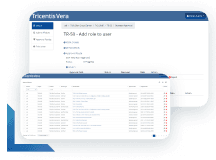
Learn how digital validation accelerates approval, verification, and compliance processes while ensuring compliance.
Learn how digital validation accelerates approval, verification, and compliance processes while ensuring compliance.