

Webinars
Test automation in 2026: Tosca in the cloud, agentic AI, and a smarter, more scalable future
Watch this webinar to hear two Tricentis experts discuss what’s next...
Discover what MCP servers do for automated testing and how they streamline UI, API, and mobile test workflows in modern pipelines.

TL;DR:
Last quarter, our QA team tried to wire an AI assistant into an automation stack. We had UI, API, and performance coverage, but every time we wanted the AI to trigger a test run or summarize results, we had to build a one-off connector.
Each tool spoke its own language, and every new workflow added another brittle bridge.
This guide explains why an MCP server for test automation matters, how to use MCP with your stack, and how Tricentis brings MCP to enterprise-scale testing.
Model context protocol (MCP) is a standardized API layer that lets AI systems discover and invoke tools in a structured, secure way. Instead of hardcoding every integration, MCP gives AI assistants a consistent interface for the actions your testing tools already support.
An MCP server is the runtime endpoint that exposes those tools, enforces authentication, and translates AI requests into test actions.
It’s basically the boundary where natural language becomes authorized execution. Once we wrapped our heads around that, things started clicking.
As Tricentis describes it, MCPs create a standardized API, so AI tools can communicate with testing platforms and external services without custom plumbing.
One line I keep coming back to is from Tricentis’s own AI leadership, Dave Colwell (VP of AI and ML): “An MCP is kind of like a UI for AI… the AI’s way of understanding how to use your product.”
Natural language becomes executable test operations.
An MCP is kind of like a UI for AI… the AI’s way of understanding how to use your product.
Test automation is strong, but the workflows around it are not.
Our team still spends hours translating intent into test runs and writing scripts just to answer basic questions like, “What failed in the last regression?” MCP changes that by turning your testing tools into AI-addressable services.
Key benefits show up fast (we noticed these within the first few sprints):
Short takeaway: MCP reduces the glue code that slows down test automation at scale.
The way I explain it to new team members: think of MCP as a translator plus a gatekeeper.
That loop is the core pattern for UI regression, API validation, and performance analysis. We’ve been running this pattern for about six months now, and it holds up.
Here is a practical comparison that helps teams align expectations:
| Integration Style | What It Looks Like | Operational Impact |
|---|---|---|
| Custom scripts & APIs | Each tool has its own adapter and auth flow | High maintenance, brittle changes |
| MCP server | One standardized protocol for tool discovery and execution | Reusable workflows, faster onboarding |
When teams adopt MCP, the most successful rollouts start small, then scale. We learned this the hard way after trying to expose everything on day one.
A good MCP rollout doesn’t replace your automation suite. It makes it dramatically easier to operate.
Treat MCP like any production API: define user scopes, tokens, and audit trails.
Here are realistic, high-impact workflows teams implement first. I’ve seen all three of these work in practice:
The difference between a demo and a production-grade MCP rollout is operational discipline.
The goal is to make MCP predictable, not magical. Trust me on this one.
MCP isn’t hard, but there are a few predictable friction points. We hit most of these ourselves:
MCP lets AI act. Agentic AI lets AI plan, iterate, and improve. Together, they make test automation feel less like a script and more like a feedback loop. This is where things got interesting for our team.
Here’s the practical bridge:
Together, MCP and Agentic AI make test automation feel less like a script and more like a feedback loop.
Tricentis is shipping MCP server for test automation across the testing stack so teams can connect AI assistants directly to enterprise testing workflows.
We’ve been evaluating a few of these and wanted to share what’s available. MCPs are available for Tricentis Tosca, qTest, NeoLoad, and SeaLights, all exposed through secure, remote API layers designed for AI-driven testing (Tricentis MCP overview).
See how Tricentis can enable AI-driven testing and modernize test automation across your enterprise.
This post was written by Rollend Xavier. Rollend is a senior software engineer and a freelance writer. He has over 18 years of experience in software development and cloud architecture, and he is based in Perth, Australia. He’s passionate about cloud platform adoption, DevOps, Azure, Terraform, and other cutting-edge technologies. He also writes articles and books to share his knowledge and insights with the world, including the book Automate Your Life: Streamline Your Daily Tasks with Python: 30 Powerful Ways to Streamline Your Daily Tasks with Python.
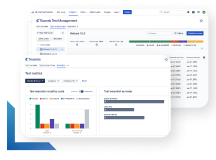
Learn how to supercharge your quality engineering journey with our advanced testing solutions.
Learn how to supercharge your quality engineering journey with our advanced testing solutions.
An MCP server for testing is a secure endpoint that exposes testing actions as structured tools so AI assistants can run tests, analyze results, and interact with your testing platforms.
You use MCP by connecting an AI assistant to your MCP server, selecting the tools you want to expose, and then triggering tests or reports with natural language prompts.
You need an MCP server because it standardizes how AI systems connect to testing tools, eliminating one-off integrations and making AI-powered workflows consistent and scalable.
Teams typically validate MCP servers with the same automated test frameworks they already use for UI, API, and performance testing, plus API checks that confirm tool schemas and responses.
An MCP server for browser testing exposes UI test actions as discoverable tools, so an AI assistant can run tests, retrieve results, and summarize failures in natural language.
Yes. Any AI assistant that supports MCP can connect to an MCP server once it’s configured and authorized to access the tools you expose.