

What is test case management: What it is and why it’s important
Discover the importance of test case management in software...
Discover the main types of QA testing tools, what features matter most, and how to choose QA testing tools that fit your team.

In software development, quality assurance (QA) testing is designed to ensure that each software release meets project requirements, provides a great user experience, and has as few bugs or defects as possible.
As more companies adopt DevOps and Agile methodologies for developing software, developers and testers require superior QA testing tools to help manage the task of testing software in Agile sprints and accelerated development timelines.
Before you evaluate vendors or shortlist platforms, it helps to zoom out and get clear on:
This guide covers each of these, then closes with practical best practices for using QA testing tools effectively.
QA testing tools fall into three general categories:
Test management tools assist QA teams with writing test cases for software based on project requirements. These tools help teams create, plan, and execute test cases and track bugs against requirements.
In modern teams, test management also means connecting test work to Agile user stories and sprint execution, and making it easy to report progress across releases.
When you evaluate tools in this category, focus on traceability (requirements -> tests -> defects), reporting that matches how your teams ship (sprint/releases dashboards), and integrations with the rest of your delivery toolchain.
Performance testing tools help QA teams evaluate the scalability and reliability of an application. These QA testing tools simulate performance in a distributed environment, testing maximum and minimum response times with different loads.
If your product has SLAs (or your users simply expect speed), performance tools help you catch regressions before production. Look for support for both API and user-journey load models, plus the ability to run performance checks as part of CI/CD.
In modern teams, test management also means connecting test work to Agile user stories and sprint execution, and making it easy to report progress across releases.
Functional testing tools evaluate discrete features or modules of software and report errors to the development or QA team. This category of tools includes tools for API testing, unit testing, multi-browser testing, and multi-device testing.
Functional testing tools can be used in different ways: some prioritize coded frameworks for developers, while others emphasize low-code or codeless authoring so QA and business teams can contribute. In practice, many organizations use a hybrid approach.
There are 10 essential capabilities to keep in mind as you compare QA testing tools.
QA testing tools must meet the needs of developers and test automation experts. Developers typically want tools that fit their languages, IDEs, and CI workflows. Test automation specialists often need stronger authoring, reusability, diagnostics, and suite maintenance features.
Enable users with nontechnical role business analysts, product owners, and subject matter experts to participate in testing. Low-code/codeless authoring, readable test cases, and safe role-based controls can make collaboration easier without sacrificing governance.
your teams to test across operating systems, browser types/versions, and mobile devices. If you ship to the public internet, real-device and real-browser coverage can prevent “works on my machine” issues from escaping.
Change impact analysis is the ability to prioritize tests based on code changes and risk. Instead of running every test every time, you can focus on the subset that validates what changed, reducing cycle time while protecting quality.
Tools with templates and accelerators (template libraries and wizards) can simplify testing for specific applications such as ServiceNow, Salesforce, or SAP. If your business depends on packaged apps or complex workflows, accelerators can reduce time-to-value.
Consider what kind of QA testing tools you’ll need to support various UI and API formats/protocols across desktop, web, mobile, AR/VR, IoT, and full-stack cloud application testing. Broad support helps you avoid tools sprawl as your architecture evolves.
Intelligent automation includes capabilities like AI and machine learning, self-healing technologies, bots, and automated test generation. The goal is to reduce the brittleness of automation, have faster authoring, and to lower maintenance over time.
Open-source support (and the ability to extend open-source frameworks) matters for portability and long-term flexibility. Even if you standardize on a commercial platform, teams often need APIs, SDKs, and integrations to connect everything cleanly.
DevOps tool integrations that should support DevOps, Agile planning, and ALM tools. Strong integrations keep test execution close to the pipeline and reduce manual reporting work.
Dashboards and analytics should track and analyze overall test progress, sprint-level test activities, and individual tests. Good analytics turn test data into release confidence and help leadership understand risk.
For broader foundational testing principles and terminology, the ISTQB CTFL syllabus is a useful reference. For security testing guidance, OWASP’s Web Security Testing Guide (WSTG) is a high-quality, community-maintained resource. You can find it here.
Below is a practical list of the industry’s top QA testing tools and platforms that teams commonly evaluate for modern quality engineering programs. The right choice will depend on your application portfolio, team skills, delivery cadence and governance needs.
UIPath’s agentic testing capabilities are designed to help teams accelerate testing across enterprise application ecosystems.
The platform emphasizes AI-driven approaches to generate, execute, and refine tests, and it’s commonly positioned for organizations looking to expand coverage without relying exclusively on hand-coded automation.
This type of approach can be especially helpful when you’re testing complex business processes that span multiple systems (for example, packaged apps plus custom web services) and you need repeatable regression coverage across frequent releases.
Keysight’s software testing offering (commonly associated with Eggplant) focuses on AI-powered software testing across platforms. Its focus is on teams that need end-to-end validation of digital experiences, including non-web environments and user journeys where reliability and monitoring matter.
This tool is advantageous when validating complex flows (not just UI pages) and you want testing to help inform release readiness as part of continuous delivery and quality engineering practices.
ACCELQ Autopilot is an AI-powered, codeless test automation tool that targets full-cycle automation (from scenario discovery through test creation and maintenance) It highlights autonomous capabilities intended to reduce the effort required to create and keep tests up to date.
Autopilot would be a great fit if your organization wants a faster ramp to automation, broader participation beyond specialist coders, and a consistent way to scale regression coverage across web, mobile, and APIs.
SmartBear is known for a broad portfolio of QA and developer tools across API testing, UI testing, and test management, with ongoing investment in AI-assisted workflows.
Organizations often shortlist SmartBear when they want to cover multiple testing layers, like API checks and UI validations, while keeping reporting and collaboration aligned across teams.
OpenText Functional Testing is positioned as an AI-powered functional testing tool that supports desktop, web, mobile, and enterprise applications. It emphasizes streamlining automation across many application types while reducing maintenance through object recognition and automation capabilities.
It’s commonly evaluated by teams modernizing legacy environments or supporting complex enterprise app portfolios where consistent automation across different technologies is a priority.
LambdaTest provides a cloud platform for browser and device testing, and it has expanded messaging around AI-driven testing and agent-based approaches. It’s typically considered for teams that need scalable cross-browser/device execution without maintaining in-house device labs.
If your users span many browsers and devices, cloud execution can shorten feedback loops by making it easy to validate changes quickly across environments, especially in CI/CD.
A helpful rule of thumb: a good QA tool doesn’t just run tests, it shortens feedback loops and makes risk visible.
BrowserStack is quite popular when cross-browser and real-device testing at scale is a top priority. It provides access to many browser/OS/device combinations via the cloud.
Teams often adopt BrowserStack to reduce the cost and complexity of maintaining physical device labs while still validating real-world compatibility issues that emulators can miss.
Applitools is best known for visual testing (“Visual AI”) helping teams catch UI regressions that functional assertings can miss. It’s often used to add visual confidence to existing automation, especially for design-heavy apps, dynamic layouts, and accessibility-sensitive experiences.
Consider Applitools when pixel-perfect changes matter (branding, layout, localization, responsive behavior) and you want your automated checks to validate what users actually see.
Katalon is an all-in-one automation platform for web, mobile, API, and desktop testing with an emphasis on AI-augmented productivity and flexible authoring.
Teams that want to standardize how tests are authored, executed, and reported—while still allowing advanced users to drop into code when needed for complex scenarios—will find Katalon a fantastic choice.
Qyrus positions itself as an AI-driven all-in-one software testing platform spanning web, mobile, API, and other testing needs, with a strong emphasis on simplifying testing workflows through no-code automation.
Organizations may consider Qyrus when they want to consolidate a fragmented toolchain and provide a simpler authoring experience for teams that need to scale testing quickly.
As an AI-native test automation platform for web and API testing, mabl changed the game for teams focused on maintainability and continuous testing workflows.
Additionally, it’s quite popular with teams that prioritize authoring speed and robust scripts in CI/CD, especially when frequent UI changes have historically caused flakiness and maintenance overhead.
Functionize promotes an AI-driven approach to end-to-end automation, including capabilities intended to reduce test maintenance via self-healing. It also emphasizes enabling non-technical contributors to participate in creating workflows.
Functionize can be a great asset when your team wants broad participation in automation, and you need to scale coverage across complex applications without spending all your time fixing brittle selectors.
Leapwork is a no-code automation platform that uses visual “flow” modeling to build and maintain automated tests. It’s designed to help teams create reusable components and scale automation across QA and business users, including end-to-end journeys that span multiple systems.
If you’re trying to expand automation beyond a small specialist group, visual authoring and composable building blocks can make it easier to standardize patterns and reduce duplication across projects.
Tricentis offers an AI-augmented software quality platform spanning test automation, test management, performance testing, and quality intelligence. Teams commonly prefer it when they want to unify testing across tools and teams while supporting both custom and enterprise applications. applications.
If your organization is standardizing quality engineering across multiple programs, a platform approach can reduce tool sprawl and create shared reporting, governance, and test assets across teams.
Now that we have a better understanding of the tools available on the market and their value proposition, let’s make sure we understand the best practices for using QA testing tools.
Narrow, purposeful tests are easier to understand and debug, and they fail for clearer reasons.
Each test should focus on a specific feature or a part of the user experience. Narrow, purposeful tests are easier to understand and debug, and they fail for clearer reasons. This also improves reuse: a focused “login succeeds” or “payment authorization fails gracefully” test can be combined into multiple suites without becoming fragile.
Central features of applications should be tested every time there are new additions to code. Frequent regression runs reduce risk and improve release confidence, especially when they’re part of a pipeline gate. Keep your regression suite trimmed: remove redundant tests and prioritize high-value user journeys.
Open-source tracking tools provide an inexpensive option, while proprietary tools can be customized to your specific workflow. Whatever you choose, standardize bug reporting so defects include reproducible steps, expected vs. actual results, environment details, and logs/screenshots where relevant.
Track specific QA metrics to determine where bugs are most likely to occur. This will help your teams design tests that address critical areas. Over time, analytics can highlight flaky tests, unstable environments, and high-risk components so you can improve both product quality and the health of your test suite.
Your QA testing tool should enable testing over a broad array of devices, operating systems, and user profiles. Aim to validate in environments that match production closely (browsers, device classes, data sets, feature flags). Cloud device/browser platforms can help when you need to scale without building labs.
Functional tests by human testers can deliver a better sense of the quality of an application’s UI. Pair automation with exploratory testing and visual validation, especially for critical user workflows. Tools that support visual testing can add coverage for layout changes that traditional assertions won’t catch.
A growing number of companies have adopted Agile and DevOps methodologies to accelerate software development and speed to market. To integrate testing into this software delivery model, many development and QA teams require QA testing tools that overcome the limitations of legacy systems.
Most legacy tools don’t integrate well with modern automation and delivery workflows, which makes it difficult to integrate testing into continuous delivery pipelines. Testing inevitably gets pushed to the end of the development sprint when fixing bugs becomes more difficult, time-consuming, and costly.
QA becomes a bottleneck, software releases are often delayed, and the quality of the product tends to suffer.
To accommodate testing in an Agile or DevOps environment, companies need QA testing tools that are:
Most legacy tools don’t integrate well with modern automation and delivery workflows, which makes it difficult to integrate testing into continuous delivery pipelines.
The Tricentis Continuous Testing platform provides a suite of QA testing tools that is totally automated, fully codeless, and intelligently driven by AI. With Tricentis, you can easily integrate testing into Agile and DevOps methodologies to dramatically accelerate software delivery, reduce costs, and improve quality across custom and enterprise apps.
The Tricentis platform of testing solutions supports all phases of testing and includes:
To learn more about testing fundamentals, approaches, and tooling, visit Tricentis Learn here.
If you’re evaluating AI-driven UI automation as part of the broader Tricentis ecosystem, you can also explore Tricentis Testim here.
A helpful rule of thumb: a good QA tool doesn’t just run tests, it shortens feedback loops and makes risk visible. When your toolchain reduces the time from code change to reliable signal, it’s easier to ship with confidence, keep quality work inside the sprint, and avoid “testing as a phase” at the end.
In practice, that usually means choosing tools that match the way your teams work: integrations into CI/CD, clear reporting for stakeholders, and automation that doesn’t become a maintenance burden. The topics discussed helped you translate those goals into concrete selection criteria and a focused shortlist.
Simplify your QA toolkit, request a demo to see how Tricentis unifies testing across tools and teams. Learn more here.
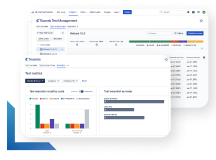
Learn how to supercharge your quality engineering journey with our advanced testing solutions.
Learn how to supercharge your quality engineering journey with our advanced testing solutions.
Quality assurance or QA testing tools are used by software development teams to ensure that their releases meet project requirements, offer a superior user experience, and are as free of bugs and defects as possible.
+QA testing tools allow developers and testers to manage testing, including writing appropriate test cases, executing cases, and tracking results.
QA testing tools may also test individual features or modules of software for bugs and defects. Performance testing tools reveal how well a piece of software can scale to accommodate many simultaneous users in distributed environments.
Start with the outcomes you need (release confidence, faster feedback, fewer regressions), then map tools to the testing layers you must cover (unit, API, UI, performance). Standardize reporting and ownership, and prioritize integrations so results are visible in the same workflow your teams already use (issue tracking, CI/CD, and test management).
To deepen your understanding:
Together, these resources and tools can help you design a QA strategy that scales with your products and teams—without overwhelming them.