

Webinars
Business driven testing: A 360 degree test approach designed by Dior
QA director at LVMH shares how they transformed testing and created...
Test execution ensures the functionality, performance, and usability of software before its release. Let’s learn more in this post.

In the early days of computing, testing was quite informal and was owned by developers. It consisted mainly of debugging to fix issues. There was no concept of a test suite to vouch for an application’s accuracy.
As the software development life cycle (SDLC) processes started gaining better structure, test execution also shaped up to be an integral part of development. Test execution emerged as the process to assess and measure the quality of the software.
It was in this more formalized, structured environment that the term “test execution” likely solidified. It was needed to describe the phase of the process where test cases, created during the planning and design stages, were actually run.
Agile methodologies and the rise of test-driven development (TDD) played a major role in promoting test execution as a phase of development.
In this post, we’ll deep dive into test execution and understand why it’s important.
Test execution ensures the functionality, performance, and usability of software before its release
Let me try to answer this in the simplest way possible. When you design software, you also have a checklist of the application’s expected behavior. Imagine stating the same in code and ensuring every new iteration follows these expectations constantly.
Test execution thus entails running test cases that are based on these scenarios and accounting for the software’s accuracy. It’s the phase that follows the test planning and design phase. It’s in this phase that thoughts become reality, and we can see the impact of failed tests in diagnosing bugs and ensuring the software is robust.
Test execution ensures the functionality, performance, and usability of software before its release. This also helps us provide data to ascertain if the test plan and test cases were effective in allowing the product to meet its goals.
Test execution is the moment of truth in your development process. It’s the checkpoint where you can see if the assumptions about your system work well under real conditions. Spotting bugs right at the start of the testing cycle cuts back on extra fixes and speeds up the whole release timeline.
Good test execution goes further than just finding problems. It delivers real data points like pass and fail rates, defect density, test coverage levels, and cycle times. That kind of info helps teams decide what to do next in a smart way. The same metrics also depict whether the current test design is effective or not.
Test execution is much more than it seems on the surface. Teams rely on different types of test execution depending on the context, risks, and project maturity. Let’s take a look at some of these below.
This is the earliest form of test execution, where a QA engineer interacts directly with the software, just like a user would, and observes the outcomes for all the interactions. Manual testing works when you’re dealing with:
The catch is that it’s slow. And repetitive. And since it’s a manual process, it can end up being quite error-prone.
Automated test execution is when you write scripts (or use tools) to run your tests. You write things once, and the automation runs as many times as you want. Automation makes sense for:
Exploratory testing is when you’re actively investigating the application, learning how it behaves, and designing tests on the fly based on what you find.
Ad-hoc testing is even looser—just trying random stuff to see what happens. Like, what if I paste emoji into this field that’s supposed to be a phone number? What if I hit submit 47 times in a row? This type of execution is weirdly valuable because:
James Bach, a well-known figure in software testing, once said: “Exploratory testing is simultaneous learning, test design, and test execution.” And honestly, that’s the best description I’ve heard.
Executing tests effectively requires more than just hitting “run.” It’s a sequence of deliberate steps that link strategy to outcome.
Before you run anything, you need a place to run it. And ideally, that place should look enough like production that your test results actually mean something. Your test environment should have similar database sizes, similar network conditions, similar everything.
Environment prep means:
This is the part where you actually run the tests. Manual testing would entail steps such as documenting weird behavior and taking screenshots. Meanwhile, automated tests would be part of the continuous integration (CI) pipeline.
Running tests in parallel can save time. The goal here isn’t just pass/fail—you’re gathering information about performance metrics, error messages, stack traces, and so on.
Good reporting includes what passed or failed, as well as detailed failure info—error messages, stack traces, exact steps to reproduce, screenshots or videos showing the failure, and coverage numbers showing what code actually got exercised
So your tests ran. Now what? You got to compare what actually happened versus what should’ve happened. For automated tests, this is built in—assertions check if things are correct. For manual tests, you’re comparing against your expected results documentation. But the comparison is only useful if the reporting is good.
Good reporting includes what passed or failed, as well as detailed failure info—error messages, stack traces, exact steps to reproduce, screenshots or videos showing the failure, and coverage numbers showing what code actually got exercised.
The last step is making sense of everything. Look for patterns:
Let’s look at what might actually work in practice to improve test execution.
You need a system for organizing test cases. You can choose a tool, a spreadsheet, Jira, a markdown file, anything. Whatever it is, you need to know what tests exist, what they cover, and how to find them. Good test documentation includes a clear description of what’s being tested, steps to execute the tests, expected outcomes, and any prerequisites for running the tests.
You can’t test everything. There’s never enough time. So you have to be smart about coverage. Risk-based testing helps here—focus on the stuff that would hurt most if it broke.
Think about what customers would notice immediately or what’s changed recently, as new code is always high risk. Another good metric is focusing on a complex flow that has historically had bugs or features that affect revenue.
Test cases become obsolete as an application changes or adds new features. You should schedule time to review test cases, maybe quarterly, and ask questions like:
Answers to these questions will provide you with a lot of clarity.
Not everything should be automated, and not everything should be manual. You have to figure out the right mix. Regression tests that run frequently, stable tests that don’t change constantly, or tests that run across multiple configurations are the best candidates for automation. New features still in flux are actually best handled by manual testing.
Flaky tests—the ones that pass inconsistently—are terrible for test execution. They destroy confidence in your test suite. When a test fails, you need to know if it’s a real bug or a flaky test. If the answer is dicey, the whole test suite becomes less valuable.
Common causes of flakiness include:
Test execution should be part of how you build software, not an isolated process
Test execution should be part of how you build software, not an isolated process. Modern development uses CI/CD pipelines, where code changes usually trigger automated tests. Developers get quick feedback about breaking changes. This shift-left approach catches issues when they’re fresh and easy to fix.
Test execution is where testing goes from theoretical to real. It’s running the tests, seeing what breaks, and using that information to ship better software. Whether you’re manually clicking through scenarios, running automated suites, or just poking around to see what happens, good test execution gives you the confidence to make smart decisions about releases.
Test execution isn’t about achieving 100% pass rates or perfect coverage. It’s about understanding your software’s quality well enough to make informed decisions.
Testing keeps evolving. Tools get better. Automation becomes easier. The challenge is keeping up with increasingly complex systems and faster release cycles. That’s where platforms like Tricentis come in—they’re built specifically to handle the messiness of real-world test execution at scale.
They offer AI-powered test automation, risk-based testing, and continuous integration. If you’re wrestling with slow test cycles, flaky automation, or just trying to figure out what to test next, it’s worth checking out what modern test execution platforms like Tricentis can do.
This post was written by Deboshree Banerjee. Deboshree is a backend software engineer with a love for all things reading and writing. She finds distributed systems extremely fascinating and thus her love for technology never ceases.
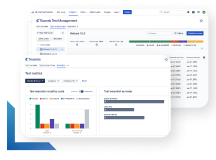
Learn how to supercharge your quality engineering journey with our advanced testing solutions.
Learn how to supercharge your quality engineering journey with our advanced testing solutions.