

Webinars
Data validation for cloud migration: Best practices for data testing, data reconciliation, and data comparison
Learn best practices for accelerating the extensive data validation...
A validation strategy can help determine ways that you can confirm if the software product is fit for purpose throughout its life cycle.

We’ve all heard of test cases, automation scripts, and coverage metrics, but validation strategy often stumps us! It turns out that’s pretty common. Most teams know how to test, but very few know how to validate. The difference sounds subtle, but it’s not.
Testing is about finding defects. Validation is about proving that the software truly meets the user’s needs. It helps in establishing that the software you built works in real-life scenarios.
A validation strategy can help determine ways that you can confirm if the software product is fit for purpose throughout its life cycle, from the first sprint to the final release.
In this post, we’ll develop a deep understanding of validation strategy in software testing.
Consider it a quality blueprint, something along the lines of a framework that guides every decision on what to test, how to test, and when to test it. If a test plan is tactical, a validation strategy is strategic. It defines why you test certain things, which risks you focus on, which techniques make sense for your context, and how you’ll measure success.
Validation is a bridge between development speed and product reliability. It’s the piece that ensures automation, tools, and processes actually serve the business goal, which is delivering reliable and meaningful software faster.
In essence, a validation strategy is a systematic approach to confirming that your product consistently meets its intended purpose.
In a setup where code pushes are frequent, one can not rely on human intuition to catch regressions
Validation strategies belong anywhere quality is of prime essence, which is everywhere. In regulated industries like healthcare, aerospace, or finance, validation isn’t optional. It’s part of the compliance. Auditors would want to see a documented rationale for every testing decision taken.
But even outside of regulated industries, modern Agile and DevOps setups demand validation strategies. In a setup where code pushes are frequent, one can not rely on human intuition to catch regressions. We need a guiding framework that says, “Here’s how we know this build is ready.”
We also need to ensure these frameworks evolve with time. Modern validation strategies are living systems. They change perennially as architecture, risks, and priorities change.
Every solid validation strategy aims to answer five questions:
We must define our objective. For instance, for a SaaS product, it might incline toward performance and usability, but for a banking platform, it can be accuracy and security.
This is something you need to decide: whether it will be something like risk-based testing, automation first, or a mix of exploratory and scripting approaches.
As James Bach says, “Testing is an infinite process of comparing the invisible to the ambiguous in order to avoid the unthinkable happening to the anonymous.” This infinite process can not be held by a QA alone. Validation isn’t solely a tester’s job. Developers, business analysts, and even compliance officers often share responsibility.
A reliable validation strategy massively relies on repeatability. For instance, you need environments that behave consistently, test data that mirrors real user behavior, and automation frameworks that scale as your product does.
This is where an automation platform like Tricentis Tosca fits naturally. It lets you automate across the API, UI, and database, while managing data dynamically such that every validation run reflects a real scenario, not static mocks.
This is where documentation and traceability help massively. Tools, like Tricentis, let teams map each test directly to its requirement or risk, so you can show exactly how quality was achieved.
Together, those five pillars form a complete strategy. A strategy that scales, adapts, and actually supports delivery.
Automate repetitive flows if you have those, or use manual testing for exploration or complex user scenarios if that is the state of your application
It’s tempting to over-engineer the process. Teams can end up writing volumes of docs, which no one is referring to after a while. The key, like always, is clarity.
A lot of validation strategies fail because they no longer cater to the current reality of the application. Some of the common pitfalls around validation strategies include:
When teams don’t agree on the success parameters, building validation strategies looks like tedious work. You can’t measure “done” if you never defined it. The goal is to ensure that quality goals are explicit and shared values.
Many teams start by choosing a tool and then build the process around the tool. The strategy—involving your goals, risks, and validation flow—comes first. The tools should serve it, not steer it.
Fast-moving projects tend to lose track of what’s been validated. When you’re relying on memory instead of traceability, confidence drops. You may end up rerunning redundant cases or missing critical ones. That’s why traceability matters. This serves as a central place where every validation is mapped to a requirement.
Your validation strategy should grow alongside your codebase, and much like your codebase, it should grow iteratively
Your validation strategy should grow alongside your codebase, and much like your codebase, it should grow iteratively. As new features ship and old ones are deprecated, risks change shape. A good validation approach keeps pace with these changes. Reviewing them regularly and deprecating what’s not useful anymore is the key to a good strategy.
A good way to develop a better understanding of a validation strategy is to see it in action. Let’s take this time to go through a few examples of how this actually works:
Banks and trading platforms often define validation strategies around data integrity and transaction timing. For example, a trading API validation plan might define latency thresholds, cross-system reconciliation methods, and testing rollback for failed transactions.
SaaS companies practice continuous validation as part of their DevOps life cycle. Each code change automatically triggers tests across different layers—such as functional, performance, and integration—and validation results directly feed back into the deployment pipelines.
Validation strategies aren’t just paperwork; they are a mindset. It’s the discipline that connects velocity to quality, automation to meaning, and testing to business outcomes.
When you have a strategy that everyone aligns with, you stop reacting to bugs and instead anticipate them. You build software that holds together not just because the code works, but because the process does.
Tools like Tricentis Tosca and Test Management help teams operationalize that mindset. These tools enable linking requirements, tests, and outcomes in one continuous flow. They turn validation from a once-a-quarter audit into a daily habit.
In the end, that’s the goal. Validation isn’t about proving that the software is perfect. It’s about proving that it’s ready.
This post was written by Deboshree Banerjee. Deboshree is a backend software engineer with a love for all things reading and writing. She finds distributed systems extremely fascinating and thus her love for technology never ceases.
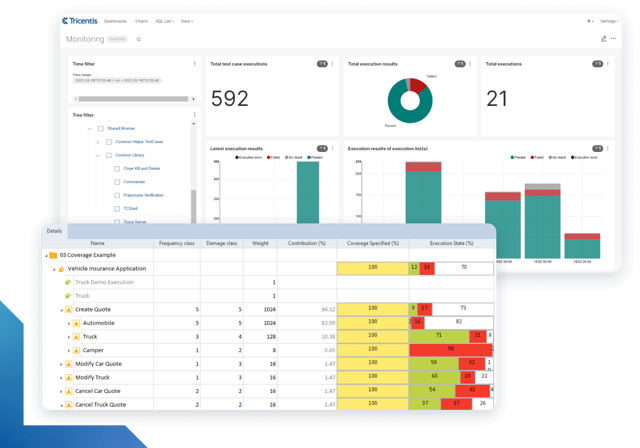
Learn more about intelligent test automation and how an AI-powered testing tool can optimize enterprise testing.
Learn more about intelligent test automation and how an AI-powered testing tool can optimize enterprise testing.