

Webinars
How to cut regression testing timelines from days to minutes
Allocating adequate time for regression testing before a new release...
Learn how agentic AI enhances regression testing, reduces maintenance, and improves regression reliability at scale.

Regression testing at scale creates a problem. Complete coverage requires time teams don’t have, while speed requires cutting tests teams can’t afford to skip. Manual selection and maintenance don’t solve this problem; they just shift where the issue occurs.
Agentic regression testing addresses this through autonomous test management. This post explains how it works, what changes it makes from traditional testing, and how to get started.
TL;DR: Agentic regression testing uses autonomous AI agents to select, execute, and maintain regression tests based on code changes and risk analysis, reducing manual maintenance and improving adaptability compared to static automation.
Agentic regression testing uses autonomous AI agents to manage and execute regression test suites through reasoning rather than preprogrammed rules.
Unlike traditional automation, which follows static scripts, agentic systems interpret application changes and make testing decisions independently.
Agentic regression testing significantly reduces test maintenance overhead compared to traditional rule-based approaches.
The key difference is adaptability. Traditional tests break when UI elements change. Agentic systems recognize the change, understand context, and adjust test logic automatically.
They select relevant tests based on code changes, heal broken scripts, prioritize execution by risk, and adapt validation strategies when applications behave unexpectedly.
Agentic systems recognize the UI change, understand context, and adjust test logic automatically.
TL;DR: As regression suites grow, execution time increases, maintenance overhead rises, and flaky tests create noise—making manual selection and traditional automation inefficient at scale.
As applications mature, regression suites grow exponentially. A suite that used to finish in two hours now takes eight hours. Testing gets pushed to overnight runs.
Engineers pick tests based on gut feeling instead of data, leading to inconsistent coverage and missed regressions. Teams spend hours debating which tests to prioritize.
Maintenance overhead steadily increases. UI changes break locators, API updates invalidate assertions, and environment drift introduces failures. Teams commonly spend 40-60% of their automation effort fixing existing tests rather than expanding coverage.
False positives accelerate the decline. Flaky tests generate noise that obscures real failures. Teams develop alert fatigue and begin ignoring certain results.
Instead of executing every test or relying on manual selection, agentic AI systems analyze changes, assess risk, and adapt test logic in real time.
TL;DR: Agentic AI enhances regression testing through autonomous maintenance, intelligent test selection, and dynamic risk-based prioritization—delivering faster feedback and reduced maintenance effort.
Agentic AI solves all the problems mentioned in the previous section through autonomous decision-making.
According to Gartner, “By 2028, at least 15% of day-to-day work decisions will be made autonomously through agentic AI, up from 0% in 2024.”
Instead of executing every test or relying on manual selection, these systems analyze changes, assess risk, and adapt test logic in real time.
When developers rename a button or restructure an API response, traditional tests break. But agentic systems detect these changes during execution, reason about the element’s purpose based on context, and update test logic accordingly.
Autonomous test maintenance reduces the time engineers spend fixing broken selectors, letting them focus on expanding coverage instead.
When code changes, agentic systems analyze what changed. They connect changes to affected features and select only the relevant tests.
For example, a backend API change triggers only related integration tests while skipping unrelated UI tests. A 2,000-test suite might run just 300 relevant tests, reducing feedback from hours to minutes.
Risk-based prioritization does more than rerun failed tests. Agentic systems score tests based on failed history, code changes in related areas, and business impact.
High-risk tests run first, catching critical defects early. If the build fails, teams can tell immediately whether it’s a minor issue or a revenue-impacting problem.
These three approaches answer different questions about control and automation. Who decides which tests run? How do tests handle change? When do humans intervene?
| Aspect | Traditional | AI-Assisted | Agentic |
| Test Selection | Manual selection by engineers | AI suggests, engineer approves | Autonomous selection via code analysis |
| Test Maintenance | Engineer fixes all breaks | AI flags issues, engineer fixes | Self-healing with human oversight |
| Decision Authority | Engineer decides everything | Engineer makes final calls | AI decides within defined boundaries |
| Execution | Scheduled or manually triggered | Scheduled with AI optimization | Event-driven, risk-based execution |
| Adaptation | Requires code updates | AI proposes changes for review | Real-time logic adjustment |
In summary, traditional testing puts all decisions in human hands. AI-assisted systems provide recommendations but wait for approval. Agentic systems make and execute testing decisions independently within guardrails.
Each approach has valid use cases depending on risk tolerance, team size, and app complexity.
Implementing agentic regression testing requires strong planning and risk management.
TL;DR: Begin with a measurable pilot, establish baseline metrics, define success targets, monitor results closely, and expand gradually based on proven impact.
Implementing agentic regression testing requires strong planning and risk management. Teams that skip this will struggle to demonstrate value or scale effectively.
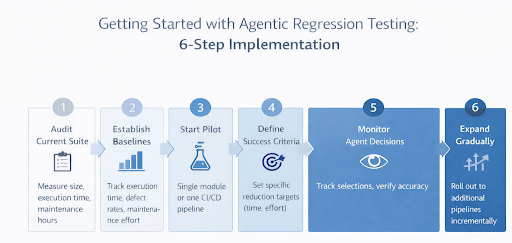
(Infographics created by the author using ChatGPT)
Measure suite size, execution time, and how many hours you spend on maintenance each week. You need these numbers to prove ROI later.
Do this before implementing any changes. Track test execution time, defect escape rate, and maintenance effort. Without concrete numbers, you cannot prove improvement or calculate ROI.
Start with a pilot on a single application module or one CI/CD pipeline. This limits risk while you validate the approach.
Define specific success targets, like 50% reduction in execution time or 40% less maintenance effort. Clear goals prevent scope creep and give your team objective measures.
Monitor which tests the agent selects or skips, and verify accuracy against actual defects found. Regular monitoring builds trust and surfaces edge cases that need human intervention.
If the pilot meets your criteria, roll out to additional pipelines incrementally. Use learnings from each phase to refine your approach.
Autonomous systems still require oversight and continuous improvement. The following practices help teams maintain quality while leveraging agentic capabilities.
TL;DR: Tricentis enables agentic regression testing through AI-powered impact analysis, risk-based optimization, autonomous maintenance, and governance controls integrated into enterprise CI/CD pipelines.
Tricentis brings agentic regression testing to enterprise scale through AI-powered capabilities in its Tosca platform. These features handle test selection, autonomous maintenance, and risk-based prioritization.
AI-Powered Impact Analysis examines code changes and identifies relevant tests, reducing testing timelines by 85% while maintaining complete risk coverage.
Risk-Based Test Optimization prioritizes tests by business impact, cutting unnecessary runs by 40% while increasing risk coverage by over 90%. This automates what used to require manual triage.
Vision AI handles autonomous maintenance through visual recognition that self-heals tests when UI elements change. Model-Based Automation separates test logic from application details. Teams update models once rather than fixing tests one by one.
In July 2025, Tricentis launched Agentic Test Automation, which generates tests from natural language and drops test creation time by 85%.
Tricentis integrates with CI/CD pipelines and adds governance controls for production releases. Model Context Protocol (MCP) lets organizations connect AI agents like Claude and ChatGPT straight to Tosca, qTest, NeoLoad, and SeaLights. Custom models work too.
Ready to implement agentic regression testing? Explore how Tricentis Tosca enables AI-driven regression testing at enterprise scale.
Agentic regression testing lets AI agents independently select, run, and maintain regression tests based on code changes and risk analysis. The system analyzes application updates, chooses which tests to execute, and self-heals when UI or API changes occur.
Traditional regression testing requires engineers to manually select tests and fix broken scripts. Agentic regression testing makes these decisions autonomously based on code changes, risk analysis, and historical data.
It solves exponential test suite growth, high maintenance overhead, and slow feedback cycles. Teams spend less time fixing broken scripts while getting more accurate regression coverage.
No, it manages and optimizes existing test suites rather than replacing them. The system selects which tests to run, performs maintenance on broken tests, and prioritizes execution based on risk.
Teams with large regression suites, frequent releases, and CI/CD pipelines benefit most. Organizations spending more time on test maintenance or struggling with long execution times see the biggest impact.
This post was written by Chosen Vincent. Chosen is a web developer and technical writer. He has proficient knowledge in JavaScript, ReactJS, NextJS, React Native, Node.js, and databases. Aside from coding, Vincent loves playing chess and discussing tech-related topics with other developers.
Agentic regression testing lets AI agents independently select, run, and maintain regression tests based on code changes and risk analysis. The system analyzes application updates, chooses which tests to execute, and self-heals when UI or API changes occur.
Traditional regression testing requires engineers to manually select tests and fix broken scripts. Agentic regression testing makes these decisions autonomously based on code changes, risk analysis, and historical data.
It solves exponential test suite growth, high maintenance overhead, and slow feedback cycles. Teams spend less time fixing broken scripts while getting more accurate regression coverage.
No, it manages and optimizes existing test suites rather than replacing them. The system selects which tests to run, performs maintenance on broken tests, and prioritizes execution based on risk.
Teams with large regression suites, frequent releases, and CI/CD pipelines benefit most. Organizations spending more time on test maintenance or struggling with long execution times see the biggest impact.