Once the first checks are stable and people act on them, you can add more. Start with SAST rules focused on critical paths. Then add infrastructure-as-code policies for things like public access or encryption. You can also include automated API tests with security assertions.

If there’s one place you don’t want to rely on last-minute heroics, it’s security. Teams keep shipping faster, attackers keep getting smarter, and the old pattern of throwing a pen test at your app right before release just doesn’t hold up anymore.
Automated security testing is really about building guardrails into your delivery pipeline so you get feedback early and often, not about replacing every human with a scanner.
When you get this right, you reduce the chance of embarrassing issues reaching production without turning every release into a security fire drill.
What is automated security testing?
TL;DR: Automated security testing continuously scans applications, dependencies, and infrastructure for vulnerabilities during development and delivery.
Automated security testing is the practice of using tools and pipelines to continuously check your applications and infrastructure for vulnerabilities as you build and ship software.
Automated security testing is not “we bought a scanner license and run it once a quarter.” It’s also not “security owns a tool and occasionally sends scary PDFs to engineering.”
Instead, developers see the results next to their build status, and they can act on them while the change is still fresh in their heads.
Automated security testing works best when it’s treated as guardrails, not gates. The guardrails can then be tuned to focus on high‑impact issues, and they can help developers move quickly without falling off a cliff.
The goal of shift‑left security is to provide faster feedback loops on high‑risk changes, not to push all responsibility onto developers.
Why does security need to shift left?
TL;DR: Shift-left security moves security checks earlier in development so teams catch risks faster without slowing releases.
You’ve probably heard the “security is everyone’s job” mantra so many times that it sounds like a cliché. Either releases slow down, or risky changes sneak through, or both.
Shift‑left security doesn’t mean every developer becomes a security engineer overnight. It means security concerns show up earlier, in smaller pieces, and as part of normal development routines.
A pull request that introduces a known vulnerable dependency should get feedback before it hits main, not three weeks later when someone runs a quarterly scan. A misconfigured cloud resource should be caught at the infrastructure‑as‑code level.
The goal of shift‑left security is to provide faster feedback loops on high‑risk changes, not to push all responsibility onto developers.
Core types of automated security testing
TL;DR: The most common automated security tests include SAST, SCA, DAST, and infrastructure or configuration scanning.
When people say “security testing,” they often throw a lot of different techniques into one bucket. To make this practical, it helps to break things down into the common categories you’re likely to use in pipelines:
1. Static application security testing (SAST)
SAST analyzes source code or binaries to detect potential vulnerabilities before the application runs. This kind of testing is good at catching patterns like unsafe input handling, insecure use of libraries, or dangerous functions that show up in code.
2. Software composition analysis (SCA)
SCA checks your dependencies and open‑source libraries for known vulnerabilities and license issues. This type of testing is usually one of the easiest wins to integrate early, because it’s relatively fast and directly tied to concrete risk.
3. Dynamic application security testing (DAST)
DAST exercises a running application to find vulnerabilities from the outside. Instead of looking at code, DAST interacts with HTTP endpoints, inputs, and flows, trying to identify issues like injection or broken authentication.
DAST integrates well into later stages of CI/CD when you have something deployed that can be probed safely.
4. Infrastructure and configuration scanning
This evaluates your cloud resources, containers, and infrastructure‑as‑code for insecure settings. Running automated checks on your Terraform, Kubernetes manifests, or cloud accounts gives you a way to catch those issues before they go live or soon after.
Starting small: How to add security checks to CI/CD
TL;DR: Begin with a few high-value checks like dependency scanning in CI pipelines, then expand gradually.
When teams first look at automated security testing, they often try to design the perfect future state. It’s much more effective to treat this as an iterative journey: start small, learn, and expand.
A practical starting point is to pick one or two checks that are clearly valuable and easy to reason about.
SCA is often first on that list, because it deals with known vulnerabilities and actionable updates. You wire it into your CI pipeline, maybe on pull requests and on main, and you initially only fail builds on the most critical issues. Everything else gets reported but doesn’t block.
Progress in automated security testing comes from layering small, reliable steps over time, not from designing a perfect system on day one.
Effective automated security testing focuses on high‑impact, high‑confidence findings that developers can actually fix.
Avoiding noise and alert fatigue
TL;DR: Tune security tools to focus on high-confidence vulnerabilities so developers aren’t overwhelmed with alerts.
If you’ve ever worked with an overeager monitoring setup, you know what happens when tools scream all the time. People mute them.
Security tools can fall into the same trap. If your automated checks constantly flag low‑priority or low‑confidence issues, developers quickly learn to ignore the output or find ways around the gates.
A good rule of thumb is to start “soft” and tighten over time. Initially, configure checks to report broadly but only block the worst problems. Make it clear which findings are truly release‑blocking and which ones are advisory.
Effective automated security testing focuses on high‑impact, high‑confidence findings that developers can actually fix. That means tuning rules, suppressing noisy patterns, and making sure the output is understandable without a security PhD.
Where Tricentis and SeaLights can help
TL;DR: Risk-based testing and coverage analytics help teams focus testing on critical areas and risky code changes.
Tools like Tricentis products and SeaLights can reinforce your security posture when they’re used as part of your guardrails.
For example, when you use risk‑based testing and impact analysis, you’re effectively focusing more testing energy on the parts of the system most likely to cause trouble if they fail.
Test impact analytics and coverage‑driven approaches can help make sure critical flows are always exercised when code changes.
By automatically selecting relevant tests and highlighting untested changes, you’re shortening the window in which vulnerabilities could ship unnoticed.
It’s still on you to include security‑relevant tests in that mix, but the underlying mechanism makes it easier to keep those tests close to the code.
AI‑driven insights in testing platforms are most valuable when they help you prioritize and focus your limited security attention where it matters most.
Instead of adding more noise, they can surface patterns like “these components are frequently touched, under‑tested, and close to sensitive data,” which is exactly where you want to invest more security effort.
Agentic AI should not be given free rein over your security posture until you fully understand its behavior and failure modes.
Conclusion: AI has potential and risk
TL;DR: Agentic AI can assist security testing, but teams should adopt it cautiously and understand its risks.
Agentic AI is one of those ideas that looks amazing on slides: autonomous agents that scan your systems, open tickets, and maybe even patch vulnerabilities on their own.
In practice, we’re still early. Recent OpenClaw-style issues have made it obvious how dangerous security-sensitive automation can be when it goes wrong.
Agentic AI should not be given free rein over your security posture. You must first understand its behavior and failure modes.
That might sound conservative, but security is one of those areas where overly optimistic experiments can have real‑world impact.
If you’re going to introduce agentic behavior, start with read‑only or advisory roles, measure how well it performs, and only then consider giving it more authority.
As security expert Bruce Schneier said, “Security is a process, not a product.” That mindset fits automated security testing perfectly. If you want to improve your security testing, get started with Tricentis today.
This post was written by David Snatch. David is a cloud architect focused on implementing secure continuous delivery pipelines using Terraform, Kubernetes, and any other awesome tech that helps customers deliver results.
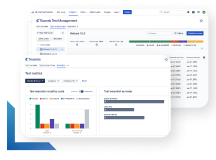
Tricentis testing solutions
Learn how to supercharge your quality engineering journey with our advanced testing solutions.
Date: Apr. 06, 2026
In this article:
Tricentis testing solutions
Learn how to supercharge your quality engineering journey with our advanced testing solutions.
Date: Apr. 06, 2026