

Aegon speeds releases and reduces costs with test automation from data to UIs
How Aegon Asset Management expanded test automation to enable faster,...
In software development, teams need to stay informed about the state of the product they are building at all times. What potential issues with our software prevent us from shipping it right now? What is the impact of the addition of the latest new feature we implemented?
Author of the post: Bas Dijkstra
For decades, test automation has been seen as crucial for development teams in supporting their testing efforts and retrieving the product feedback they need. However, many of these teams still report challenges when it comes to test automation: it is expensive, it takes a long time to get the feedback they’re looking for, and the feedback that they do get is often not reliable enough to support critical business decisions.
In this report, we will zoom in on these challenges and present steps towards a holistic test automation strategy that gives teams what they’re looking for: valuable feedback, fast.

Test automation tools have existed since the 1970s. However, while the tools since then have without doubt become more powerful and sophisticated, many teams still struggle with their test automation implementation.
Test suites that take hours or even days to run. Large amounts of false positives and false negatives. Teams that have to spend much more time than they want, or than they even have in the first place, just to keep the tests running.
While there is very little factual evidence of the direct impact on businesses, research indicates that there is plenty of room for improvement in test automation (all numbers from the 2024 State of Testing survey ):
It is safe to conclude that a lack of efficient test automation leads to either or both of these outcomes:
In this report, we will present a number of recommendations for teams that do want to improve their test automation efforts and get (back) on the road towards test automation success.
If test automation is all about getting valuable product feedback, fast, then why does it too often fail to live up to the expectations?
There are a number of root causes that contribute to test automation that is slow, expensive and unreliable:
In my experience, the most important contributor to suboptimal test automation is a lack of product testability, or the degree to which a product enables us to uncover information about its state and behaviour in an efficient manner.
Some examples of how low testability manifests itself in products are
All of these examples will lead to less efficient automation, and in some cases, even to automation being virtually impossible to implement in the first place.
Another factor that plays a role in inefficient test automation is a lack of skills in the individuals and teams responsible for the implementation, execution and maintenance of that test automation.
Test automation is a software development activity intended to support testing, meaning it requires both significant software development and software testing skills.
Only when those involved in test automation have good software development skills will the test code be readable, maintainable and generally well-structured. If the test code is of poor quality, it will take longer to maintain it when the product under test changes, to find problems with the test code in case of failures, and to onboard new team members in the test code base.
Using ‘low code’ tools and solutions (AI-powered or otherwise) is not the solution to this challenge, despite what the marketing efforts of some of these tools would like you to believe. These tools, too, require solid engineering skills to be implemented successfully.
Another problem that often leads to poor test automation results is treating test automation as an afterthought instead of an integral part of the development process.
Seeing test automation in this way effectively means test automation is a ‘nice to have’, and something that can be postponed when time is scarce (and when is time ever not scarce?)
Also, starting your test automation efforts only after the product has been designed and developed means that the moment to have a conversation regarding how to test the product and how to use tools to do so efficiently has passed. The right moment to have a conversation about testability is before you start development, not after it has been completed.
Test automation truly shines when it is created, executed and maintained in lockstep with the product.
Typical root causes of slow and inefficient test automation are:
So, what should leadership do to remove these bottlenecks and free the way for test automation that actually delivers on its promise? Let’s take a look at a few suggestions.
Think and talk about testability
As we discussed before, testability matters when you want to succeed with test automation. In other words, your product should allow for easily observing the behaviour of the system or parts of it in a controlled test environment.
Reverse engineering testability into an existing product (the dreaded ‘codebase refactoring’) is not something teams will look forward to. Also, it presents us with a catch-22 situation:
Therefore, the best time to talk about testability is generally ‘as early as possible’, or more practically, when the behaviour of a new product, feature or bug fix to be implemented is discussed. For many teams, this will be during some form of refinement session.
During discussion of the intended behaviour of a feature, make it a habit to also ask:
Generally speaking, test automation will be most efficient when it is written as close to the code it verifies as possible, both in terms of scope (don’t write integration tests for something that can be verified with a unit test) and in terms of time (don’t write your test automation too long after writing the code it verifies).
The spectrum of skills required to do test automation well is very hard to find in any individual, which is why so many companies struggle to find the elusive ‘test automation engineer’ or ‘software development engineer in test’. In my own 20 years of experience, I have only worked with a handful of people who were really good in both development and testing.
Rather than spending a lot of time and effort to find or grow individuals that can ‘do it all’, make test automation a whole team effort, instead. Find people who are great at software testing and people who are great developers, and have them work together on your test automation throughout the development process.
This collaboration ideally should be synchronous, with people with complementary skill sets pairing up in real time to work on a specific task. Synchronous collaboration provides a number of benefits over asynchronous work (like through a pull request process), such as:
But what if your team does not yet have the range of skills needed for test automation success? Well, it’s high time to support them to obtain those skills through training and deliberate practice. Also, consider strategic hiring of additional engineers, either temporary or permanent.
Tests are only valuable when they are executed, because that’s when they inform development teams about the current state of that product and any potential problems with it.
It’s generally a good idea to make the process of executing tests and reporting on the results thereof an automated process, too, for example using build automation tools and Continuous Integration (CI) platforms such as Azure DevOps or GitHub Actions.
The sooner the process of executing your automated tests is automated, the easier this is. If you only have a few tests, they will not take up a lot of time yet, and the code base is small enough to change to allow for automated execution on demand. If you wait too long with automating the execution of your tests, on the other hand, there is a significant risk that it will take a lot of time and effort to achieve, and maybe even require rewriting (part of) your tests to allow for automated execution in the first place.
There is a lot of conversation happening online about what is ‘the best’ tool. Often, these discussions quickly degrade towards people advocating for their personal favourite, rather than discussing differences between certain tools in an objective manner. Personally, I’d rather steer clear of these discussions altogether, and I recommend the teams I work with to do the same.
In my opinion, the most important question to answer during tool selection is
“Which tool or set of tools is the best fit for our specific context?”
There are a number of factors that determine whether a tool is fit for context, including (but not limited to):
There are more factors that come into play when it comes to tool selection, but the ones mentioned above tend to come up with every team I talk to and have worked with over the last 20 years.
These days there is no avoiding discussing the use of AI to enhance and support software testing and software development efforts, and the topic of test automation is no exception.
Much has been said about AI already, both by its advocates and by its critics, and the general consensus, and a view that I subscribe to, is that AI can be a very powerful addition to your test automation efforts, if it is used with prudence, yet it can be outright dangerous if it’s not used carefully.
Here are some examples of what for me constitutes prudent use of AI in test automation:
In short, I recommend seeing AI as a team member that is very good and lightning fast at making suggestions on how to improve your automated tests, but that does not have the ability to make critical decisions by itself. I recommend keeping a human in the loop to scrutinize the suggestions made by AI before adoption.
That means that I do not recommend the following types of AI use:
When used with prudence, AI can be an excellent accelerator of your team’s test automation efforts. Without the oversight of skilled human beings, however, there is a significant risk that you’ll quickly find yourself with a test suite that might look good, but that no human understands or trusts.
Here’s what leadership should do to increase the probability of test automation success:
In this report, we have seen what it takes to be successful with test automation, and we established that doing so requires much more than selecting the right tool for the job – teams need a holistic test automation strategy tailored to their specific context if they want their test automation to deliver valuable feedback, fast.
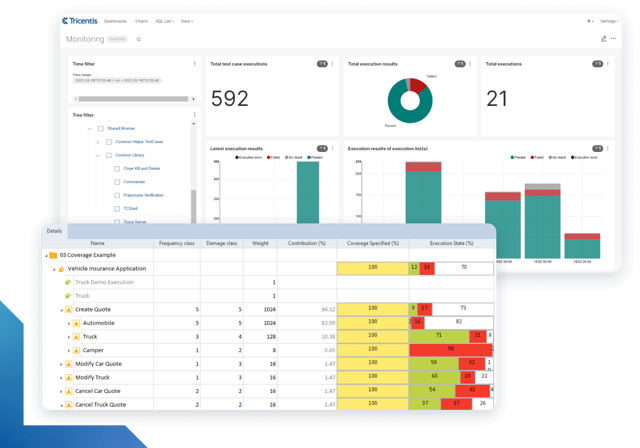
Learn more about intelligent test automation and how an AI-powered testing tool can optimize enterprise testing.
Learn more about intelligent test automation and how an AI-powered testing tool can optimize enterprise testing.