

Reports & White Papers
Driving efficiency with DevOps agility: Avoiding the speed traps on the road to innovation
Discover best practices for overcoming common challenges on...
Test traceability is the practice of documenting the connection between software tests and the application behaviors that they validate.

Testing your software is how you validate that it works the way you want it to. Each software application has a whole pile of features and expected behaviors, but without testing, you can’t validate that the code that makes up your application does what you want it to.
For small, simple applications, rudimentary testing of the components of the application is enough to validate that the application works as expected.
As your application grows, so does the complexity of your software. This makes rudimentary testing, whether automatic or manual, less effective at determining how well your software is working.
What’s more, complex software usually means that you have more people working on that software, making it more difficult to understand how well individual parts of the software are performing across your team.
The process of cutting through the noisy relationship between software tests and the quality of the underlying software is called test traceability. In this post, we’re going to talk about the realities of test traceability and how improving your test traceability will help your team write better software.
Test traceability is the practice of documenting the connection between software tests and the application behaviors that they validate. The practice of test traceability is often done through a “matrix” of application features mapped to specific tests.
One important aspect is understanding that the tests included in a traceability matrix can be both manual and automated tests. So the matrix might link to a set of test files inside a code repository, but another part of the matrix might include a link to a set of testing plans used by manual testers on a company wiki.
The important part of test traceability is the explicit link between official behaviors of the application itself and the tests that validate those behaviors. A well-defined test traceability matrix includes all of the officially-supported features of your application, along with tests that anyone can perform, which prove that those features are working as expected.
Test traceability is a key part of software risk management for mature teams. As Jake Stowe notes, while writing for Ketryx, “By establishing traceability links between requirements, design elements, and testing activities, teams can assess the impact of changes or failures and take proactive measures to mitigate risks.”
Test traceability is the practice of documenting the connection between software tests and the application behaviors that they validate
There are two major concepts included in the overarching concept of test traceability. We call them forward traceability and backward traceability. Let’s dive into what each of those is and how they benefit your team.
Forward traceability describes the concept of tying desired behaviors within your application to the tests that validate them. If you are responsible for the care and feeding of a particular software feature, and you want to know what tests will tell you whether it’s working or not, forward traceability answers the question that you’re asking.
Forward traceability is often desired by engineering managers, product managers, and project managers. People whose primary focus isn’t necessarily the implementation of a feature, but the behavior of the feature itself. When people think about test traceability, this is often the concept that they’re thinking of.
If forward traceability is tracing from a feature to the associated tests, it stands to reason that backward traceability is the opposite: tracing from tests back to the feature(s) that they connect to. This sort of capability is usually more important to quality assurance and software engineering teams.
For a lot of people who think about test traceability, they wonder why this functionality would be important. There are a few reasons:
If you have a feature that has very few tests supporting it, backward traceability helps you to identify where those features are. With that information, you have the ability to shore up the tests for those features to improve your testing posture.
This is the opposite problem from the previous one. Sometimes you’ll trace your tests and find that one test is supporting perhaps a dozen different features. That’s a sign that you might need to make some tests more granular, so that they’re testing specific functionality, instead of making them too broad.
There are many different ways to test your software. Backward test traceability allows you to identify features that are relying too much on types of tests that don’t do a great job of validating the functionality.
For instance, a user-facing experience flow that’s only covered by unit tests, which do a great job of testing logic, but which are not as good at testing the overall experience of interacting with the application. Or performance-intensive work that doesn’t have any load testing attached.
Ideally, we always want tests to work correctly. But we don’t live in an ideal world. Sometimes you might need to break or disable a test for a period of time, for any number of reasons.
When you have strong backward traceability, you can quickly see which features are at risk when a test is disabled. You can also identify other tests that still validate the same behavior. This provides clarity about how confident you can be that the feature will continue working as users expect.
The traceability matrix benefits people across the organization, and as such, it needs input from across the organization
In short: everyone! A lot of different people within a software organization benefit from test traceability. Doing a good job requires input from your product teams, your engineering teams, and your quality assurance teams. In order to create the best test traceability matrices, all of those teams need to work in concert with one another.
One of the quickest ways for test traceability approaches to fail is for organizations to treat it as “only” a software developer’s responsibility, or “only” a project manager’s responsibility. The traceability matrix benefits people across the organization, and as such, it needs input from across the organization.
If you’re thinking about adopting a test traceability matrix for your organization, consider the following best practices. They can help you implement and maintain it effectively.
It’s easy for test traceability to start as a requested project, but the matrix often ends up in a dusty corner. Over time, nobody uses it, and it provides no real value. Instead, make the matrix easy to find, simple to use, and easy to update. This ensures it continues providing useful information.
Much like the first item, one of the easiest failure states for a traceability matrix is that you consider it a one-time project, and not an ongoing commitment. Your software is always changing, and you’re always writing new tests. You need to keep your matrix up-to-date.
Another common failure state for test traceability matrices is for teams to use basic terms to describe the features that they’re testing. And sure, having a row that says the email validation function on signup is supported by a list of tests is more useful than not having that information.
But it’s much more helpful for your matrix to link to the supporting project management tracker, the test automation platform that shows the status of all the tests, and the product design documents that outline why the team made specific decisions. By linking all this information together, you make test traceability the hub of your engineering team’s software delivery.
By automating your tests, you boost the value of your matrix instantly
This might feel obvious, but it’s worth stating clearly. Without test automation, your traceability matrix loses some value. The matrix should not include only automated tests. However, automated testing is a major upgrade for traceability. It lets teams quickly see which tests are passing or failing.
That’s where Tricentis Test Automation will provide a huge benefit. By automating your tests, you boost the value of your matrix instantly. Automation takes your tests from basic technical validations to guarantees that your software works the way you want. If you’re interested in finding out how Tricentis can help elevate your testing regimen, schedule a demo today!
This post was written by Eric Boersma. Eric is a software developer and development manager who’s done everything from IT security in pharmaceuticals to writing intelligence software for the US government to building international development teams for non-profits. He loves to talk about the things he’s learned along the way, and he enjoys listening to and learning from others as well.
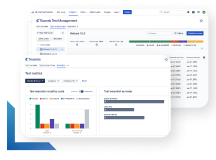
Learn how to supercharge your quality engineering journey with our advanced testing solutions.
Learn how to supercharge your quality engineering journey with our advanced testing solutions.