

Webinars
How remarkable women lead digital transformation
Hear from a group of panelists coming together to discuss...
The waterfall model of testing is a linear, sequential approach to software development and QA in which each phase flows into the next.
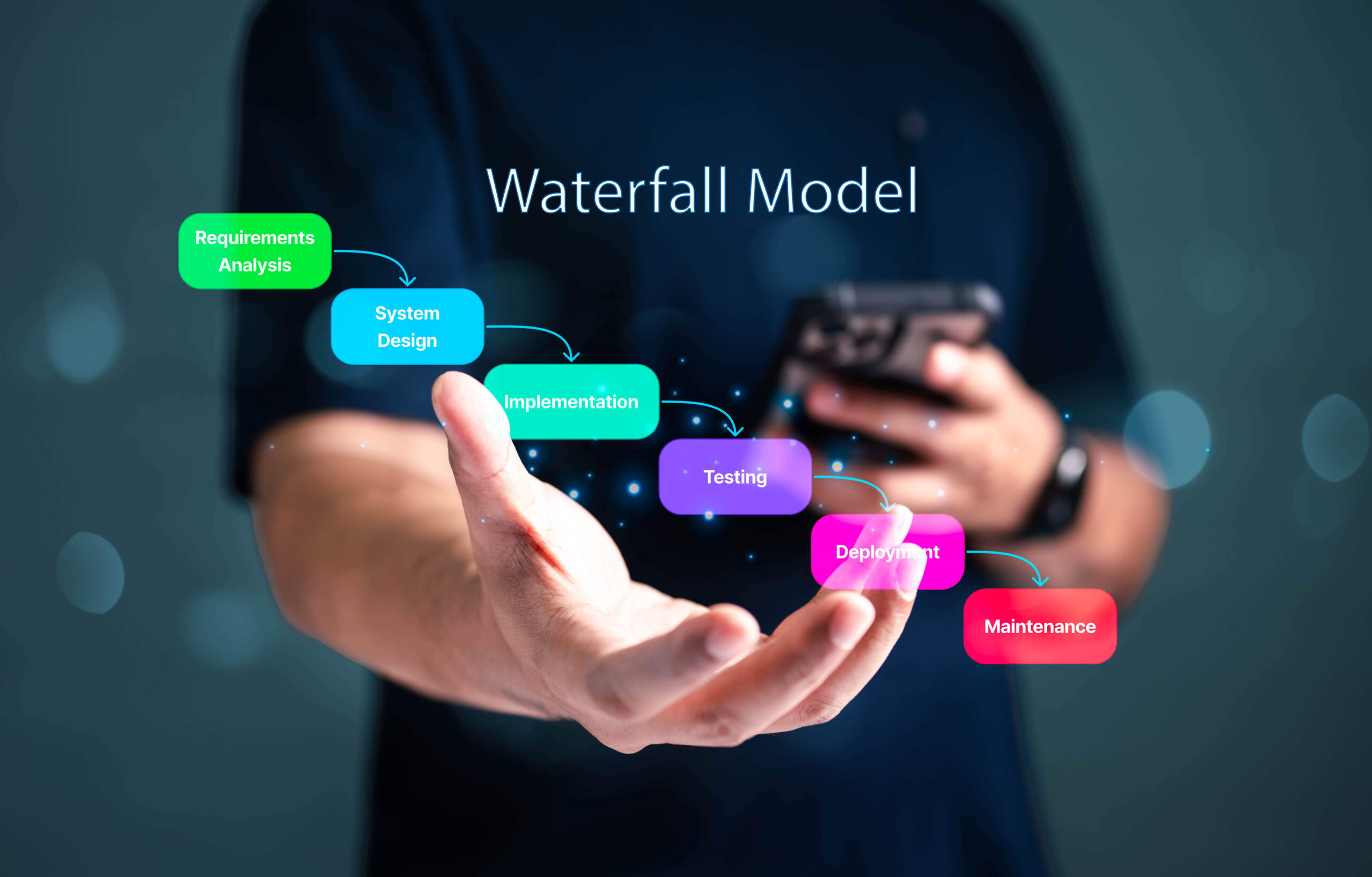
Software testing has changed a lot over the years, but every modern approach has its origins in earlier methods. One of the earliest and most structured methods was the waterfall model of testing. It follows a clear, step-by-step sequence where one phase leads naturally into the next.
Even though Agile and DevOps practices are more common today, the waterfall model still plays an important role in projects that require strict requirements, stability, regulatory compliance, or extensive cross-team coordination.
This post covers how the waterfall model of testing works, when it is most effective, and why it continues to hold value in today’s software landscape.
The waterfall model of testing is a linear, sequential approach to software development and quality assurance in which each phase flows logically into the next, much like a waterfall. It follows a development life cycle that has clearly defined phases: requirements → design → implementation (coding) → verification (testing) → maintenance.
It’s a “plan first, execute later” approach. Each phase must be completed and formally approved before the next begins. This structure provides clarity, control, and documentation.
Testing happens only after the development phase is complete. This means the product is built in full before being tested for defects, performance, and compliance with requirements, rather than iterating continuously like in Agile methods.
The waterfall model of testing is a linear and sequential software development approach where each phase must be completed before the next begins. Testing happens only after the full system or module is developed, rather than running concurrently with development.
The waterfall model of testing remains important for projects that require a high level of control and accountability
Although Agile and DevOps methodologies dominate today’s software world, knowing the waterfall is still crucial for QA engineers, developers, and test leaders. The waterfall model of testing remains important for projects that require a high level of control and accountability.
Industries such as aerospace, government, defense, healthcare, and manufacturing often depend on this approach because it creates a verifiable audit trail.
Every test case can be traced back to a specific requirement, which is invaluable in environments with strict compliance standards.
Modern software development often emphasizes speed and flexibility through Agile and DevOps practices. However, the waterfall model continues to provide a reliable foundation for risk-averse projects because it focuses on planning, documentation, and control.
Many organizations now operate in hybrid environments, where Agile development is combined with waterfall-style testing, documentation, and approval workflows.
Tricentis solutions such as Tricentis Tosca and Tricentis NeoLoad enable organizations to modernize traditional testing environments with automation, performance validation, and end-to-end traceability.
Waterfall testing differs significantly from modern testing methodologies such as Agile and DevOps testing. Agile and DevOps emphasize speed, collaboration, and adaptability. In contrast, the waterfall model focuses on structure, documentation, and control. Let’s take a look at this comparison table:
| Feature | Waterfall | Agile |
| Documentation | Extensive and rigid documentation | Lightweight and flexible documentation |
| Change management | Changes are costly and discouraged mid-project | Changes are expected and embraced |
| Team structure | Roles are defined and often siloed | Cross-functional and collaborative teams |
| Feedback loops | Limited and occurs at the end | Frequent and continuous |
In waterfall, testers primarily validate completed builds. In Agile or DevOps environments, testing is integrated into every sprint or pipeline.
As software engineering expert Roger S. Pressman states, “The waterfall model, sometimes called the classic life cycle, suggests a systematic, sequential approach to software development that begins with customer specification of requirements and progresses through planning, modeling, construction, and deployment, culminating in ongoing support of the completed software.”
The waterfall model follows distinct, sequential, non-overlapping stages. Each phase produces deliverables that flow into the next, and testing is primarily concentrated after implementation.
This is the first phase, where stakeholders and analysts gather and document functional and non-functional requirements. Testers then review requirement specifications to understand what needs to be validated later in the process.
Deliverables: Requirement specification documents, test requirement matrix.
In this stage, system architects and developers create the overall design of the application. Test teams begin preparing test plans based on these design documents, outlining the scope, strategy, resources, and timelines for the testing process.
Deliverables: High-level design (HLD), low-level design (LLD), and draft test plans.
Developers translate design specifications into code. Although testers are not yet executing tests, they can start preparing test cases and scripts. This preparation ensures that testing can begin immediately once the product is ready.
Deliverables: Source code, test cases, and environment setup.
Once development is complete, testers execute their test cases against the built software. This phase validates that the system meets all specified requirements.
Common testing levels in this phase include:
Deliverables: Test execution reports, defect logs, and test summary reports.
After deployment, any defects or issues discovered in production are fixed and re-tested. This phase may also include updates and enhancements to the system. Maintenance ensures long-term stability and customer satisfaction.
Deliverables: Maintenance logs, change requests, and patch verification reports.
The waterfall model is best in scenarios that demand clarity, structure, and compliance
The waterfall model is best in scenarios that demand clarity, structure, and compliance. But it’s less effective for fast-moving, ambiguous projects.
The waterfall model performs best in projects where structure and predictability are essential. Typical examples include:
In practice, the waterfall model may struggle in situations that demand flexibility and rapid adaptation. Common examples include:
Despite being one of the earliest methodologies, the waterfall model remains valuable for many organizations today.
The waterfall model’s sequential structure is straightforward. Each phase has clear objectives, deliverables, and sign-off points, which simplifies management and tracking.
Since every phase requires detailed documentation, teams can easily track progress, replicate tests, and audit compliance.
With fixed requirements and defined stages, project outcomes are easier to forecast.
For projects with limited complexity or well-understood requirements, waterfall ensures faster and more cost-effective execution without the overhead of continuous iteration.
New team members can quickly understand the project’s progress through documentation. However, while strong documentation helps in onboarding, the siloed structure of the waterfall can make onboarding slower compared to more collaborative approaches like Agile.
Note: While the waterfall model offers clarity and predictability, it’s not ideal for projects with evolving requirements or frequent changes. Teams working in fast-moving environments may benefit more from flexible approaches like Agile.
No methodology is perfect. The waterfall model carries certain limitations that teams should weigh carefully before adopting it.
Since testing occurs only after development, defects found late in the cycle can be expensive to fix.
Waterfall does not handle changes well. Once a phase is completed, revisiting earlier stages can disrupt the entire project flow.
Stakeholders see the product only after development, which can lead to mismatched expectations if requirements weren’t captured accurately.
For large or innovative projects, unknowns may emerge that were not accounted for in the initial planning. Waterfall’s rigidity makes it harder to adapt midstream.
With Agile, DevOps, and continuous integration dominating the industry, waterfall’s sequential model may feel outdated. However, teams can mitigate this by incorporating automated testing and test management tools, such as Tricentis Tosca, to modernize legacy processes.
While Agile and DevOps have redefined modern testing practices, the waterfall model remains relevant in certain contexts
The waterfall model of testing is one of the most structured and historically significant methodologies in software development. Its sequential approach, thorough documentation, and great focus on quality control make it indispensable for projects requiring predictability, traceability, and compliance.
While Agile and DevOps have redefined modern testing practices, the waterfall model remains relevant in certain contexts. It’s particularly effective when integrated with automation and continuous testing tools.
Organizations can enhance their waterfall-based projects by incorporating modern test management and automation platforms such as Tricentis Tosca, Tricentis NeoLoad, Tricentis Test Automation for Salesforce, and Tricentis Test Management for Jira. These solutions bring efficiency and flexibility to even the most traditional workflows, ensuring software quality at every stage.
This post was written by Bravin Wasike. Bravin holds an undergraduate degree in software engineering. He is currently a freelance machine learning and DevOps engineer. Also, he is passionate about machine learning and deploying models to production using Docker and Kubernetes. He spends most of his time doing research and learning new skills in order to solve different problems.
Learn how to supercharge your quality engineering journey with our advanced testing solutions.
Learn how to supercharge your quality engineering journey with our advanced testing solutions.