

Webinars
Achieve extreme automation with API testing and service virtualization
Find out how to test APIs directly and learn about a method for...
Discover how AI is transforming API testing—its benefits, challenges, real-world uses, and future outlook.

It’s 2025, and the world is very different. Artificial intelligence (AI) is now integrated into everything, from mobile apps to customer support bots to every phase of the software development life cycle.
AI can be found enhancing engineering workflows, optimizing CI/CD pipelines, and even now being applied in software testing, specifically to API testing.
With a lot of companies generating almost half of their revenue from their APIs, and hence they now treat them as standalone products, the developer experience has become the customer experience. Making sure that a successful first call is guaranteed is now more important than ever, and to achieve this, a robust API testing strategy is required.
Usually, testing APIs involves verifying all HTTP methods, JSON/XML payloads, status codes, headers, authentication, and rate limits, as well as making sure that the examples provided in the API documentation are useful enough, close to real-world production scenarios, and accurately match the API responses.
Also, when we design APIs, we usually assume it’s a human on the other end who will interact with it, either with a frontend app or a tool like Postman. But the reality now is that there has been a huge surge in requests made by AI agents due to the massive adoption of AI tools by developers.
In October 2025, a Gartner report predicted that by 2028, 70% of enterprises will use AI-augmented testing tools as part of their development process, up from just 20% today. Unlike humans, AI agents introduce unpredictable payloads, non-deterministic queries, and real-time adaptation requirements, which most traditional testing simply wasn’t built to handle.
To understand the value of AI, you need to first understand the problem with traditional API testing.
According to Postman’s state of the API report for 2025, “Eighty-two percent of organizations have adopted some level of an API-first approach.” But, for some reason, many testing teams are still heavily reliant on UI testing or manually working with Postman collections. This approach is no longer sufficient.
In the past, traditional testing meant that once the developers updated an API endpoint, it was handed over to the QA team for testing, where they manually updated their test script.
But due to a scheme mismatch, the Jenkins build could fail overnight, leaving the engineer to spend the next 4 hours debugging the script and not the code. And in a smaller scope or less complex API, predictions can be made for every possible input, output, and scenario that the API could be called with.
However, modern APIs of today are too complex (with thousands of endpoints), are frequently updated, and have more edge cases that can’t be anticipated by just manual testing.
Hence, with AI, changes are detected in the CI pipeline, automatic self-healing begins (e.g., refactoring the relevant tests), and 50 new edge-case tests are then generated based on the new parameters. The build passes, and the QA engineer receives a report detailing potential performance degradations.
Natural language can play a role in making it easier for testers to create meaningful API tests that verify the behavior of their system.
AI in API testing can step in here to fill the gap, not a replacement for other testing methods, but as a force multiplier. Natural language can play a role in making it easier for testers to create meaningful API tests that verify the behavior of their system. There are many steps required in API testing, which means there are many opportunities for AI to assist.
Testers no longer need to manually create test cases with many parameters, nested objects, and validation rules. AI models can parse and interpret API documentation, contracts like OpenAPI specs, traffic logs, and usage patterns.
Based on this analysis, AI can generate comprehensive test cases with auto-parameterization. These scenarios include positive, negative, boundary cases, and cases humans might overlook.
For example, AI can generate valid, invalid, and security payloads based on schema analysis. It can also identify missing validation for negative inputs such as invalid data types and boundary values.
Another complexity with API testing comes from grappling with response payloads and working with XPath, which can be challenging for testers to master. This can be a pain when documents are large, with complex logic to factor in, and thus a minor change in the response structure can invalidate an entire assertion, leading to maintenance debt.
AI simplifies this by analyzing a response payload’s structure. It interprets plain English prompts to generate correct JSONPath or XPath expressions. This makes it easier for testers to automate API tests.
In chained API tests, AI can identify and extract dynamic values like session tokens. It then passes them to the headers or bodies of subsequent requests.
Imagine running 10,000 tests per build. Well, that’s a fast way to run into a CI/CD bottleneck. AI can take the first step in eliminating this redundancy using an approach called test case prioritization (TCP).
Rather than just randomly executing tests, TCP involves using contextual data to decide in what order tests will be run. It could be based on how frequently tests failed previously, how high the code commit activity is in a code module, or identifying revenue-generating features.
This is to enable a faster feedback loop, reducing the time for defect resolution.
While TCP handles the order of test executions, AI can further reduce build times. It does so via another process called test impact analysis (TIA).
This works by identifying specific lines of code and functions modified or added in recent commits and mapping them back to their related test cases.
Only the tests that directly correspond will be selected for execution; the others will be quietly skipped.
Rather than just randomly executing tests, TCP involves using contextual data to decide in what order tests will be run.
Whenever you have schema drifts, such as renamed or removed fields, AI can detect and self-heal these mismatches dynamically at runtime. When a field is renamed, such as user_id becoming account_uid, AI checks the structure of the new response and analyzes it to map the assertion to the newly named field, allowing the test to continue running without interruptions.
AI, although powerful, is not a magical solution for all API testing problems. Here are some possible risks to consider.
| Challenge | Risk | Mitigation |
| Data Bias | Models trained on flawed data produce skewed results, amplifying agent errors | Use diverse, production-representative datasets with bias audits |
| Black-Box Decisions | Lack of explainability erodes trust in agent-API interactions | Implement XAI (explainable AI) dashboards for traceability |
| Over-Reliance | Blind trust in AI outputs misses nuanced human contexts | Combine AI with human oversight in hybrid loops |
| Integration Complexity | Tooling silos disrupt workflows amid rapid AI adoption | Choose modular platforms like Tricentis Tosca for seamless CI/CD embedding |
Let’s take a look at some future trends below:
We are currently in the AI-augmented testing phase. Humans are the drivers, and AI is the assistant. In the future, you won’t need to write scripts. Instead, you will instruct the AI with objectives. Tools will change from “record and playback” to “intent-based testing.”
For example, “Verify that the payments API handles concurrent transactions without latency.” The AI will map the API structure, generate the necessary data, orchestrate the load, analyze the results, and report back.
AI will anticipate bugs rather than merely identify them. AI technologies will identify “high-risk” commits before they reach the testing stage. This is done by comparing code complexity measurements with historical defect data. This will advise developers to rework complex logic before it causes an outage.
Instead of running tests in a sandbox, AI in the future will continuously monitor API traffic in production.
Instead of running tests in a sandbox, AI in the future will continuously monitor API traffic in production. As a result, it will automatically generate new tests based on actual usage patterns.
Tosca is a codeless and model-based solution that extracts the complexities and allows non-technical users to build, maintain, and extend test cases without needing to worry about complex API artifacts like JSON, XML, or XPaths.
This makes it possible for API tests to be created early in a sprint. Thus, overcoming the prominent delay of waiting for the full application UI to be ready. It can also run 200 API tests in under one minute. Thereby, saving a lot of time when compared to UI-level testing.
Unlike many other testing tools limited to REST and SOAP, Tosca supports a wide range of API technologies. This includes legacy protocols, enabling true end-to-end testing.
To try it out, visit Tosca’s page and get started.
This post was written by Wisdom Ekpotu. Wisdom is a software & technical writer based in Nigeria. Wisdom is passionate about web/mobile technologies, open source, and building communities. He also helps companies improve the quality of their technical documentation.
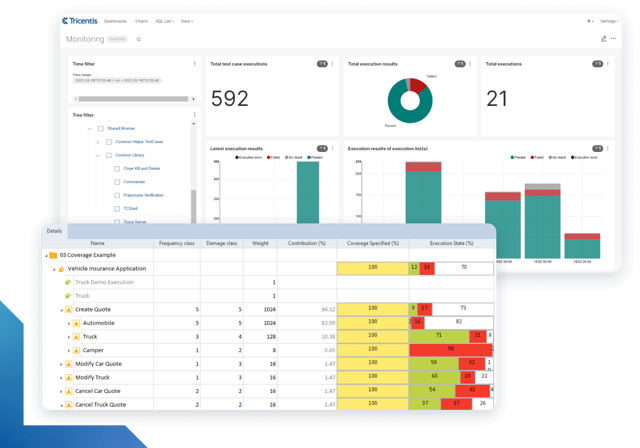
Learn more about intelligent test automation and how an AI-powered testing tool can optimize enterprise testing.
Learn more about intelligent test automation and how an AI-powered testing tool can optimize enterprise testing.