

Agile testing: Best practices for continuous quality
Accelerate Agile testing with Tricentis: codeless AI automation,...
Learn what Agile methodology is, plus its challenges, benefits, pillars, and main types of Agile methodologies in this helpful guide.

lsoAgile is an iterative approach to creating software that helps development teams deliver faster, higher quality, more responsive software projects. Rather than focusing on a single launch where the finished product is released, Agile methodology delivers work in smaller increments that allow software and requirements to be revised along the way.
Agile methodology reorganizes the software development process in several key ways.
Rather than a sequential, “Waterfall” approach to development where developers, testers, and business analysts work independently, Agile calls for intense collaboration between teams, and continuous communication with customers who are encouraged to provide feedback about the product throughout the development lifecycle.
Agile methodology also requires significant changes in the way software is tested. Rather than relegating testing to the end of the development process, Agile software testing takes place at every stage of development. As a result, defects are found and fixed earlier in the process, helping to improve quality and reduce costs.
Agile methodology is a set of principles more so than a distinct set of rules or guidelines. Agile practices are constantly evolving, and different organizations employ different versions of Agile development.
At its heart, Agile is about getting all the stakeholders involved in creating software to think differently about the development process. Agile encourages more effective collaboration to produce software with greater speed and higher quality, and to ensure that the customer receives a product that meets or exceeds their wishes.
The “Agile” movement was formalized in 2001 when a group of software leaders published the Manifesto for Agile Software Development and the principles behind it. In other words, Agile is both a mindset and a way of working. Many organizations treat Agile as “how we plan and deliver value,” not just a project management framework.
The core values of Agile methodology include:
Agile encourages more effective collaboration to produce software with greater speed and higher quality, and to ensure that the customer receives a product that meets or exceeds their wishes.
Many teams refer to the four values in the Agile Manifesto as the “pillars” of Agile because they help teams choose what to prioritize when tradeoffs appear.
Agile recognizes that software is built by people. Teams that communicate well and collaborate across roles tend to deliver better outcomes than teams that rely only on handoffs, templates or tools.
Agile favors evidence over speculation. Teams aim to demonstrate a working increment early and often so stakeholders can make better decisions based on real behavior, not assumptions.
Agile assumes that the best way to build the right solution is to collaborate frequently with customers and users. Practices like demos and acceptance criteria keep delivery aligned with what the customer actually needs.
Agile planning is designed to be adaptive. Teams expect requirements and priorities to change and build processes that can respond quickly without destabilizing quality.
The 12 principles behind the Agile Manifesto explain how Agile teams translate values into everyday behaviors.
Delivering in small slices reduces risk and improves learning because customers can evaluate real functionality sooner.
Agile teams treat change as expected and build workflows that make change safer through prioritization and strong quality practices.
Short iterations enable faster feedback loops, which improves alignment and reduces the cost of rework.
Regular collaboration prevents long “interpretation chains” and helps teams connect technical decisions to business outcomes.
Agile assumes teams perform best when they’re trusted, supported, and given autonomy with clear goals.
Fast, direct communication creates shared context and helps teams resolve ambiguity quickly.
Agile evaluates progress by what users can run and benefit from.
Sustainable delivery depends on managing quality and controlling technical debt while reducing burnout.
Maintainability enables speed over time. Clean design and disciplined engineering reduce the cost of change iteration after iteration.
Agile teams prefer the simplest solution that meets the need, which helps reduce waste and focus effort where it matters most.
Teams closest to the problem usually make the best day-to-day decisions, especially when they have clear objectives and constraints.
Retrospectives enable teams to inspect what’s working, change what isn’t, and improve continuously.
Agile is popular because it can improve delivery outcomes, especially when teams pair iterative development with modern engineering practices like continuous integration and continuous testing (CI/CD).
Agile is popular because it can improve delivery outcomes, especially when teams pair iterative development with modern engineering practices like continuous integration and continuous testing (CI/CD). Here are some of the benefits of implementing the methodology in your team.
Instead of waiting for a single big release, Agile teams deliver increments of value throughout the project lifecycle. That makes it easier to validate what matters early and it allows organizations to realize value while the product is still being built.
Frequent demos, backlog refinement, and iterative delivery keep customer expectations close to implementation. Teams can validate assumptions quickly and adjust the backlog before costly work is finished.
Smaller changes are easier to rest, review, and rollback. They also reduce late-cycle integration surprises by making integration a daily habit instead of an endgame.
When testing is integrated into each iteration, teams detect regressions earlier and keep quality visible as they product evolves. This is especially important for Agile teams working in short sprints and deploying frequently.
Agile makes progress visible through working increments, spring goals, and demos, which improves decision-making. Stakeholders can see what is working and prioritize based on evidence.
Agile emphasizes cross-functional delivery. Developers, testers, analysts, and business stakeholders make decisions with shared contexts, which reduces misunderstandings and speeds up defect resolution.
Agile frameworks are designed to incorporate change without forcing full scale replanning, helping teams respond to business needs faster. That flexibility is a competitive advantage when markets or regulations shift.
Agile teams inspect and adapt regularly. Over time, that can reduce waste and increase delivery predictability by turning lessons learned into concrete process improvements.
Because Agile development incorporates many iterative phases rather than a single, sequential development process, traditional methods of software testing no longer apply.
Where testing was once left until the very end of development, in Agile methodology, it is integrated into the development lifecycle from day one.
Instead of working independently from the development team, testers and quality assurance (QA) staff are integral members of the team who collaborate closely with developers, business analysts, and customers to review each iteration of the software and find bugs, defects, or problems with functionality that would adversely impact the user experience.
Agile teams also need reliable quality signals at sprint speed. One of the best-known Agile frameworks, Scrum, explicitly ties iterative delivery to risk management. As the 2020 Scrum guide defines: “Scrum employs an iterative, incremental approach to optimize predictability and to control risk.”
Where testing was once left until the very end of development, in Agile methodology, it is integrated into the development lifecycle from day one.
In practical terms, that means teams need a quality strategy that matches their delivery cadence. Unit and component checks provide fast feedback for developers, API checks validate integrations early, and a smaller set of end-to-end UI tests protects critical workflows.
Agile testing also benefits from continuous integration pipelines that run automated suites on every change, along with lightweight quality gates that prevent known-bad builds from moving forward.
When these signals are reliable, teams spend less time arguing about whether something is “done” and more time improving the product.
Because of the speed of software development, the Agile methodology often benefits from automated testing tools that can significantly accelerate testing, improve accuracy, and enable testers to stay focused on high-value priorities rather than routine, mundane tasks.
Agile testing also requires a certain amount of manual or exploratory testing, especially when validating new user journeys or assessing usability. Test automation technologies can help teams manage the myriad of complex tasks involved in automated and manual testing for Agile development.
There’s no single “Agile method.” In practice, teams choose a framework (or mix of frameworks) that matches their product, constraints, and organizational structure.
PMI describes Agile as both a way of working and a mindset, and notes that multiple Agile methodologies are widely used.
Scrum structures work into timeboxed iterations (sprints), with roles, events, and artifacts that support planning, delivery, and learning. For many organizations, Scrum becomes the “default” Agile approach because it provides a clear cadence.
Scrum is a strong fit when teams can commit to a sprint goal and deliver a potentially shippable increment on a predictable schedule.
It works best when teams invest in sprint hygiene (clear refinement, stable environments, and a definition of done that includes testing) so that the sprint review demonstrates real, releasable progress.
Kanban is a flow-based approach focused on visualizing work, limiting work in progress (WIP), and improving throughput. It’s useful for teams with continuous inflow (support, maintenance, or operations) where timeboxed sprints aren’t the best fit.
Kanban also gives teams practical ways to improve predictability: monitor cycle time, identify blockers early, and reduce context switching by keeping WIP limits real.
Extreme Programming (XP) emphasizes engineering excellence. Practices like test-driven development (TDD), pair programming, and continuous integration help teams maintain quality while changing quickly.
XP is often a strong match for complex products where quality issues become expensive fast. Its practices can keep codebases maintainable even as requirements evolve.
Lean software development is all about eliminating waste, optimizing the whole value stream, and delivering value quickly. It often shows up as shorter cycle times and smaller batch sizes.
Lean is helpful when organizations need to improve end-to-end delivery, not just sprint rituals. It encourages teams to fix system bottlenets that slow quality and release confidence.
Crystal is a family of methodologies designed to be tailored to team size and criticality. The code idea is pragmatic: small, low-risk projects typically need less process overhead than large, high-risk systems.
Cristal is a reminder that Agile should be adapted to context. Teams can stay lightweight while still enforcing the practices that protect quality, like peer review and automated regression for critical flows.
When Agile moves beyond a single team, organizations often adopt scaling frameworks to coordinate dependencies across many teams and products. One example is SAFe.
Scaling can add structure, but it also increases complexity, so it requires strong ownership and quality practices that keep integration safe.
In scaled environments, quality risks often show up as integration failures and inconsistent standards across teams. Shared test strategies, standardized reporting, and automation are what keep scale from turning Agile into a slower waterfall.
Agile testing involves several methods that are designed to uncover defects early in the process and to ensure that the features and functionalities of software meet the customer’s requirements.
Developers write code to support the scenario, testers create scripts to test the functionality, and business analysts compare the actual functionality to the customer’s wishes.
BDD starts with scenarios that clearly articulate for developers, testers, and business analysts how a specific feature of the software should function. Developers write code to support the scenario, testers create scripts to test the functionality, and business analysts compare the actual functionality to the customer’s wishes.
ATDD encourages collaboration between developers, testers, and the customer to develop acceptance tests that evaluate the software as a user would in the real world. ATDD testing is driven by a user perspective, rather than a technical perspective. Additionally, it can reduce rework by clarifying “done” early.
Exploratory testing relies on the creativity and critical thinking skills of testers to uncover actions or paths that break the software and reveal flaws. Rather than using pre-scripted tests, testers devise tests on the fly, with the result of one test informing the substance of the next.
Session-based testing is a more orderly version of exploratory testing, designed to ensure that testing is comprehensive. Also, session-based testing adds charters that determine what should be tested and places emphasis on reporting to document what is discovered during each test.
The Agile methodology places enormous pressure on testers. The speed of development is constantly changing and software must be continuously tested.
Massive amounts of regression testing are required to ensure that new changes and additional functionality haven’t broken the software or impaired existing functionality. Though Agile sprints are short, each iteration requires extensive test coverage in a short period of time.
When testing is treated as a separate “phase,” it becomes the bottleneck. Embed QA activities throughout the sprint, define acceptance criteria early, and validate continuously.
Teams often resolve this by shifting work left: clarify acceptance criteria during refinement and build testability into stories before development begins.
Regression effort grows as the product grows. A risk-based automated regression suite paired with smart test selection helps teams stay fast without sacrificing confidence.
The key is to prioritize coverage around business-critical journeys, not just technical components, so automation protects what matters most.
API testing adds complexity, and UI-only strategies tend to be slow and brittle. Define where tests live (unit/API/UI) so most changes are validated quickly, with end-to-end checks reserved for critical workflows.
This approach also reduces maintenance burden because fewer tests depend on fragile UI selectors and timing.
Unstable environments and poor test data create false failures and wasted time. Automating environments provisioning and treating tests data as a shared product reduces avoidable delays.
Stable environments and representative data turn test results into signals, which is essential in short sprints.
High-volume testing creates a communication burden. Teams reduce noise with shared quality metrics, automated reporting, and dashboards that surface risk and readiness.
When reporting is automated, QA spends most of its time improving coverage and preventing defects.
Teams reduce noise with shared quality metrics, automated reporting, and dashboards that surface risk and readiness.
Automation can’t replace human insight for usability and edge cases. Protect time for exploration while automating repeatable checks, and feed learnings back into the automated suite over time.
Superior test automation technology can help address these challenges by automating a significant portion of the process, including regression testing, performance testing, and analysis of test coverage.
Tricentis provides software testing solutions that represent a fundamentally different approach to testing. Tricentis solutions are totally automated, fully codeless, and intelligently driven by AI.
With Tricentis, Agile teams can dramatically accelerate software delivery, reduce costs, and improve quality.
Tricentis qTest is an Agile test management solution that enables teams to track, organize, and report against testing activities across the enterprise.
With easy-to-use test management tools built for Agile methodology, Tricentis helps organizations prioritize quality, develop more reliable software, and increase speed to market. qTest offers a suite of tools that integrate testing with developer tools to enable continuous delivery by unifying and organizing testing efforts across the organization.
Tricentis Tosca is a next-generation automated continuous testing solution that enables teams to achieve unprecedented 90%+ test automation rates.
Tricentis Tosca provides faster feedback for Agile and DevOps methodologies and reduces regression testing time to minutes. Testers can maximize reuse, minimize maintenance burden, and gain clear insight into business risk.
In addition to solutions for Agile testing, Tricentis provides tools for data integrity testing, performance testing, Jira test case management, smart impact analysis, Salesforce test automation, SAP tests, and more.
Tricentis is an industry leader in AI-based automation testing, and Tricentis solutions are typically at the top of any test automation tools list.
Transform Agile theory into practice, explore Tricentis solutions today, and embed quality across your Agile lifecycle.
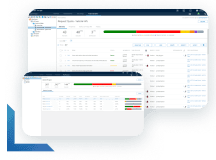
Learn more about how to scale, orchestrate, and accelerate test automation for complete visibility into your testing process.
Learn more about how to scale, orchestrate, and accelerate test automation for complete visibility into your testing process.
Agile methodology is an approach to software development that provides a faster, more flexible, and more adaptable way of delivering software. The Agile methodology focuses on collaboration between teams rather than strict plans, and it prioritizes working software over finished products. Agile development happens in a series of iterations rather than a single push to release finished software. Throughout the Agile development lifecycle, software is continuously evaluated by developers, testers, business analysts, and the customer to ensure that each iteration comes closer to meeting customer requirements.
Agile testing is a method for testing code within an Agile development framework. In contrast to traditional testing methods that take place at the end of a development process, Agile testing happens throughout the development lifecycle.
Because Agile testing happens continuously throughout development, bugs and defects are discovered much earlier when they are easier and less costly to fix. Continuous testing in Agile methodology helps to accelerate the pace of development and to deliver better software faster. Agile testing enables closer collaboration between testers, developers, business analysts, and customers to improve each iteration of the software.
Agile can look different depending on whether a team uses Scrum, Kanban, XP, or another framework. Still, most Agile implementations follow a similar iterative loop. First, define the vision and build the backlog.
Second, plan the iteration, selecting the highest-priority work that fits the team’s capacity. Third, develop and test continuously by implementing in small increments with ongoing validations. Fourth, Review and deliver value. Finally, fifth, reflect and improve. Hold a retrospective and identify improvement opportunities.